
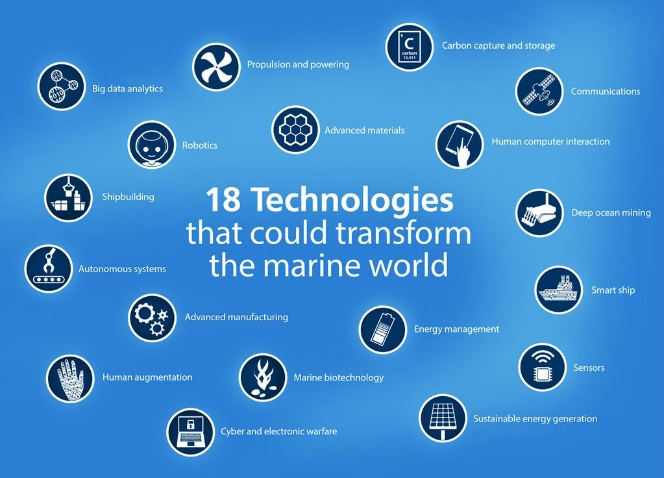

A team from Lloyd’s Register, QinetiQ and the University of Southampton in the U.K, has looked towards the future of technology and provided a glimpse of the future these evolving technologies may provide by 2030 in their report “Global Marine Technology Trends 2030.”
As humanity is faced with challenges, such as consequences of climate change, increasing population and depletion of resources, technologies will play a key part in further development of humankind. Their roles may be classified into protecting the people, protecting the environment, and providing for the people.
The speed of innovation is rapid and the introduction of new technologies is swift, which means that predicting which technologies will transform commercial shipping, ocean space exploitation and naval operations is always a challenge.
As LR’s Marine Marketing Director, Luis Benito explains, “The marine world in 2030 will be a connected and digital one, bringing closer integration between people, software and hardware in a way that could transform the way we operate. We know technology is changing our world and there is a great deal of overlap between technologies and how they combine will be important.”
Marco Ryan, who is the Chief Digital Officer & Executive Vice-President of Wärtsilä Corporation. Ryan said at Nor-Shipping 2017: “Digital disruption is already affecting the marine sector and will do so increasingly in the future. There is today a subtle, yet significant, shift in thinking at all levels of the industry as we move from closed systems to more modular, secure, and interoperable products and solutions.”
The report identifies two groups of technology drivers – those that will transform the ship design and build space – leading to advancement in ship building, propulsion and powering and the development of smart ships; and the technologies that drive safety, commercial and operational performance – advanced materials, big data analytics, communications, sensors and robotics.