

While the conventional electronics like computers and smartphones is built around silicon integrating billions of transistors and is manufactured using complex, costly and wasteful processes in multi-billion dollar foundries . The printed and flexible electronics aim to replace this by “organic” semiconductors which are long chains of thousands of repeating molecules (a plastic), made with materials based on carbon. Organic semiconductors can be made to be soluble, and can be turned into an ink.
Printing electronics is a special type of manufacturing, where electronic components, circuits, and systems are developed on a wide variety of substrates in a similar fashion as drawing text and figures on a paper, textile, and handicrafts. The difference between normal printing and printed electronics is that in printed electronics, functional material is used as ink that exhibits functionalities of insulator, conductor, and semiconductor materials, which are essential for the electronic devices. This means it’s possible to print electronic circuits, with the potential to manufacture components as fast as printing newspapers. A printer would do this by applying different inks onto the film. As the inks dried, they would turn into wires, transistors, capacitors, LEDs and all the other things needed to make displays and circuits.
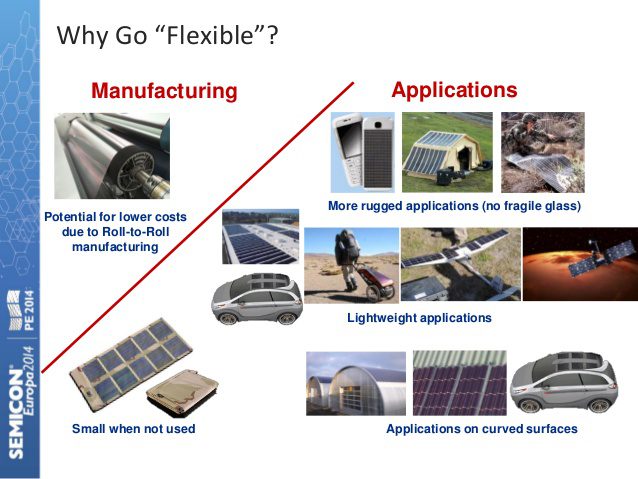
Simplified processing steps, reduced materials’ wastage, low-fabrication costs, and simple patterning techniques make printing technologies very attractive when compared to standard microfabrication in clean room processes. The potential benefits of printed and flexible electronics include thinness, lighter weight, greater durability, and the ability for conformal integration. The intrinsic scalability of printing as a manufacturing process is also of great advantage; the process lends itself to production runs of an arbitrary size. The concept appears to provide a likely path to truly all-embracing electronics. Printed and flexible electronics (PFE) have potential to revolutionize multiple markets—health care, environmental monitoring, displays, human-machine interactivity, energy, communication, and wireless networks.
The global printed electronics market size was almost $30 billion in 2017 and a growth potential to over $70 billion in ten years. The surging demand for the flexible electronics at low manufacturing costs and the need for eco-friendly technologies is paving the way for increased adoption of the technology. Additionally, the increasing penetration of IoT worldwide is proving to be a prime factor in pulling the printed electronics market over the forecast period. The continuously growing demand for IoT in the telecommunication industry for enhancing the network and optimizing the performance along with operations is expected to propel the application of technology over the forecast period.