

Introduction
Unmanned aerial vehicles (UAVs) have evolved from hobbyist toys to critical tools with applications spanning across various industries. As the demand for UAVs with extended flight endurance continues to grow, propulsion system technologies have risen to the challenge. This blog article explores how cutting-edge UAV propulsion systems are enabling lightweight, fuel-efficient designs, revolutionizing long-endurance missions in both commercial and military sectors.
Understanding UAV propulsion
Over the years, the UAVs have been employed by wide range of industries including mining, security, healthcare, wildlife, forest, disaster management, traffic management, urban development, and agriculture among others. The use of unmanned aerial vehicles can provide these industries a superior option to gather highly precise remote data in real-time in a cost-efficient manner as with higher safety compared to piloted aerial vehicles.
Defense and Security have also deployed advanced UAVs for a wide variety of critical missions. They provide capability to fight effectively in urban areas against widely dispersed forces, while minimizing collateral damage and achieving information superiority. The UAVs have become one of the essential constituents of all militaries to perform intelligence, surveillance, and reconnaissance missions. Their roles have expanded to areas including electronic attack, suppression or destruction of enemy air defense, network node or communications relay, combat search and rescue and many others. The increasing demand and reliance on UAV in warfighting and peacekeeping operations has doubled the pace of UAV-related R&D in recent years.
The employment of UAVs by various industries and in Defense and Security missions are enabled by their propulsion system to provide them with the necessary power to propel the aircraft for forward flight or hover. Propulsion systems can advance the flight time or endurance of a UAV which is influenced by the propulsion technology used and is dependent on the aerodynamic design and amount of fuel carried. To fulfil the energy requirements of a large variety of UAVs, several variants of piston-engines and electric motors have been designed by the market players.
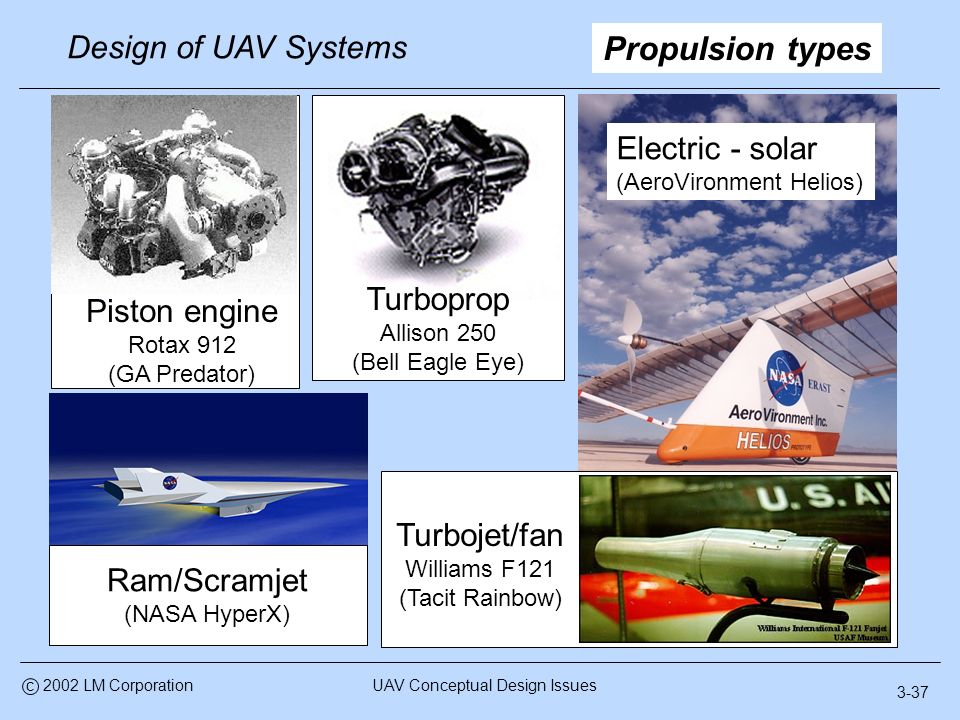
The type of propulsion depends on the type of UAV and desired performance. UAS are categorized in a variety of ways based on vehicle attributes including the type of aircraft (fixed wing or rotorcraft), flight altitude (high, medium, low), weight, speed, etc. In general, larger aircraft use larger engines that confer higher altitude, longer endurance and more payload capacity than smaller vehicles. The main propulsion system types are electric systems and gas systems. Both systems can be used to drive propellers or ducted fans.
If the performance required of a UAV is similar to the performance of conventional aircraft, the propulsion system may also be similar. Many UAVs will weigh more than 1,000 pounds, fly at subsonic and supersonic velocities at altitudes below 60,000 feet, maneuver at 9g’s or less, and will be maintained in ways similar to current military or commercial aircraft. These UAVs will not require unique propulsion technology. For example, a UCAV may require a gas turbine engine that can operate at much more than the 9g forces that limit manned vehicles.
The potential benefits of a propulsion system are measured by their impact on the costs of the whole UAV. Lightweight, more fuel-efficient engines permit usage of expensive payload for a given mission without significantly affecting the size and cost of the UAV. Although promising, the performance of propulsion systems in unmanned aerial vehicles still needs to be significantly improved to meet the requirement for executing increasingly difficult missions. In recent years, electric propulsion system has gained more popularity amongst small or mini UAVs for its apparent advantages: quiet operation, easy and safe to handle and store, precise power management and control.
Nevertheless, for some UAVs, the propulsion system is a critical limiting technology. These include subsonic High Altitude Long Endurance (HALE) UAV that must operate above the altitude limits of current engine technologies and Micro UAVs that are very low-cost, high-performance vehicles.Researchers are developing new engine technology, new designs, or even new fundamental research and propulsion concepts for these new classes.