
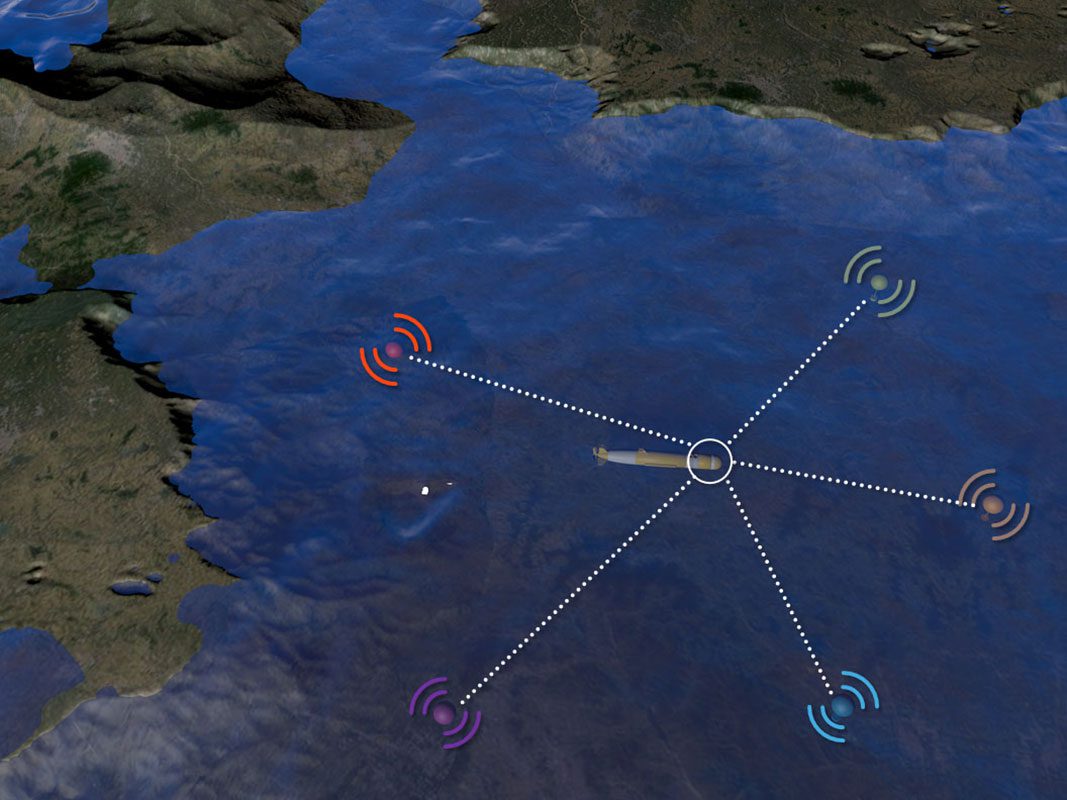

The unmanned underwater vehicles (UUVs) depend on stealth as they conduct surveillance and reconnaissance and other missions in the deep oceans. With GPS signals unable to penetrate the ocean’s surface, these UUVs can rely on inertial sensors to provide acceptable positioning information during short missions. On longer missions, however, inertial sensors accumulate error, forcing the vehicles to risk exposing themselves to enemies as they periodically surface to obtain a GPS fix.
GPS rely on Radio waves that do not propagate well underwater due to the high attenuation. In fact, radio waves propagate at long distances through conductive salty water only at extra low frequencies (30− 300Hz), which require large antennae and high transmission power. However, the acoustic waves are low frequency waves which offer small bandwidth but have long wavelengths. Thus, acoustic waves can travel long distances and are used for relaying information over kilometers
The Defense Advanced Research Projects Agency (DARPA) is addressing this issue by funding the development of a small number of acoustic transmitters that can be anchored to fixed locations around ocean basins to serve as an undersea navigation constellation.
“Stealth is a critical capability for counter-anti-access/area denial (C-A2AD) missions,” said Joel Parry, Draper’s maritime warfare and intelligence, surveillance and reconnaissance (ISR) lead. “Giving UUVs GPS-like accuracy anywhere in the ocean, without the need for surfacing or active signal emissions, will significantly boost the chances of success of the types of missions that UUVs take on today, and will enable them to conduct missions that would be considered too risky today because of the chance of detection.” Some of these dangerous missions could be locating underwater mines and track enemy subs.
Defense Secretary Ashton Carter told that $600 million shall be invested over the next five years toward unmanned undersea technology development. He further told sailors that variable size and variable payload unmanned undersea vehicles shall be developed that shall lead to new capability of “distributed lethality,” defined by Carter as “making our ships and aircraft work together in ways that they haven’t before but technology makes possible.” “So you’re going to see a fleet that is much more powerful, much more lethal, much more connected,” Carter said.