
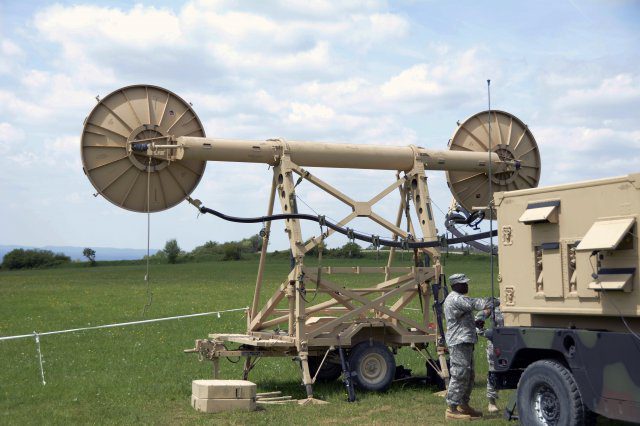

The dominant mode of communication today uses antennas to transmit information carrying high frequency signals using antennas which at the receive site produce an electrical signal which is amplified and demodulated by the receiver equipment. However this form of communication is limited by line of sight propagation limiting the range to slightly more than the line of sight.
Tropospheric scatter (also known as troposcatter) is a method of communicating with microwave radio signals over considerable distances – often up to 300 kilometres (190 mi), and further depending on terrain and climate factors. This method of propagation uses the tropospheric scatter phenomenon, where radio waves at UHF and SHF frequencies are randomly scattered as they pass through the upper layers of the troposphere. Radio signals are transmitted in a narrow beam aimed just above the horizon in the direction of the receiver station. As the signals pass through the troposphere, some of the energy is scattered back toward the Earth, allowing the receiver station to pick up the signal.
Troposcatter systems are ideal for crisis response. Responders facing a lack of reliable communications after a natural disaster can deploy a troposcatter system to quickly establish networks even when no power is available. Raytheon IIS vice-president Todd Probert said: “Think about any natural disaster over the last several years; one of the biggest problems is a lack of reliable communications. “A troposcatter system easily can be deployed anywhere in the world and can transfer data at extremely high rates, the equivalent to streaming ten high-definition videos simultaneously at a range of more than 115 miles.”
Military is interested in Troposcatter communucations as it delivers beyond-line-of-sight communications up to a distance of about 200 miles, providing secure, reliable wireless data networks with 100Mbps data transmission speeds almost anywhere in the world, regardless of terrain or operational condition. Raytheon has secured a ten-year contract worth up to $663m to deliver troposcatter communication systems to the US Army. Under the indefinite-delivery indefinite-quantity contract, Raytheon will ensure troops have access to secure voice and data communications in contested environments.

“Not only does troposcatter save the service money, it also serves a very important strategic function,” Vigil said. “It offers a bigger pipe for data—more than satellites supply—as well as less latency. In combat, milliseconds count.” Troposcatter fits an interesting niche,” said Cedric Vigil, Raytheon’s troposcatter program manager. “Tropo doesn’t replace radios, fiber or satellite communications. It’s another tool for network planners to use when the conditions warrant it.”
Raytheon Intelligence, Information and Services president Dave Wajsgras said: “Soldiers on the front lines can’t afford dropped calls. Our solution, a secure, reliable and wireless troposcatter system, allows troops to communicate in areas that would otherwise be dead zones. “Importantly, it also gives the military a way to communicate in satellite-denied environments.”
US-based Comtech Systems has received a contract to supply the Swedish Defense Material Administration (FMV) with deployable troposcatter systems for the Swedish Armed Forces (SwAF). The latest $2.2m contract follows the assessment of commercial off-the-shelf (COTS) Comtech troposcatter products. As part of the evaluation, rigorous field-testing was carried out in various operational environments, including high northern latitudes.
Under the terms of the contract, the company will supply MTTS deployable troposcatter terminals customised to meet SwAF requirements. MTTS uses Comtech’s CS67500 50Mb/s troposcatter modem, CS4400 frequency converter system, and 500W solid state power amplifiers (SSPA).Comtech Telecommunication’s president and CEO Fred Kornberg said: “This contract highlights the growing need of militaries around the world to augment their existing communications toolkits with high-bandwidth, long-range alternatives to satellite communications in order to enable critical communication links under a wide variety of operational scenarios.
Earlier Raytheon tested its satellite communications system terminals and demonstrated that it can also carry out long-range “troposcatter” communications without a satellite relay. Raytheon has also utilized its GaN technology to troposcatter communication systems to increase its range while reducing the size of terminals.