
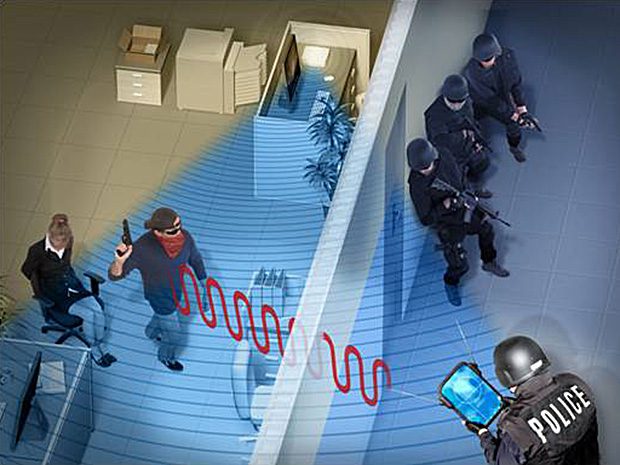

Urban Warfare Operations are complicated by a three-dimensional environment, limited fields of view because of buildings, enhanced concealment and cover for defenders, and the ease of placement of booby traps and snipers. Unknown individuals hidden from view can slow emergency efforts and can increase the inherent dangers of tactical operations.
Security forces require effective ground ISR technologies that can overcome these challenges and provide effective situational awareness. One of the technologies useful in such situations is through-wall imaging which apply radio frequency (RF) and other sensing modes to penetrate wall materials and optimally estimate the terrorists hiding in other rooms and buildings and their activities.
Through-wall imaging has also been of particular interest due to its benefits for scenarios like disaster management, surveillance, and search and rescue, where assessing the situation prior to entering an area can be very crucial. This technology may improve situational awareness during emergencies and law enforcement activities such as after a building collapse, during fires in large buildings, and during tactical operations (e.g., building clearance, hostage threat situations).
US security forces have long been using see through the walls systems like RANGE-R system that can register motion inside closed spaces. The radar system’s high sensitivity is even able to detect a hiding man’s breathing somewhere deep inside a building, behind several walls. These systems have been used in FBI hostage-rescue missions, by firefighters during collapsed building search-and-rescue operations, in the U.S. Marshals Service operations when catching fugitives, and so on.
However, the general problem of through-wall imaging using RF signals is a very challenging problem, and has hence been a topic of research in a number of communities such as electromagnetics, signal processing, and networking. Detectability of the human being, wall modeling, and target differentiation have been identified as the main open issues in the field of TWRI.