
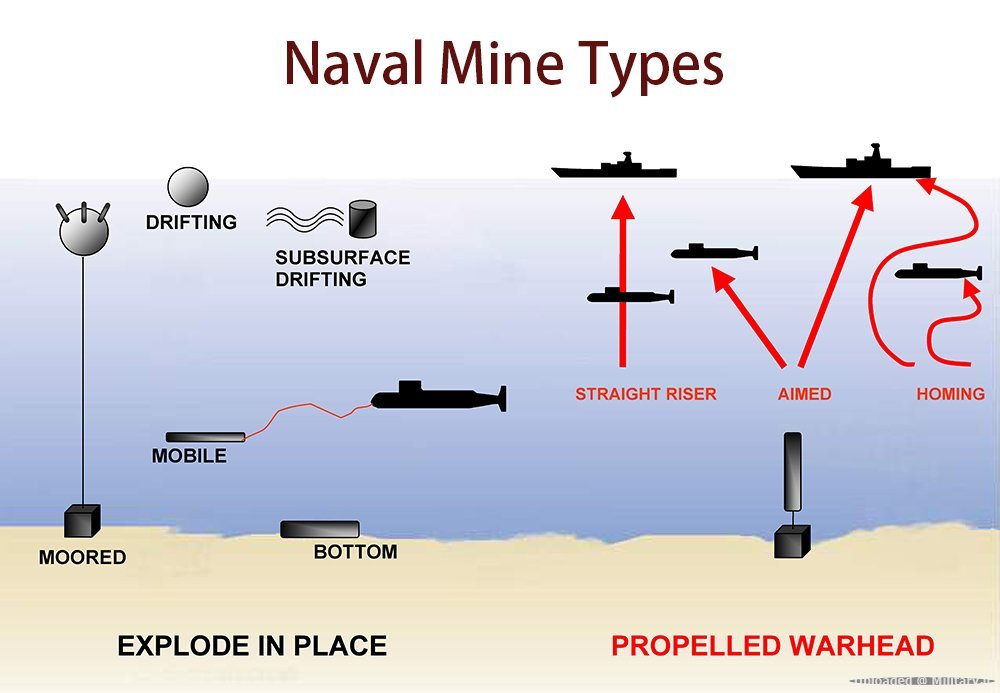

Traditional navies as well as maritime terrorists can and have used mines and underwater improvised explosive devices (UWIEDs) to challenge military and commercial uses of the seas. Mines have been utilized in defensive capabilities, such as denying access into a region, and offensive capacities, such as denying egress out of a region.
Naval mines are especially potent. On April 14, 1988, a single contact mine nearly sank the USS Samuel B. Roberts (FFG 58), causing over $96 million in damage. Since World War II, mines have seriously damaged or sunk 15 U.S. ships, nearly four times more than all other threats combined.
“In February 1991 the Navy lost command of the sea—the North Arabian Gulf—to more than a thousand mines that had been sown by Iraqi forces. Mines severely damaged two Navy warships, and commanders aborted an amphibious assault for fear of even more casualties,” says a U.S. Navy mine warfare history. However, unlike aircraft carriers and other capital ships, traditional sea mines offer little ability to project power and, once identified, can be avoided.
More than thirty countries produce mines, and twenty countries export them. Iran has reportedly laid several thousand naval mines, North Korea’s 50,000, China 100,000 or so, and Russia estimated quarter-million. Since World War II, sea mines have damaged or sunk four times more U.S. Navy ships than all other means of attack combined, according to a Navy report on mine warfare. There are still an estimated 50,000 mines remaining in the waters from World War I and World War II, Rear Adm. Jens Nykvist, chief of the Royal Swedish Navy, said in a keynote speech at the conference.
With 95% of the world’s commerce moving by sea, the security of waters, coastlines and military personnel remains a key issue for navies. Sea mines and underwater explosives have become cheap to acquire and easy to deploy now pose a real threat to navies and commercial shipping by reducing freedom of movement in shallow waters and strategic choke points.
Similar to the land-based IEDs that devastated North Atlantic Treaty Organization 18 (NATO) forces during operations in Iraq and Afghanistan, terrorists have developed naval mines utilizing commercial-off-the-shelf (COTS) goods integrated with simple influence firing devices. It has become easy for a terrorist to influence the economy by putting explosives in chokes points. A few statically positioned mines would stop all traffic for a long time before it considered safe again.
“There is an increase in the mine threat particularly in the shallow waters of the Baltic Sea,” he said. Some 2,000 to 4,000 boats and ships traverse the sea on a daily basis, which means more targets for mines. The maritime traffic also causes a lot of clutter when trying to detect potential adversaries, he said. There has always been “dynamic tension” in the U.S. Navy between the so-called “blue water Navy” and the “littoral Navy,” DiGiovanni said. But most conflict has taken place in the littorals where ports are located and shipping takes place. That is where sea mines are placed.
Naval mines also have defensive applications and being able to rapidly emplace them could provide an additional layer of defense around strategic naval bases and ports, as well as established or temporary outposts on small islands, during a crisis. In the latter case, they could be useful in deterring immediate enemy amphibious counterattacks and give ground units some extra breathing room to continue establishing a beachhead for follow-on forces.
New Research and development is continuing for new mines and components, including such features as improved capabilities against submarine and surface targets, better resistance against minesweeping and hunting, more flexibility, easier and less expensive maintenance, simpler and faster preparation for laying, and improvement of mine detection and control systems with increased sophistication.
There is also emerging threat of Networked or Swarming mines. The Navy’s Strategic Studies Group 35 concluded the “Navy’s next capital ship will not be a ship. It will be the Network of Humans and Machines, the Navy’s new center of gravity, embodying a superior source of combat power.”
Such a network could consist of networks of sea mine swarms and their support ships. Networked sea mine swarms could converge on masses of adversary ships, bringing to bear overwhelming force. The visibility of surface support ships would enable the network to generate conventional deterrence by signaling the swarm’s presence, while helping maintain the swarm itself.
“Mines are a type of asymmetric warfare. They are cheap. They are easy to place. They’re a nuisance and they are out there,” Frank DiGiovanni, deputy director of the expeditionary warfare division of the U.S. Navy, said at the Undersea Defense Technology symposium in Stockholm, Sweden. They are not just a military problem as they can threaten commercial sea traffic and impede free trade, he noted
There are three important goals to improve counter-mine warfare technology, DiGiovanni said. Navies must improve the speed of clearing mines, the accuracy of their detection systems, and they must reduce the cost of operations, he said.