
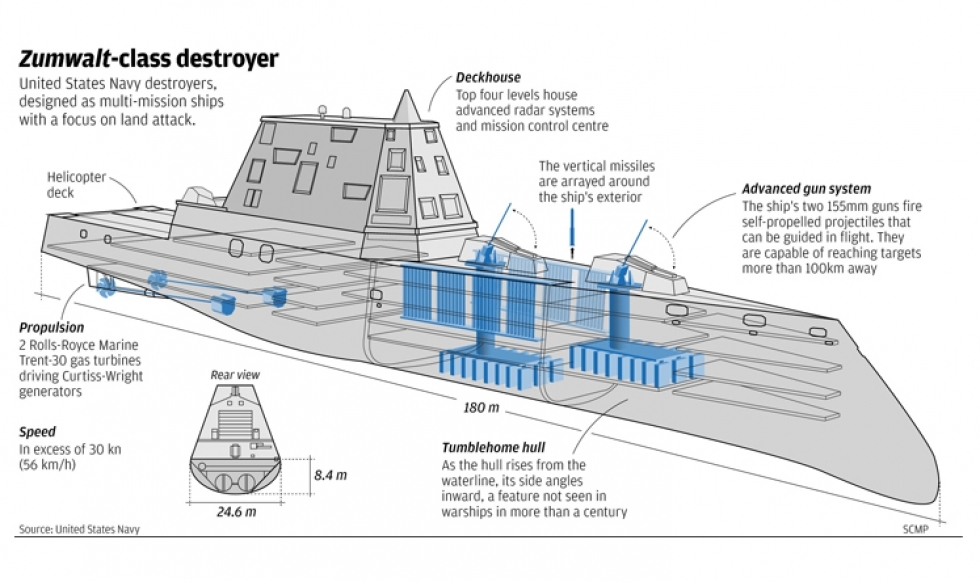

Introduction:
Naval warfare has seen remarkable technological advancements over the years, and one of the most significant additions to the United States Navy’s fleet is the USS Zumwalt (DDG-1000) class destroyer. As the largest and most technologically advanced destroyer in the US Navy, the USS Zumwalt represents a game-changer in modern naval warfare. This blog article will delve into the key features and capabilities of this cutting-edge warship, highlighting how it is redefining naval operations and strengthening the nation’s maritime defense.
In naval terminology, a destroyer is a fast maneuverable long-endurance warship intended to escort larger vessels in a fleet, convoy or battle group and defend them against smaller powerful short-range attackers. It can also operate independently in hunting out enemy surface and undersea threats. The typical size of destroyers also allow them to operate relatively close to the shore than he most other ships in the fleet while also maintaining capabilities of open-sea deep water travel.
The USS Zumwalt (DDG-1000) is the US Navy’s largest and most advanced stealthy destroyer. Named after Admiral Elmo Zumwalt, who served as Chief of Naval Operations during the Vietnam War, the Zumwalt-class destroyers are designed to provide advanced capabilities for naval operations.
At 610 feet long and weighing in at 15,000 tons, the Zumwalt is larger and more heavily armed than previous US Navy destroyers. Built by General Dynamics Bath Iron Works (BIW), DDG 1000 is the first surface combatant of the Zumwalt-class designed to combat various naval threats. It has taken four years to build at an estimated cost of $4.3 billion.
One of the key features of the Zumwalt-class destroyers is their stealth technology. The ship’s hull is angled to deflect radar signals, and its composite deckhouse is designed to reduce its radar signature. This makes the Zumwalt difficult to detect, allowing it to operate in enemy territory without being detected.
The Zumwalt class was designed with multimission capability. It is designed to operate in both shallow and deep waters, and its advanced technology makes it nearly invisible to radar.
Unlike previous destroyer classes, designed primarily for deep-water combat, the Zumwalt multi-mission surface combatants are designed for littoral operations and land attacks, in addition to the usual destroyer missions of anti-air, anti-surface, and antisubmarine warfare. The class is multi-role and designed for surface warfare, anti-aircraft, and naval fire support.
The Zumwalt’s advanced electronics and communications systems also give it a significant advantage over previous US Navy destroyers. The ship’s combat system is capable of integrating data from multiple sources, including satellites, UAVs, and other ships. This allows the Zumwalt to provide a more comprehensive picture of the battlefield, giving naval commanders the information they need to make informed decisions.
One of the key missions of the Zumwalt-class destroyers is naval gunfire support. The ship’s 155mm cannon is capable of firing precision-guided shells that can provide fire support for troops on the ground. The ship is also equipped with missile launchers that can fire a variety of missiles, including Tomahawk cruise missiles and anti-ship missiles. Tomahawk cruise missiles, can be used to strike targets on land or at sea.
Armed with SM-1, SM-2 and SM-6 missiles (fired from the ship’s Mk 57 Vertical Launch System), the Zumwalt can be used for ballistic missile defense. The US Navy’s Zumwalt-class guided missile destroyer USS Zumwalt (DDG 1000) successfully conducted its first in-class live-fire missile exercise in April 2022. As part of the exercise, the crew of USS Zumwalt fired a series of missiles, including RIM 162D Evolved Sea Sparrow Missile Block 1 (ESSM) and the Standard Missile 2 (SM-2). It marked the final air defence testing of the Zumwalt-class guided missile destroyer.
“The USS Zumwalt is capable of being equipped with powerful railguns. They outperform any other types of modern weapons. If such a warship was deployed near the Korean peninsula this would be a headache for China,” the expert said. At the same time, Kim Dongyeop, professor of the Institute for Far Eastern Studies at Kyungnam University, told Sputnik , that ship has not yet undergone railgun and other weapons tests and “its deployment as a strategic weapon would be complicated.”
The Zumwalt is also equipped with advanced anti-submarine warfare capabilities. Its advanced sensors and communications systems allow it to detect and track enemy submarines, and its torpedo tubes can launch both torpedoes and anti-ship missiles.
The ship was commissioned in Baltimore on 15 October 2016. Her home port is San Diego, California. USS Zumwalt (DDG-1000) was delivered to the fleet after completing its combat system activation and subsequent at-sea trials in April 2020. In April 2019, Zumwalt departed San Diego for a first operational deployment into the Pacific since the shipyard availability conducted in 2017 and 2018.
USS Zumwalt (DDG 1000) has also completed a structural test fire of its gun weapon system (GWS), Mark 46 MOD 2, in May 2020. “DDG 1001 completed her Combat System Availability in March 2020 and work has transitioned to the next phase for developmental and integrated at-sea testing of weapons, sensors and communication systems,” Navy spokesman Capt. Danny Hernandez told USNI News.
In addition to its testing requirements, Zumwalt had already been assigned to the Surface Development Squadron 1 (SURFDEVRON) as part of the surface navy’s efforts to work out tactics, techniques and procedures for the new class of destroyers and understand how the Zumwalt class could operate alongside other types of ships – manned and unmanned – to add the most capability and lethality to the force. Zumwalt will remain under SURFDEVRON and will continue experimental activities with the command.
The U.S. Navy offered to dispatch its deadliest surface warship, the 16,000-ton next generation guided-missile destroyer USS Zumwalt (DDG 1000), to South Korea in order to better deter North Korea threats, as reported by the Korea Herald. China already announced its opposition to the stationing of the USS Zumwalt in South Korean waters. Chinese Foreign ministry spokesman Lu Kang said that Beijing is “watching closely.”
Despite its advanced technology, the Zumwalt-class destroyers have faced some challenges. The program has been plagued by cost overruns and delays, and the Navy initially planned to build 32 of these ships but later reduced the number to just three. The Zumwalt has also faced technical issues, including problems with its electrical system and the ship’s engines.
Despite these challenges, the USS Zumwalt remains a critical component of the US Navy’s fleet. Its advanced technology and capabilities make it a formidable presence on the high seas, and it is expected to play a critical role in future naval operations.