


The goal of future generation networks is to meet the future communication needs of the information societies such as Smart infrastructures, Smart City, Smart Grid, Smart Health, and Smart Transportation. The future will be a completely data-driven society in which people and things are connected universally, almost instantaneously (milliseconds) to form an incredibly fully connected utopian world. It will also be key enabling technology to fully realize the Industry 4.0 revolution i.e., the digital transformation of manufacturing through cyber physical systems and IoT services. Wireless communication carrier frequencies have been gradually expanding over recent years in an attempt to satisfy ever-increasing bandwidth demands. The peak rate, which is one of the key technical indicators is expected to reach tens of terabits per second.
In the past, the frequency spectrum ranging from 0.3 to 3THz (or 300 to 3000GHz) was spoken as infamous “Terahertz Gap” as it lies between traditional microwave and infrared domains but remained “untouchable” via either electronic or photonic means. The conventional “transit-time-limited” electronic devices can hardly operate even at its lowest frequency; the “band-gap-limited” photonic devices on the other hand can only operate beyond its highest frequency. However continuous progress is being made for Terahertz components and devices to overcome electronic/photonic barriers for realizing highly integrated Terahertz systems.
Due to the lack of compact and efficient THz devices (the so-called “THz gap”), THz-band applications have been traditionally restricted to the areas of imaging and sensing. However, following recent advancements in THz signal generation, modulation, and radiation, communication based THz-band use cases can now be foreseen
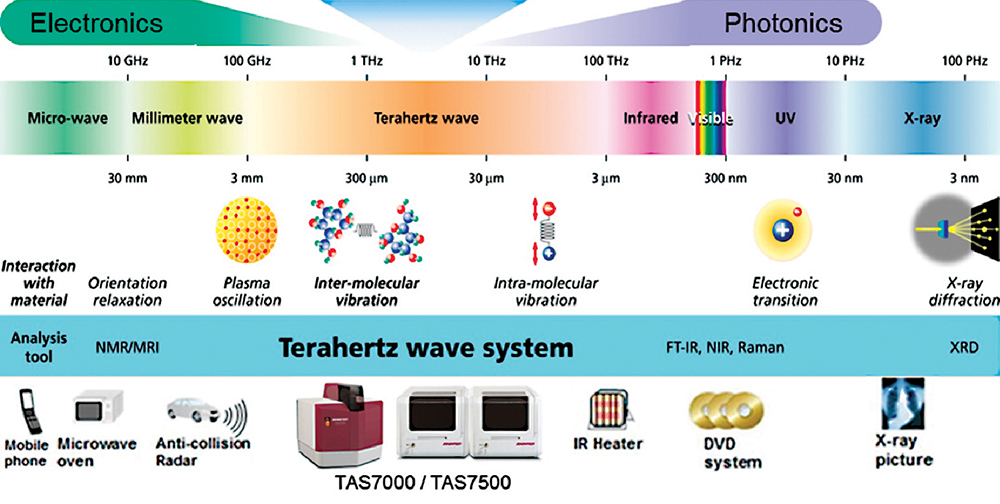
Terahertz can provide hundredfold, increase in the frequency compared to the mmWave addressing spectrum scarcity and capacity limitation in current wireless systems. Terahertz wi-fi could in theory support data rates up to 100Gb/s within ranges of about 10m. THz ad hoc network can be formed in the battlefield to connect soldiers, armoured personnel carriers, tanks, etc. The limited transmission range and highly directional antennas makes eavesdropping extremely difficult.
“Imaging, radar, spectroscopy, and communications systems that operate in the millimeter-wave (MMW) and sub-MMW bands of the electromagnetic spectrum have been difficult to develop because of technical challenges associated with generating, detecting, processing and radiating the high-frequency signals associated with these wavelengths. To control and manipulate radiation in this especially challenging portion of the RF spectrum, new electronic devices must be developed that can operate at frequencies above one Terahertz (THz), or one trillion cycles per second,” says DARPA.

The researchers have created many breakthroughs in terahertz technologies recently that has led to testing and deployment of terahertz wireless links. The Researchers from the Tokyo Institute of Technology have already demonstrated 3Gb/s transmission at 542 GHz. At the heart of the team’s 1mm-square device is what is known as a resonant tunnelling diode, or RTD. During the 2008 Olympic Games in Beijing, scientists from Osaka University and NTT Corp. already demonstrated a 120 GHz data link across a distance of 1 km.
Nevertheless, there still exist many challenges in THz communications requiring innovative solutions, where the well-established technologies may be prohibited. Sensitive to atmospheric attenuation and molecular absorption, the THz signals experience an extremely severe path loss, which leads to a great limitation on communication distance. Meanwhile, the complex structures of THz devices pose extra constraints on the system, where conventional approaches, e.g., completely digital signal processing at baseband for each antenna, are no longer suitable.