
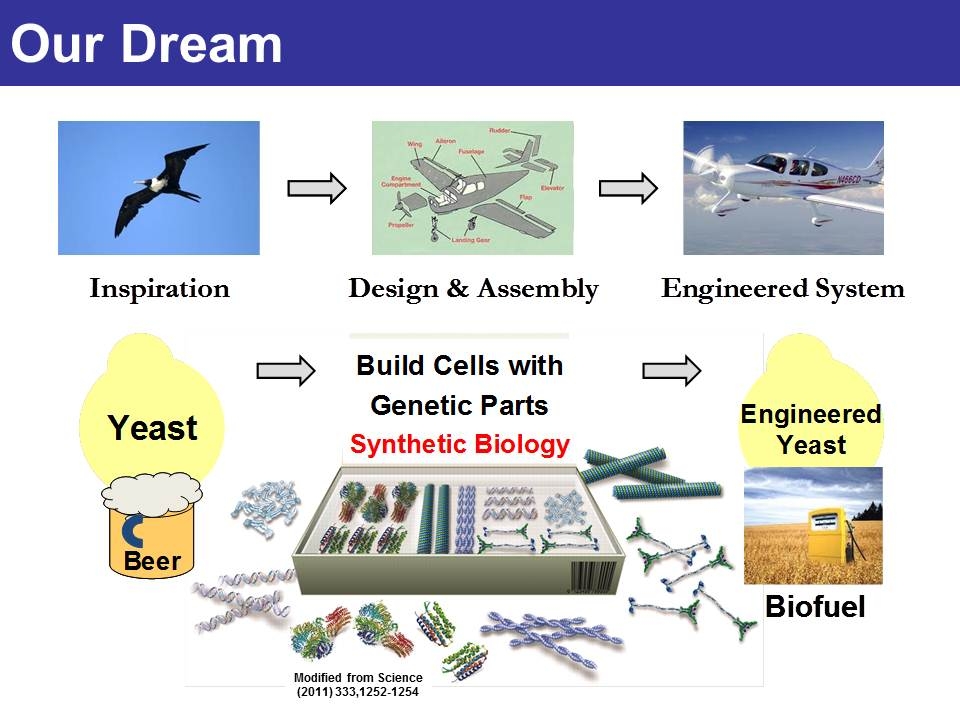

Synthetic biology is the application of science, technology and engineering to facilitate and accelerate the design, manufacture and/or modification of genetic materials in living organisms, as defined by the European Commission. It envisions the redesign of natural biological systems for greater efficiency, as well as create new organisms as well as molecules with desired bio-attributes. Among the potential applications of this new field is the creation of bioengineered microorganisms (and possibly other life forms) that can produce pharmaceuticals, detect toxic chemicals, break down pollutants, repair defective genes, destroy cancer cells, and generate hydrogen for the post petroleum economy.
Synthetic Biology is also predicted to transform Defense and Security. New techniques to edit and modify the genome may allow scientists to harness organisms or biological systems as weapons or to perform engineering tasks typically impractical with conventional methods. DARPA wants to utilize the potential of Synthetic biology, to provide on-demand bio-production of novel drugs, new materials, food, fuels, sensors and coatings whatever suits the military’s needs. Future advances might include the construction of new biological parts and brain-computer interfaces.

While DARPA was providing almost no funding to synthetic biology in 2010, the organization had increased its investment to $100 million per year by 2014. Funding increases were followed by the creation of the DARPA program Living Foundries: Advanced Tools and Capabilities for Generalizable Platforms, which sought to increase the speed and decrease the cost of generating new production strains of organisms.
This program started in 2012, and in 2014, Living Foundries transitioned to a new program, Living Foundries: 1000 Molecules, which will invest $110 million through 2019 to enable facilities to generate organisms capable of producing 1,000 molecules of industrial and defense interests. These funds are going to a diverse group of projects. Some are incredibly broad, such as funding provided to MIT’s Broad Institute to advance our ability to assemble large genetic systems. Other projects have a specific, discrete purpose, such as the DARPA–funded biotech startup Ginkgo Bioworks, which is developing probiotics to help prevent common infections for soldiers.
Recognizing the importance of biotechnology, in 2014 the DOD created the Biology Technology Office (BTO), which houses the Living Foundries program as well as numerous others, such as Battlefield Medicine, which is developing platforms for creating medicine on demand in the field, and Safe Genes, a program to create tools for safe genome editing. While the purview of the BTO is greater than synthetic biology alone, further development of synthetic biology tools will result in the application of synthetic biology tools and techniques in greater numbers of projects. Synthetic biology is one of the most important research fields in the present day, and the DARPA approach to synthetic biology research has proven successful so far: the first iteration of Living Foundries succeeded in increasing the speed of creating production strains of new organisms by 7.5-fold, while decreasing the cost 4-fold.
“Just the amount of technological change in that area and the … more capability we have to engineer biology for use, is why I think it’s the most exciting field at DARPA right now, and why we stood up an office in 2014 to focus on it.”
During a discussion with Northeastern University President Joseph E. Aoun at the Center for Strategic and International Studies in Washington yesterday, Steven H. Walker said the life sciences trumps other areas of research as holding the most promise for the future. “That’s the area that I see the most incredible technical leaps and bounds every day,” Walker said. “DARPA researchers looking at how to make gene editing safe and actually reverse a gene edit if they need to,” he added.
While DARPA was providing almost no funding to synthetic biology in 2010, the organization had increased its investment to $100 million per year by 2014. Funding increases were followed by the creation of the DARPA program Living Foundries: Advanced Tools and Capabilities for Generalizable Platforms, which sought to increase the speed and decrease the cost of generating new production strains of organisms. This program started in 2012, and in 2014, Living Foundries transitioned to a new program, Living Foundries: 1000 Molecules, which will invest $110 million through 2019 to enable facilities to generate organisms capable of producing 1,000 molecules of industrial and defense interests.
These funds are going to a diverse group of projects. Some are incredibly broad, such as funding provided to MIT’s Broad Institute to advance our ability to assemble large genetic systems. Other projects have a specific, discrete purpose, such as the DARPA–funded biotech startup Ginkgo Bioworks, which is developing probiotics to help prevent common infections for soldiers.
Another DARPA project is rapid development of vaccines for never-before-seen viruses. “This is about being able to inject the cells in your muscles, say to produce antibodies automatically, for a vaccine that we’ve never seen before, and do it in 60 days or less to protect a large population,” Walker said. “This is work we’ve been funding for about 10 years at universities, and now we are going into clinical trials with this as we speak.”