
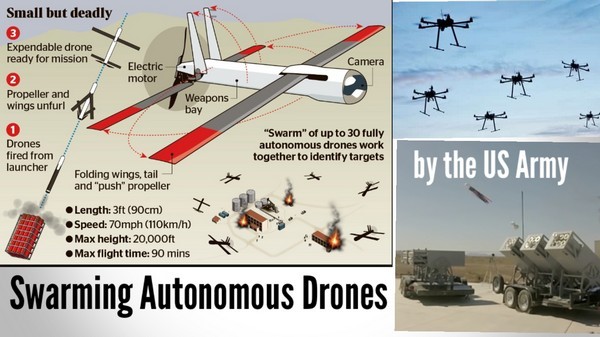

Criminals and militants have now started using swarm of commercial available drones thereby engancing their effectiveness and lethality. Military is also developing swarms for many applications including ISR, decoys or as swarm of weapons. Swarms are expected to be effective even in A2/AD environments.
Instead of being individually directed by a human controller, the basic idea of a drone swarm is that its machines are able to make decisions among themselves. So far the technology has been at an experimental stage, but it is edging closer to becoming a reality.
However, many of applications like improved disaster response and unique vehicles for transportation are still stuck in the lab or still in concept phase. The main factors holding back swarming robotics are the stigma of widespread robots, the lack of reliable communications, readily available distributed algorithms, and the cost of individual robots. However, these are quickly changing and the concerns can be mitigated by designing safeguards into these complex systems, writes Jason Ernst, PhD Candidate, CS, is the CTO of Redtree Robotics. The sensors, cameras, motors and other parts that make the robot work are all expensive, however the scale of mobile phones have made some of the key sensors like accelerometer, gyroscope, GPS have become insanely cheap.
The robots need to exchange positions, direction of motion, pitch, yaw, roll, and they may need to also keep track of information about the task they are solving, there is a lack of coordinated algorithms readily available writes Jason.
In turn, holding back the development of coordinated algorithms is the lack of reliable, robust communications between robots. For swarm to become a reality, robots must communicate with each other directly, in addition to communicating to the Internet. This means local meshes must be setup between robots. The communications stack must be smart enough to determine if it should use local meshes or external Internet communications to reach other robots or the Internet.
In addition, since the information being exchanged between robots may affect critical systems and prevent crashes and other dangerous behavior, the communications should use either redundant technology (several Wi-Fi cards, or a variety of communication tech – satellite, Bluetooth, UHF/VHF, 4G/LTE, etc.
The last, and perhaps most troublesome, is the fear people have of the robot revolution, Many people in manufacturing are afraid of losing their jobs, and people are becoming downright afraid to even imagine a future with robots as core enabling technology.