

The International Data Corp. reported that the global datasphere contained 33 zettabytes, or 33 trillion gigabytes, in 2018. By 2025, they expect that number to grow to 175 zettabytes. 175 zettabytes of information stored on DVDs would fill enough DVDs to circle Earth 222 times. In classical computing, information is stored as either 0s or 1s, the same way a coin must land on either heads or tails. In quantum computing, qubits can be stored in both states at the same time – a so-called superposition of states. Think of a coin balanced on its side, spinning so quickly that both heads and tails seem to appear at once.
When qubits are entangled, anything that happens to one qubit affects the other through a principle called nonseparability. In other words, knock down one spinning coin on a table and another spinning coin on the same table falls down, too. A principle called nonlocality keeps the particles linked even if they’re far apart – knock down one spinning coin, and its entangled counterpart on the other side of the universe falls down, too. The entangled qubits create a Bell state, in which all parts of a collective are affected by one another. “This is key, because if you manipulate just one qubit, you are manipulating the entire collection of qubits,” Deymier said. “In a regular computer, you have many bits of info stored as 0s or 1s, and you have to address each one of them.”
While quantum computing has been touted as a way to intelligently sort through big data, quantum environments are difficult to create and maintain. Entangled quantum bit states, or qubits, usually last less than a second before collapsing. Qubits are also highly sensitive to their surrounding environments and must be stored at cryogenic temperatures.
Scientist are exploring the use and appearance of phonons in nanomechanical structures in the context of the emerging field of quantum computing and quantum-enabled device applications. Light is made from photons, the quantum of light. In the same way, mechanical vibrations or sound waves can also be described in a quantum-mechanical manner. They are composed of phonons—the smallest possible units of mechanical vibration. In an ideal crystal environment, phonons may play a role analogous to photons, though they propagate with the much slower speed of sound.
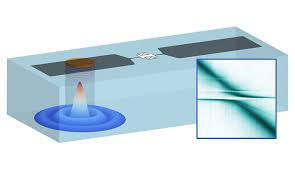
Scientists have designed a new quantum computer chip that uses sound waves to store and convert quantum data. The device uses a bulk acoustic wave resonator to store, move and translate quantum information embedded in qubits, or quantum bits. The new, simple and more efficient method for quantum data storage could accelerate quantum computing technology.