

Smartphone camera technology is growing in leaps and bounds in the past couple of years and continues to be a major point to differentiate their products. More and more technologies are being incorporated including larger sensors, better lenses, ultra-thin lens, optical image stabilization technologies, dual camera optical zoom technology that also improve low light performance and remove noise. CMOS image sensor has been the revolutionary technology for smartphones that through smaller pixels, higher sensitivity and lower noise at a decreased cost has resulted in cameras that produce fast and high-quality images.
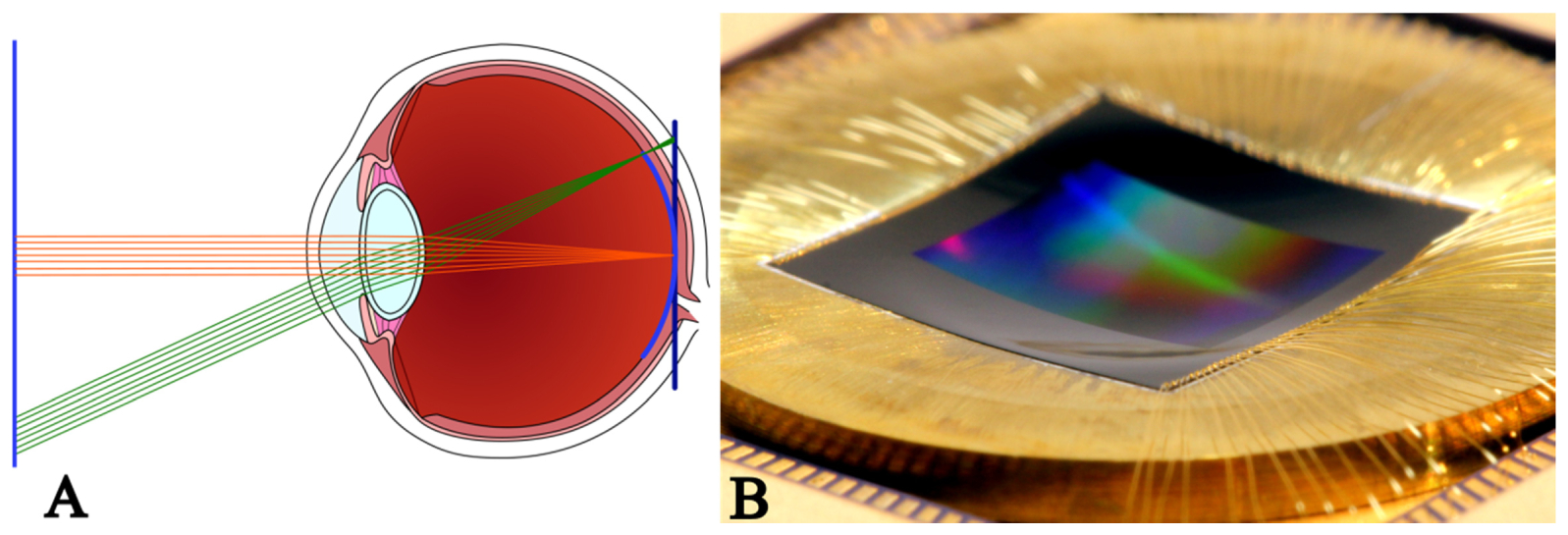
The development of curved image sensors may be the biggest advance in camera technology in decades, allowing for simpler, flatter lenses with larger apertures as well as dramatically better image quality. NIKON, Sony and Canon are reported to be in race to develop and market curved sensor camera that operates using lens designs with fewer elements, less weight, less light loss, less internal reflection, less distortion and less aberration, all at lower cost. At present Sony is leading the race and already has a patent for a 35mm F1.8 compact camera.
Leti (Grenoble, France) has also introduced PIXCURVE, new curving technology for optical components that improves performance, enhances field of view and compensates for optical aberrations. PIXCURVE is a proof of concept for optical components such as microdisplays, visible imagers and cooled infrared sensors used in mobile phones, telescopes, medical-imaging tools, IR sensors and other imaging applications. In addition to improving performance, the curving substrate technology minimizes the vignetting effect that reduces brightness on the borders of images, and it makes cameras, imagers, and microdisplays lighter and more compact.
Now in the Optical Society journal Optics Express, researchers from Microsoft Research and research-and-development laboratory HRL Laboratories LLC, report that their new method can create image sensors with three times more spherical curvature than reported previously. They have been able to incorporate one of the sensors into a prototype camera. Compared to today’s high-end commercial single-lens reflex camera (SLR) cameras, the camera with the new sensor produced higher resolution images across the entire field of view.
“When using curved sensors, it is possible to correct aberrations in a much more efficient way, making it easier to create very wide angle lenses that produce sharp images across the entire field of view or to create fast lenses that produce better images in low light,” said Neel Joshi, a member of the research team. “It is also more straightforward to make cameras that exhibit uniform illumination across the entire image.”
“Our approach to curving commercially available image sensors could make it possible to have a new class of camera that would be very small, but have image quality that would be comparable to image sensors found in much larger cameras,” said Brian Guenter, leader of the Microsoft Research team. “In addition to improving consumer cameras, curved sensors could be used to create better cameras for surveillance, head-mounted displays and advancements in autonomous vehicle navigation.
Curved FPA’s have many potential military and security applications too. Small surveillance camera Mounted in a room or across the street from a door or other place where someone might want to monitor the movement of people, vehicles, and so forth and needs to conduct this surveillance over a wide FOV without edge distortion The sensor and imaging systems of Miniature UAVs ,and ground robots need high-resolution and large FOV. Curved FPAs could be used to advantage here