

Biomedical sensors present an exciting opportunity to measure human physiologic parameters in a continuous, real-time, and nonintrusive manner by leveraging semiconductor and flexible electronics packaging technology. These sensors incorporate a broad range of advances in microelectromechanical (MEMS), biological and chemical sensing, electrocardiogram (ECG), electromyogram (EMG), and electroencephalogram (EEG)-based neural sensing platforms. Biological and chemical sensors are increasingly viewed as promising alternatives to expensive analytical instruments in the health care industry when specificity and selectivity criteria are met.
Wearable Biosensors are being developed that measure EEG, ECG, and EMG (electroencephalograms, electrocardiograms, and electromyography, tests which monitor brain, heart, and muscle activity). Fitness trackers that monitor heart rate and step count are very popular, but wearable, non-invasive biosensors would be extremely beneficial for managing diseases.
The next generation Wearable sensors employ lightweight, highly elastic materials attached directly onto the skin for more sensitive, precise measurements. Printed and Flexible electronics has started to revolutionize medical field with medical test strips with diagnostic electrodes. Engineers at the University of California San Diego have developed a flexible wearable sensor that can accurately measure a person’s blood alcohol level from sweat and transmit the data wirelessly to a laptop, smartphone or other mobile device.
At the Seoul National University in Korea researchers have created a highly flexible electronic patch capable of doing basic ECG monitoring while amplifying and storing the data locally within novel nanocrystal floating gates. The patch is made of a flexible and stretchable silicon membrane on top of which gold nanoparticles are placed so as to draw the conductive components. This eliminates conductive films that have their unique limitations while increasing the memory capacity of the device.
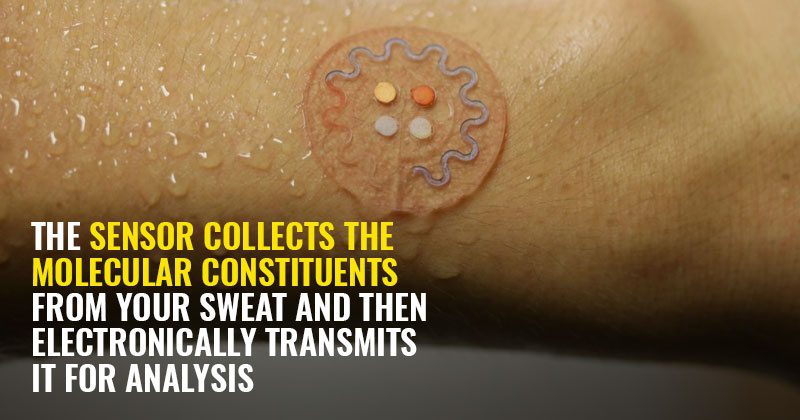
A soft, flexible skin patch that monitors biomarkers in sweat can determine whether the wearer is dehydrated, measure the person’s blood sugar level and even detect disease. The invention is part of an emerging field of wearable diagnostics. Human sweat contains many of the same biomarkers as blood; however, analyzing sweat using a skin patch doesn’t hurt like a needle stick, and the results can be obtained more quickly.
“Cosmetics companies are interested in sweat using these devices in their research labs to evaluate their antiperspirants and deodorants and so on,” Rogers said. “So sweat loss and sweat chemistry is interesting in that domain, as well. And then we have contracts with the military that are interested sort of in continuous monitoring of health status of war fighters.”
Researchers at Binghamton University, State University of New York, have developed skin-inspired electronics to conform to the skin, allowing for long-term, high-performance, real-time wound monitoring in users. “We eventually hope that these sensors and engineering accomplishments can help advance healthcare applications and provide a better quantitative understanding in disease progression, wound care, general health, fitness monitoring and more,” said Matthew Brown, a PhD student at Binghamton University.