
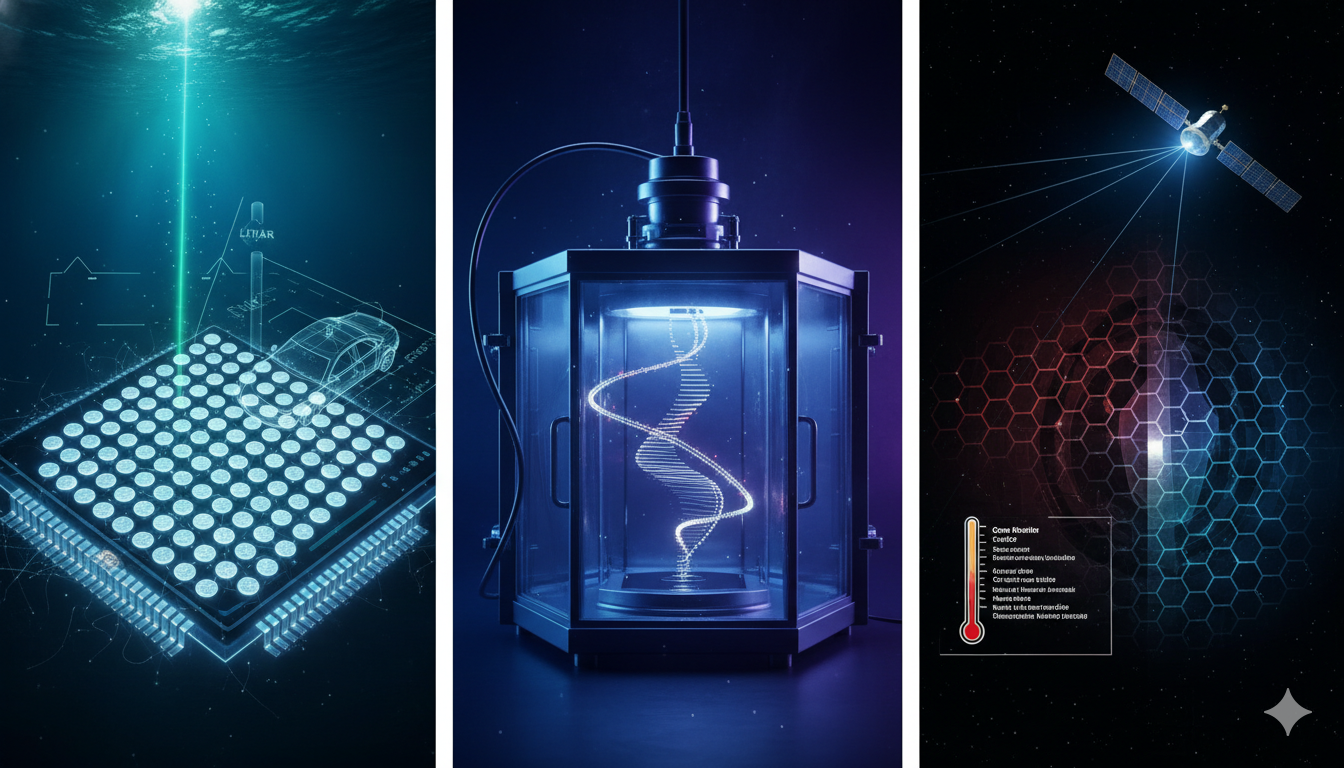

Introduction: Seeing the Smallest Signal
The ability to detect extremely faint light has become one of the defining technological capabilities of the modern era. Whether enabling secure quantum communications, guiding autonomous vehicles, imaging biological processes, tracking hypersonic objects, or probing the structure of matter itself, sensors that can register individual photons are increasingly central to strategic competition and scientific progress.
Single-photon detectors (SPDs) operate at the ultimate sensitivity limit: the detection of one quantum of light. In 2026, these devices are moving from laboratory instruments into critical infrastructure. Advances in semiconductor avalanche detectors, superconducting nanowire systems, graphene thermal sensors, integrated cryocoolers, and large-scale arrays are rapidly expanding what can be measured, where it can be measured, and at what cost.
Just as important, the technology is no longer confined to photons alone. A major breakthrough has shown that superconducting nanowire detectors can also sense high-energy particles, extending their relevance from quantum optics into accelerator science and nuclear instrumentation.
The result is clear: single-photon detectors are evolving into a foundational sensing technology for the quantum age.
The ability to detect light—whether through the human eye, cameras, or advanced sensors—lies at the core of a vast range of civilian, industrial, and military technologies. From photography, astronomy, medical imaging, microscopy, and environmental monitoring to laser detection and ranging (LIDAR/LADAR), precision manufacturing, and secure communications, photon detection underpins how modern systems observe, navigate, and exchange information. Light is also transforming communications through optical wireless links, where lasers transmit data through free space between terrestrial terminals, aircraft, satellites, unmanned aerial vehicles, high-altitude platforms, lunar relays, and future deep-space missions to Mars and beyond. In all of these systems, the detector at the receiving end is often the decisive component that determines range, sensitivity, speed, and reliability.
As technological demands intensify, conventional analog light detectors are increasingly reaching their performance limits. This has elevated the importance of single-photon detectors—devices capable of sensing the smallest indivisible unit of light. Single-photon detection represents the ultimate frontier of weak-signal sensing and is now central to quantum computing, quantum cryptography, deep-space optical communications, advanced metrology, biomedical diagnostics, autonomous navigation, and undersea blue-green laser systems. What began with the discovery of the photoelectric effect and early phototubes has evolved into a new generation of avalanche photodiodes, superconducting nanowire detectors, and emerging quantum materials capable of unprecedented sensitivity. In 2026, these detectors are no longer niche laboratory tools; they are becoming strategic enablers for next-generation computing, communications, defense, and scientific discovery
Detector Technologies
A photon is the fundamental quantum of the electromagnetic field and the smallest discrete unit of light or electromagnetic radiation. Its energy is determined by the relationship E = hν = hc/λ, where h is Planck’s constant, c is the speed of light, ν is frequency, and λ is wavelength. Because photon energy depends on wavelength, the detection challenge varies widely across the spectrum—from microwave and terahertz photons with extremely low energies, to visible and near-infrared photons used in communications and imaging, to high-energy x-rays, gamma rays, and energetic particles used in science and defense. Detecting a single visible photon is fundamentally different from detecting a telecom-band infrared photon or a high-energy proton, which is why no single detector architecture dominates every application.
Over the past decades, engineers have developed single-photon detectors based on multiple physical principles spanning semiconductors, superconductors, vacuum electronics, biological systems, and hybrid quantum materials. Semiconductor detectors remain the most widely deployed class, converting absorbed photons into electron-hole pairs that are then multiplied and electronically read out.
Superconducting detectors exploit zero resistance, Cooper-pair physics, and quantum transitions to achieve extremely low noise, ultra-fast timing, and broadband sensitivity. Biological detectors such as the human eye continue to inspire neuromorphic and bio-inspired sensing systems, while hybrid approaches increasingly combine photonic, electronic, and quantum materials to push performance boundaries. Modern detector development is therefore not about one device replacing all others, but about matching the right physics platform to the mission requirement.
Different wavelength regimes favor different technologies. Silicon avalanche photodiodes (APDs) and SPADs dominate visible-band sensing, lidar, and biomedical imaging because they operate near room temperature and integrate well with CMOS electronics. InGaAs/InP APDs are used at telecom wavelengths around 1.3–1.55 µm for fiber communications and quantum key distribution, though they still face afterpulsing and dark-count limitations.
Photomultiplier tubes remain relevant in astronomy and nuclear science where large-area detection is required, despite their bulk and high-voltage requirements. At the highest-performance end, superconducting nanowire single-photon detectors (SNSPDs), transition-edge sensors (TES), and superconducting tunnel junctions now deliver record efficiency, low jitter, and near-zero false counts across wavelengths ranging from visible to mid-infrared. Emerging technologies—including quantum dots, defects in diamond, frequency up-conversion detectors, graphene bolometers, and carbon nanotube devices—are expanding the frontier further. In 2026, the detector landscape is increasingly defined by specialization, integration, and strategic performance rather than by any single universal solution.
Why Single-Photon Detection Matters in 2026
Modern sensing environments increasingly operate in low-signal, contested, or high-noise conditions. Long-range optical links may receive only a handful of photons. Quantum computers rely on precise detection of photonic states. Lidar systems require rapid timing of weak reflected pulses. Underwater sensing must work through highly absorptive environments. Medical diagnostics often depend on tiny fluorescence signals. In each case, sensitivity determines capability.
Global demand reflects that reality. The market for SPAD-based sensors and related photon-counting systems is expanding rapidly, driven by autonomous mobility, industrial automation, quantum networking, biomedical imaging, aerospace sensing, and defense modernization.
Three structural trends are driving adoption. First, quantum communication and quantum computing require detectors with ultra-low false counts and precise timing. Second, lidar and machine vision need compact, low-cost room-temperature photon counters. Third, military systems increasingly seek passive or low-signature sensors capable of operating in difficult domains such as underwater, space, or long-range optical surveillance.
The Detector Landscape in 2026
Single-photon detection in 2026 is no longer dominated by a single device architecture. Instead, the field has matured into a multi-technology ecosystem in which each detector class occupies a distinct operational niche defined by photon detection efficiency (PDE), timing jitter, dark-count rate (DCR), maximum count rate, wavelength coverage, operating temperature, scalability, and cost. No detector simultaneously optimizes all parameters, which is why commercial, scientific, quantum, and defense markets increasingly deploy hybrid architectures. Room-temperature semiconductor devices dominate high-volume sensing markets, while cryogenic superconducting systems lead in ultimate sensitivity and timing precision. Emerging 2D-material platforms are now challenging long-standing assumptions about spectral limits and detector physics.
At the system level, detector selection has become application-specific. Automotive lidar prioritizes low cost, eye safety, and CMOS integration. Quantum networking prioritizes telecom-band efficiency and ultra-low noise. Space optical communications require extreme sensitivity with tight SWaP constraints. Biomedical imaging emphasizes timing resolution and array scalability. Anti-submarine warfare, atmospheric sensing, and covert optical links demand operation in blue-green or short-wave infrared bands. As a result, the detector market is shifting from a “best detector” model toward a “best detector for mission profile” model.
The competitive frontier in 2026 is therefore not only better materials, but full-stack engineering: photonic coupling, cryogenics, quenching electronics, ASIC readout, packaging, wafer-scale fabrication, and AI-assisted signal processing. This systems approach is accelerating deployment from laboratory prototypes into fielded products.
Photomultiplier Tubes (PMTs): Legacy but Still Operationally Relevant
Photomultiplier tubes remain important where large active areas, mature analog gain chains, and proven reliability matter more than miniaturization. PMTs consist of a photocathode followed by cascaded dynodes in a vacuum tube. A single incident photon ejects a photoelectron through the photoelectric effect, and successive secondary emission stages amplify that event by factors of 10⁵–10⁷ before readout at the anode.
They continue to serve in nuclear instrumentation, Cherenkov detectors, scintillation counting, astrophysics, and selected biomedical imaging systems. Their large aperture and mature ecosystem still provide advantages difficult to replicate economically with some solid-state arrays.
However, PMTs are increasingly displaced by newer technologies because of low quantum efficiency (often near ~10–25% depending on photocathode), timing jitter commonly around ~100–200 ps, high-voltage bias requirements, fragility, magnetic sensitivity, bulky form factor, and weak short-wave infrared sensitivity. For next-generation deployable systems, PMTs are becoming a niche rather than mainstream solution.
SPADs: The Room-Temperature Workhorse Gets Smarter
Single-photon avalanche photodiodes (SPADs) remain the most commercially scalable single-photon detector platform. They operate in Geiger mode, where a semiconductor junction is biased above breakdown voltage so that absorption of a single photon initiates a self-sustaining avalanche. The avalanche is rapidly quenched electronically, producing a digital pulse corresponding to one photon event.
SPADs dominate lidar, 3D sensing, time-of-flight cameras, fluorescence lifetime imaging, positron emission tomography, optical metrology, and compact quantum systems because they can function near room temperature and integrate directly with CMOS processes. This compatibility has enabled megapixel SPAD arrays, on-chip time-to-digital converters, and low-cost sensor modules for consumer electronics and automotive platforms.
In 2026, major improvements came through device electrostatics and junction engineering. Optimized guard-ring geometries reduced edge breakdown instabilities, lowered series resistance, and extended the avalanche multiplication region. Experimental results reported roughly 48% higher photon detection probability at visible wavelengths while preserving low dark-count performance. Reduced resistance also sharpens avalanche rise time, directly lowering timing jitter—critical for quantum key distribution, fluorescence lifetime imaging, and centimeter-accurate ranging.
At telecom wavelengths, however, InGaAs/InP SPADs still face persistent afterpulsing caused by trapped carriers released after prior avalanches. This often forces gated operation rather than true free-running detection. Thermal noise and trap-assisted tunneling also constrain dark-count performance, leaving a capability gap versus superconducting detectors in 1310–1550 nm quantum networks.
SNSPDs: The Performance Leader
Superconducting nanowire single-photon detectors (SNSPDs) remain the benchmark technology for ultimate single-photon performance. These detectors use ultrathin superconducting nanowires—typically 4–8 nm thick and tens to hundreds of nanometers wide—biased just below their critical current and cooled below the superconducting transition temperature.
When a photon is absorbed, localized heating breaks Cooper pairing and forms a transient resistive hotspot. Current is expelled around the hotspot, generating a measurable voltage pulse before the wire resets to the superconducting state.
SNSPDs offer exceptionally high system detection efficiency, near-zero dark counts, timing jitter below 50 ps in advanced systems and below 10 ps in research demonstrations, count rates approaching gigacount-per-second regimes, and broad wavelength response from visible to mid-infrared. They are now indispensable in quantum optics, photonic quantum computing, entanglement distribution, deep-space optical communications, secure telecom links, and strategic sensing systems.
In 2026, integrated SNSPD platforms exceeded 99% detection efficiency through redesigned comb-like nanowire geometries that eliminate dead zones associated with conventional hairpin turns. This matters enormously because multiphoton coincidence probability scales exponentially with detector loss. For photonic quantum computers, even small inefficiencies can collapse useful computation rates.
Another major breakthrough introduced superconducting bias rails that suppress edge current crowding—historically one of the hidden limitations in nanowire performance. By redistributing current density toward the center of the strip, researchers achieved nine orders of magnitude dark-count reduction, broader detection plateaus, and roughly 30% lower jitter. This also enables wider superconducting strip photon detectors, opening paths to large-area arrays and mm-scale sensors.
SNSPD capability also expanded into the 2 µm spectral band, where efficiencies above 90% were demonstrated. This region is strategically important for methane spectroscopy, atmospheric lidar, industrial lasers, eye-safer covert communications, and next-generation free-space optical systems.
Beyond Photons: SNSPDs as High-Energy Particle Detectors
A major strategic shift occurred when SNSPDs demonstrated utility beyond optical photons. In 2025, researchers at the U.S. Department of Energy’s Argonne National Laboratory showed that modified SNSPD architectures can detect 120 GeV protons at cryogenic temperature using niobium nitride nanowires tested at Fermilab.
Wire geometry proved decisive. Devices below ~400 nm width showed high detection efficiency, with ~250 nm structures particularly effective. This demonstrated that the hotspot physics underlying photon detection can also register high-energy charged particle interactions.
The implication is significant: SNSPDs may become a platform technology spanning quantum photonics and accelerator science. Their tolerance to high magnetic fields makes them attractive for detectors embedded near superconducting beamline magnets where conventional semiconductor devices face geometric or electromagnetic constraints.
Potential applications include far-forward instrumentation for the Electron-Ion Collider, fast timing particle tracking, compact cryogenic beam diagnostics, and hybrid quantum-nuclear sensing systems. This widens the strategic relevance of SNSPD manufacturing and cryogenic electronics far beyond communications.
Graphene Thermal Detectors: The Emerging Challenger
A new detector class based on graphene and other 2D materials is beginning to redefine what single-photon detection can mean. Instead of relying on semiconductor bandgaps or superconducting switching thresholds, these devices sense the minute temperature rise caused by absorption of a single photon.
Near graphene’s charge neutrality point, the electronic heat capacity becomes extremely small. As a result, even one photon can generate a measurable temperature excursion in the electron bath. Using Josephson-junction-based readout structures, researchers demonstrated single near-infrared photon detection with intrinsic quantum efficiency approaching ~87%, ultra-low dark counts, and extraordinary noise-equivalent power.
The disruptive aspect is broadband universality. In principle, the same detection physics can span visible, infrared, terahertz, and microwave bands—regions that normally require entirely different detector families. If manufacturable at scale, graphene detectors could reshape astronomy, dark matter searches, far-infrared imaging, secure sensing, and broadband quantum instrumentation.
In 2026, related work integrating graphene Josephson devices with superconducting microwave cavities also advanced understanding of electrothermal dynamics, 1/f noise, and parametric amplification—foundational steps toward practical cryogenic 2D-material detector systems.
Strategic Outlook
The detector landscape in 2026 reveals a clear segmentation. SPADs dominate scale and affordability. SNSPDs dominate absolute performance. PMTs retain selected legacy roles. Graphene detectors represent long-term disruptive potential.
For defense and national technology planning, the highest leverage areas are telecom-band quantum detectors, ruggedized cryocoolers, integrated photonic packaging, radiation-hard arrays, and blue-green/2 µm sensing systems. For industry, CMOS SPAD megapixel arrays and turnkey superconducting detector modules are likely to be the next major commercial wave.
The future of photon detection is no longer about detecting light alone—it is about mastering the full quantum sensing stack across communications, autonomy, medicine, space systems, and strategic security.
2026 Breakthroughs Reshaping the Field
On-Chip SNSPDs Surpass 99% Efficiency
In 2026, researchers demonstrated integrated SNSPD architectures exceeding 99% detection efficiency using redesigned nanowire geometries that reduce dead zones and waveguide losses. This is especially important for photonic quantum computing, where multi-photon success probabilities collapse when detector efficiency drops even slightly.
Rail-Based Current Control Unlocks Intrinsic Limits
Another breakthrough introduced superconducting bias rails that suppress current crowding at nanowire edges. The result was dramatic reductions in dark counts, lower jitter, and wider operating plateaus. This may enable larger-format detectors and mm-scale superconducting strip sensors.
>90% Efficiency at 2 Microns
SNSPD performance has also extended deeper into short-wave infrared bands around 2 µm, important for methane sensing, atmospheric monitoring, industrial lasers, and certain covert communication channels.
Space-Compatible Cryogenic Operation
Historically, SNSPD deployment was constrained by the need for bulky cryogenic systems. Hybrid pulse-tube and Joule-Thomson cryocooler systems demonstrated viable operation around 2.8 K, proving the path toward orbital quantum communication payloads, deep-space optical receivers, and future satellite lidar.
Beyond Photons: SNSPDs as High-Energy Particle Detectors
One of the most important developments in the field came when researchers at Argonne National Laboratory and collaborators demonstrated that SNSPDs can function as detectors for high-energy protons.
Originally optimized for photons, SNSPDs were tested with 120 GeV proton beams at Fermilab while operating near 2.82 K. The devices, fabricated from niobium nitride nanowires on silicon substrates, successfully registered particle impacts with strong timing fidelity.
This was more than a physics curiosity. It showed that superconducting nanowire platforms can migrate from quantum photonics into accelerator instrumentation.
Detector geometry proved critical. Narrower nanowires below roughly 400 nm significantly outperformed wider structures, with around 250 nm delivering strong efficiency. This means particle-detection variants can be deliberately engineered rather than merely repurposed.
Why This Matters
Particle accelerators rely on detectors that can survive constrained geometries, strong magnetic fields, and demanding timing requirements. SNSPDs naturally align with such environments because they already operate cryogenically and tolerate magnetic systems better than some semiconductor alternatives.
Electron-Ion Collider Opportunity
The upcoming Electron-Ion Collider (EIC) requires fast, compact, radiation-aware sensors for far-forward particle reconstruction. SNSPDs may fit this role, especially in magnet bores where conventional geometries struggle.
Strategic Implication
This transforms SNSPDs from a niche optical detector into a broader quantum sensing platform spanning photonics, space systems, and high-energy physics.
Defense and Security Applications
Single-photon detectors are increasingly relevant to national security.
Quantum Key Distribution (QKD): Driving Next-Generation Detector Requirements
Quantum Key Distribution (QKD) has become one of the most demanding real-world stress tests for single-photon detector technology. Operating primarily at telecom wavelengths (1310 nm and 1550 nm), InGaAs/InP SPADs are widely deployed in fiber-based QKD networks supporting secure government, financial, and critical infrastructure communications. QKD protocols such as BB84 and entanglement-based schemes rely on the transmission and detection of individual photons to generate cryptographic keys that are theoretically immune to interception without disturbance. This has enabled operational demonstrations across metropolitan fiber backbones, intercity links, and satellite-to-ground optical channels, where photon-level security is being validated under realistic atmospheric and channel loss conditions.
The dominant system constraint in QKD is timing fidelity. As key generation rates increase, detector timing jitter directly maps into bit error rate (BER) and key reconciliation overhead. In practice, QKD systems must correlate photon arrival times across multiple detectors with sub-nanosecond precision. Any excess jitter broadens detection histograms, increases temporal overlap between adjacent time bins, and reduces distinguishability between valid and spurious events. Recent SPAD engineering improvements in 2026—particularly optimized guard-ring geometries and reduced series resistance designs—have materially improved avalanche uniformity, lowered temporal dispersion, and reduced jitter contributions from edge breakdown effects. These advances directly translate into higher secure key rates and improved resilience in high-speed quantum networks.
Equally critical is the dark-count floor. In long-distance fiber QKD, especially beyond ~100 km, channel attenuation can reduce photon survival probabilities to the order of ~1% or lower depending on wavelength, fiber quality, and system losses. At this regime, false detections become the dominant noise source rather than photon loss itself. Even modest dark-count rates can overwhelm the signal, forcing aggressive post-processing that reduces usable key throughput. This is where superconducting nanowire single-photon detectors (SNSPDs) provide a decisive performance advantage, with dark-count rates orders of magnitude lower than semiconductor SPADs and timing jitter often below tens of picoseconds.
Emerging graphene-based thermal detectors add a further dimension to QKD system design by offering ultra-low dark-count operation governed by thermal fluctuation limits rather than avalanche noise. Although still in early experimental stages, their broadband response and extremely low noise-equivalent power suggest potential roles in next-generation quantum communication receivers, particularly in hybrid architectures combining superconducting and 2D-material detection layers.
Together, these trends are reshaping QKD system engineering. Rather than a single “best detector,” modern quantum networks are evolving toward layered detection stacks: SPADs for scalable terrestrial deployment, SNSPDs for ultra-long-distance and satellite links, and emerging quantum thermal detectors for future ultra-low-noise architectures. In this framework, detector physics is no longer a peripheral component of QKD—it is the primary limiting factor defining achievable secure communication distance, key rate, and network scalability.
Submarine Detection and Blue-Green Quantum Sensing
Blue-green optical wavelengths (approximately 480–520 nm) define a unique propagation window in seawater where absorption and scattering are minimized relative to other parts of the visible and infrared spectrum. This “optical ocean window” enables photon-counting lidar, underwater optical communications, and active imaging systems that can operate over tens to hundreds of meters in clear water, and significantly less in turbid coastal environments. In 2026, the combination of high-repetition pulsed lasers and single-photon detectors is enabling a transition from classical intensity-based sensing to quantum-limited photon-counting maritime systems, where information is extracted from sparse photon returns rather than bulk optical power.
The operational implication is a new class of airborne and spaceborne maritime ISR architectures. In active illumination mode, modulated blue-green laser pulses can be transmitted from aircraft, UAVs, or potentially satellites, with returns captured as discrete photon events. This enables high-resolution bathymetry, wake detection, object classification, and potential submarine tracking under favorable ocean conditions. Unlike conventional radar, which is surface-dominated, or sonar, which is slow and range-limited, optical photon-counting lidar offers high spatial resolution with low probability of intercept in certain configurations—making it strategically relevant for both surveillance and counter-surveillance scenarios.
From a detector perspective, SPAD arrays currently dominate practical deployments because silicon-based devices retain strong sensitivity near 500 nm while operating at room temperature. This allows integration into airborne platforms with manageable SWaP constraints, high pixel density, and CMOS-compatible readout electronics. SPAD-based lidar systems are already being optimized for single-photon timing resolution, high dynamic range suppression of solar background, and multi-return processing needed for complex sea-surface reflections.
SNSPDs, while cryogenic, define the performance ceiling for blue-green photon-counting systems. With engineered optical cavities and material tuning, superconducting nanowires can be optimized for visible wavelengths, offering near-zero dark counts, extremely low timing jitter, and superior photon number resolution. These properties become critical in long integration scenarios such as deep-water detection, low-reflectivity targets, or high-background daylight conditions where false counts directly limit operational range. In strategic systems, SNSPDs could therefore serve as the backend detector in high-performance maritime sensing nodes, potentially deployed on large airborne platforms or fixed coastal installations where cryogenic support is feasible.
Emerging graphene-based thermal detectors add a third pathway by offering broadband sensitivity across the entire optical and infrared spectrum, including the blue-green window. While still experimental, their potential advantage lies in material-universal photon-to-thermal conversion, which could reduce the need for wavelength-specific detector engineering. If scalable, this could simplify multi-band maritime sensing systems that currently require separate detector stacks for visible, infrared, and thermal regimes.
Recent SNSPD advances further strengthen underwater photon-counting capability. The extension of high-efficiency operation into shorter wavelengths improves sensitivity in the blue-green band, while broader detection plateaus increase tolerance to weak return signals in scattering-dominated water columns. In parallel, improvements in timing jitter directly translate into finer depth resolution for lidar-based bathymetry and improved discrimination of moving versus static underwater targets.
Taken together, blue-green photon-counting systems are evolving into a layered sensing architecture: SPADs enabling scalable operational deployment, SNSPDs providing strategic high-performance detection, and emerging 2D-material detectors offering long-term broadband convergence. In maritime ISR and anti-submarine warfare contexts, this shift represents a transition from classical optical sensing toward quantum-limited ocean observation systems with fundamentally improved range, resolution, and information density.
Space Domain Awareness
Space Domain Awareness (SDA) increasingly depends on the ability to detect extremely faint optical signatures against high-background and high-contrast space environments. Photon-counting optical sensors are becoming central to next-generation SDA architectures because they enable detection of weak reflections from small debris, dimly illuminated satellites, and laser interrogation returns that fall below the noise floor of conventional imaging systems. In cislunar and deep-space regimes, where signal attenuation and geometric spreading severely limit return photon budgets, single-photon sensitivity can extend tracking horizons and improve orbit determination accuracy for objects that would otherwise be intermittently observable or entirely lost.
In 2026 system concepts, SPAD arrays are emerging as scalable solutions for wide-field surveillance and rapid revisit imaging, while SNSPD-based receivers are being considered for high-precision optical link reception and long-baseline tracking stations requiring ultra-low noise performance. These capabilities are particularly relevant for space traffic management, rendezvous and proximity operations (RPO), and secure laser communication networks where photon-starved links define system limits. As orbital congestion increases, SDA is shifting from deterministic tracking to probabilistic, photon-limited inference—making detector sensitivity a first-order parameter in space situational awareness.
Missile Warning and Passive ISR
Next-generation missile warning systems are evolving toward passive, photon-starved infrared sensing architectures capable of detecting extremely low-signature plume emissions and thermal contrasts at long standoff ranges. Traditional infrared focal plane arrays rely on integrated signal intensity, but photon-counting detectors offer a fundamentally different operational regime where individual photon arrival statistics are used to reconstruct weak or partially obscured targets. This shift is particularly important for hypersonic vehicles, dim boost-phase signatures, and advanced propulsion systems designed for reduced infrared visibility.
Photon-counting infrared arrays—especially those based on SPADs and emerging superconducting or hybrid detector architectures—enable earlier detection thresholds by improving signal-to-noise performance under low-flux conditions. At the same time, they reduce the need for active illumination or high-power scanning, lowering system observability and improving survivability in contested electromagnetic environments. SNSPD-based infrared receivers, with their ultra-low dark counts and high timing precision, offer additional advantages for space-based early warning platforms where long integration times and extreme sensitivity are required. Together, these technologies are driving a transition from intensity-based infrared sensing to time-resolved photon-event detection for strategic ISR applications.
DARPA’s DETECT Program: Fundamental Limits of Photon Detection
The Defense Advanced Research Projects Agency (DARPA) DETECT program is a structured attempt to formalize a long-standing problem in sensing physics: there is no single photon detector architecture that simultaneously optimizes all key performance metrics. Semiconductor devices, superconducting systems, and emerging quantum or biological-inspired detectors each occupy different regions of a multi-dimensional trade space defined by timing jitter, dark-count rate, maximum count rate, bandwidth, detection efficiency, photon-number resolution, operating temperature, and scalable array size. In practice, improving one parameter—such as efficiency or timing resolution—often degrades another, such as dark counts, dynamic range, or operating complexity.
The DETECT initiative moves beyond empirical engineering toward first-principles modeling of photon-matter interaction at the detector level. Using advances in quantum many-body simulation, nanoscale device modeling, and high-fidelity material characterization, the program aims to determine whether observed performance trade-offs are fundamental physical limits or engineering constraints that can be overcome through new architectures. This includes modeling stochastic carrier dynamics, superconducting phase transitions, avalanche breakdown physics, and thermal fluctuation limits at scales involving trillions of interacting atoms within micrometer-scale detector volumes.
A central goal is to establish whether a “universal detector” is physically achievable—or whether the optimal solution space is inherently segmented across different applications and wavelength regimes. Early hypotheses suggest that while incremental improvements are possible across all platforms, true simultaneous optimization across all eight DETECT metrics may be fundamentally constrained by quantum noise, thermodynamic limits, and statistical fluctuation boundaries.
The outcomes of DETECT, expected to mature in the late 2020s, are likely to shape the next generation of single-photon detector development. Rather than chasing a single ultimate detector technology, the field may instead formalize a regime-specific framework in which SPADs, SNSPDs, and emerging 2D-material detectors are each proven to be optimal within bounded performance domains. In this sense, DETECT is not only a measurement of limits—it is a blueprint for how photon sensing systems will be architected in the post-scaling era of quantum technologies.
Cooling Technology: The Hidden Bottleneck
Despite rapid progress, cooling remains the principal challenge for superconducting and graphene detectors.
SPADs operate near room temperature and are ideal where size, weight, power, and cost dominate. SNSPDs deliver unmatched performance but require cryocoolers. Graphene thermal detectors currently remain mostly laboratory systems.
| Detector Type | Operating Temp | Cooling Method | Field-Deployable? |
|---|---|---|---|
| Si SPAD | Room temperature | None | Yes |
| InGaAs SPAD | 200–250 K (TEC) | Thermoelectric cooler | Yes |
| NbN SNSPD | 2–4 K | Liquid He or closed-cycle cryocooler | Limited (ground only) |
| NbTiN SNSPD | 2.8–4 K | Hybrid PT+JT cryocooler | Space-compatible (demonstrated) |
| Graphene bolometer | 1.2 K | Cryocooler | Lab only (2026) |
The Chinese Academy of Sciences’ demonstration of a space-compatible hybrid cryocooler for NbTiN SNSPDs [citation:missing] is a critical milestone, proving that superconducting detectors can operate outside the physics laboratory. However, cryocoolers remain bulky, power-hungry, and expensive compared to room-temperature SPADs.
The trade-off remains: For applications where size, weight, and power (SWaP) are paramount (e.g., drones, handheld sensors, cubesats), SPADs remain the only viable option. For applications demanding ultimate performance (long-distance QKD, deep-space optical comms, dark matter searches), the cryogenic overhead is justified.
The next phase of competition may therefore center not only on detectors themselves, but on compact cryogenic packaging, vibration control, integrated readout electronics, and field reliability.
Market Outlook and Industrial Competition
Asia-Pacific leads manufacturing scale, particularly in semiconductor detector production and automotive lidar ecosystems. North America leads in quantum networking, national laboratories, and advanced superconducting research. Europe remains strong in automotive sensing, environmental photonics, and quantum technology initiatives.
Key industry players include Hamamatsu, STMicroelectronics, onsemi, ID Quantique, Single Quantum, Quantum Opus, PicoQuant, and a growing ecosystem of startups focused on cryogenic systems and integrated photonics.
Intelligence / Strategic Assessment
Single-photon detectors are becoming strategic enablers rather than isolated components. Their importance spans six high-value sectors: quantum computing, secure communications, autonomous systems, biomedical imaging, aerospace sensing, and defense surveillance.
The competitive frontier is shifting from raw detector sensitivity toward system integration: arrays, packaging, AI-enhanced signal extraction, photonic chips, and deployable cryogenics.
SNSPD migration into particle physics suggests that one detector family could eventually serve quantum processors, satellites, collider experiments, submarine sensors, and ISR payloads. That convergence creates strategic leverage for nations controlling superconducting materials, nanofabrication capacity, cryocoolers, and precision electronics.
The most likely 2026–2030 market split is pragmatic: SPADs dominate mass commercial deployments, while SNSPDs command premium scientific, quantum, and military missions.
IDST Internal Classification
Primary Tags: Technology & Capability Intelligence; Strategic Competition; Capability Intelligence
Secondary Tags: Operational Impact; Threat Assessment; Technology Watch
Time Horizon:
Near-Term (0–2 Years): Quantum networks, lidar expansion, orbital demonstrations
Mid-Term (3–7 Years): Deployable SNSPD defense payloads, EIC detector integration, cryocooler miniaturization
Long-Term (8–15 Years): Broadband quantum sensing arrays, graphene detector commercialization, universal photon-counting platforms
Outlook: 2026–2030
Over the next five years, several milestones are likely. Large SNSPD arrays should move into commercial availability. Cryogenic systems will become easier to operate. Telecom-band SPADs may approach much higher room-temperature efficiency. Graphene detector arrays may emerge for far-infrared sensing. Defense systems will increasingly integrate photon-counting architectures for undersea, space, and low-signature operations.
The deeper trend is unmistakable: sensing is moving toward the quantum limit.
Conclusion: The Quantum Eye Is Opening
Single-photon detectors have become one of the most consequential hidden technologies of the decade. They are the quantum eye enabling secure communications, scalable photonic computing, autonomous perception, precision science, and new military sensing architectures.
In 2026, they also crossed a symbolic boundary: detectors built to see single photons are now detecting high-energy particles, proving their adaptability far beyond original expectations.
The race ahead is no longer about whether these detectors matter. It is about which architecture will dominate each mission space—and which nations and industries will control the ecosystems behind them.
The quantum eye is opening, and it is beginning to see everything.