
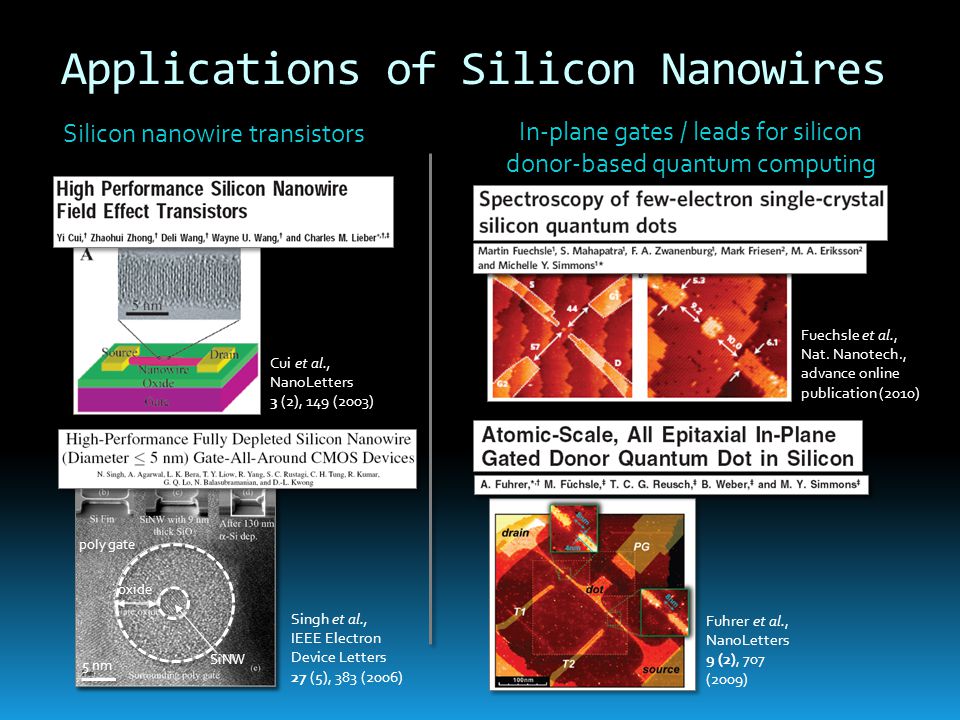

Silicon is predicted to remain as the fundamental material for the micro- and nano-electronics industry and ultra large scale integrated (ULSI) circuits despite the ever-growing research devoted to other materials and their nano structured variants.
Silicon Nanowires (SiNW) are one of the members of silicon nanostructure family, which have unique electrical, optical and mechanical properties. Even more importantly, SiNWs-based nanodevices are compatible with the current Si-based microelectronics industry, and already a number of nanodevices based on SiNWs as building blocks have been demonstrated.
Silicon nanowires are quasi one-dimensional (1D) structures with a diameter of less than 100 nm. The very small diameter results in a large surface to volume ratio. This can be exploited in many ways in electronic devices. They have so far shown promising applications in areas ranging from biological sensors, thermoelectric converters, opto-mechanical devices, piezoelectric sensors, and solar cells among others.
Silicon is a material with very good thermoelectric properties, with regard to Seebeck coefficient and electrical conductivity. Low thermal conductivities, and hence high thermal to electrical conversion efficiencies, can be achieved in nanostructures, which are smaller than the phonon mean free path but large enough to preserve the electrical conductivity.