
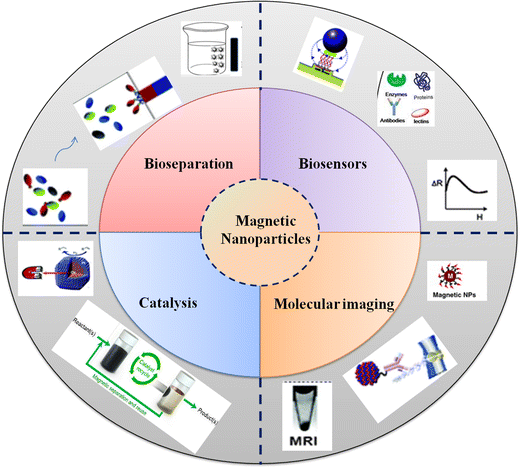

Magnetic nanoparticles are nanomaterials consist of magnetic elements, such as iron, nickel, cobalt, chromium, manganese, gadolinium, and their chemical compounds. In most cases, the magnetic nanoparticles range from 1 to 100 nm in size and can display superparamagnetism. Magnetic nanoparticles have unique properties such as extremely large surface area per volume substance and strong magnetic response. Magnetic nanoparticles (NPs), has applications in many areas including clean energy, biology and engineering because of their special magnetic properties.
Magnetic nanoparticles can be selective attached to a functional molecules and allow transportation to a targeted location under an external magnetic field from an electromagnet or permanent magnet. The possibility to guide and control magnetic nanoparticles in a non-invasive manner has spawned various applications in biotechnology such as targeted drug delivery and sensing of biological substances
In order to prevent aggregation and minimize the interaction of the particles with the system environment, surface coating may be required. The surface of ferrite nanoparticles is often modified by surfactants, silica, silicones, or phosphoric acid derivatives to increase their stability in solution. In general, coated magnetic nanoparticles have been widely used in several medical applications, such as cell isolation, immunoassay, diagnostic testing and drug delivery.
Researchers are also investigating the benefits of magnetic nanoparticles for the design of molecular communication systems. They investigated Magnetic nanoparticle based communication in a microfluidic channel where an external magnetic field is employed to attract the information-carrying particles to the receiver.
There are many Defense and Security Applications for Magnetic Nanomaterials, including destruction of Warfare Agents Using Magnetic Nanoparticles and Nanocrystalline Metal Oxides. Destruction of stockpiled warfare agents and decontamination of exposed personnel is equally important to the military and for homeland defense. Both magnetic nanoparticles and nanocrystalline metal oxides have been investigated for this purpose.
Another is detoxification Processes Using Magnetic Nanoparticles. The use of magnetic nanoparticles to detoxify contaminated military personnel or civilians following a poison gas attack is under investigation by several research groups. Magnetic nanoparticles functionalized to bind with the foreign toxin are injected into the body and drawn through it using a magnetic field gradient. In order for the nanoparticles to be pulled along with the bound toxin molecules, they must have a very high magnetic moment. Gold coated iron, nickel and cobalt ferromagnetic nanoparticles have been employed in this “tag and drag” approach. Researchers are currently searching for cheaper and lighter weight organic coatings.