

Wikipedia defines Steganography is the practice of concealing a file, message, image, or video within another file, message, image, or video. The word steganography combines the Greek words steganos (στεγανός), meaning “covered, concealed, or protected,” and graphein (γράφειν) meaning “writing”. For example, the hidden message may be in invisible ink between the visible lines of a private letter.
Whereas cryptography is the practice of protecting the contents of a message alone, steganography is concerned with concealing the fact that a secret message is being sent as well as concealing the contents of the message.
The advantage of steganography over cryptography alone is that the intended secret message does not attract attention to itself as an object of scrutiny. Plainly visible encrypted messages, no matter how unbreakable they are, arouse interest and may in themselves be incriminating in countries in which encryption is illegal.
In digital steganography, electronic communications may include steganographic coding inside of a transport layer, such as a document file, image file, program or protocol. Media files are ideal for steganographic transmission because of their large size. For example, a sender might start with an innocuous image file and adjust the color of every hundredth pixel to correspond to a letter in the alphabet. The change is so subtle that someone who is not specifically looking for it is unlikely to notice the change. Or example, concealing messages within the lowest bits of noisy images or sound files.
Generally though, there are many techniques known to be able to hide messages in data using steganographic techniques. None are, by definition, obvious when users employ standard applications, but some can be detected by specialist tools. Others, however, are resistant to detection – or rather it is not possible to reliably distinguish data containing a hidden message from data containing just noise – even when the most sophisticated analysis is performed.
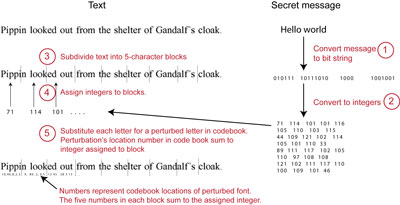
Computer scientists at Columbia Engineering have invented FontCode, a new way to embed hidden information in ordinary text by imperceptibly changing, or perturbing, the shapes of fonts in text. FontCode creates font perturbations, using them to encode a message that can later be decoded to recover the message.
Method could prevent document tampering, protect copyrights, as well as embed QR codes and other metadata without altering the look or layout of a document.