
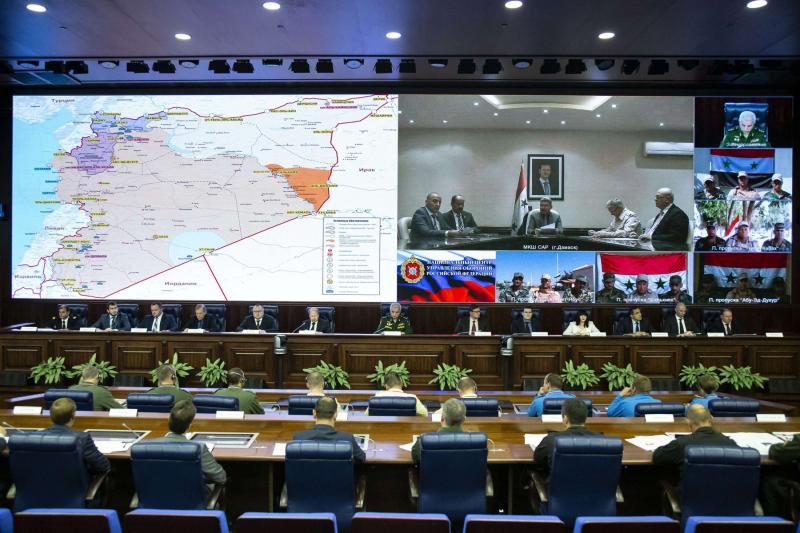

The more than 6-year-old civil war in Syria has been a showcase for Russian-made arms. Russia has supported Assad and his forces, while the U.S. has helped moderate rebel groups and called for Assad to step down. “Syria is not a shooting range for Russian weapons, but we are still using them there, our new weapons,” Putin said. “This has led to the improvement of modern strike systems, including missile systems. It is one thing to have them, and quite another thing to see how they fare in combat conditions.
Russia has emerged as the world’s second-largest arms producer after the United States. Russia surpassed Britain, which had held that spot since 2002 and remains Western Europe’s No. 1 arms maker. The Stockholm International Peace Research Institute said in its annual report on the world’s 100 biggest armaments groups that the combined arms sales of Russian companies amounted to $37.7 billion in 2017, an 8.5 percent rise from a year earlier. Siemon Wezeman, a senior researcher at the institute, said Russian producers of arms and weapon systems have been on a significant growth path since 2011. According to Rosoboronexport, a state-owned export monopoly.Russian-made weapons “proved their efficiency, reliability in the most diverse conditions,”
And that’s good news for President Vladimir Putin amid a deepening economic crisis caused by low oil prices, the falling rouble, and Western sanctions imposed over Russia’s actions in Ukraine. “Financially, it is becoming a No. 2 [source of the Kremlin’s revenue] after oil and gas,” defense expert Ruslan Pukhov said in an interview. The exports are operational in Europe, Asia, Africa, the Middle East and Latin America, he said. Russia’s military-industrial complex’s largest buyers include India, China, Vietnam, Iran, Venezuela, Algeria and the United Arab Emirates.
Russia is willing to keep its forces in Syria despite the potential losses incurred because the Kremlin believes that the benefits outweigh the costs. From the Russian perspective, Moscow’s campaign in Syria affords the Kremlin invaluable combat experience that is helping it to refine the capabilities of its military forces.
The Syria campaign has helped Russia to further develop its military leaders and provided its officer corps with actual combat experience. That, in turn, has allowed Russian forces to vastly improve their tactics, techniques, and procedures. “The use of our armed forces in combat conditions is a unique experience and a unique tool to improve our armed forces,” Russian president Vladimir Putin said during a televised public question and answer session on June 7. “No exercises can compare with actually using the armed forces in combat conditions.
Putin noted that Syria has also proven to be important for Russia’s defense industry—which has gained valuable insights into how the Kremlin’s forces use their hardware in combat. “When we started to use these modern weapons, including missiles, whole teams from our defense industry companies went to Syria, and worked there on-site—it is extremely important for us—to finalize them and figure out what we can count on when using them in combat conditions,” Putin said.
The Syrian operation provided an “excellent opportunity to show off the goods”, Ruslan Pukhov, director of the Moscow-based Center for Analysis of Strategies and Technologies, told Al Jazeera. The operation provided a chance to battle-test “all the last-generation military systems that Russia could not test in military condition – high-precision weaponry, missiles, helicopters, planes and cruise missiles”, he said.
However, while the overall performance of Russian forces in Syria was good according to Putin, the operation did reveal flaws that will need to be corrected. “Some of the weapons and equipment samples revealed flaws in Syria,” Putin said. “The objective control data say as much, as well as the firsthand feedback from our servicemen who took part in the hostilities. I am asking you to carefully study this information and make prompt adjustments to the production process.”