

Small modular reactors (SMRs) defined as nuclear reactors generally 300MWe equivalent or less. SMRs have generated global interest, and potential future applications are a subject of international research directives. Their are around 50 different SMR designs worldwide according to the IAEA. Project proposals include use of SMRs for desalination, process heat generation, biofuel conversion and military base installations.
In general, land-based NPPs have several inherent limitations including extensive land requirement, sophisticated infrastructure for connection to the grid, and continuous and high demand for cooling water. Therefore, floating NPPs have long been considered the alternative technological solution for electricity, heating, or water desalination in remote coastal towns and small islands, as they have been designed mostly based on reactors of less than 300 MWe and to be transportable with the use of barge or ship. For example, a floating NPP using an ACPR50 reactor can provide enough electricity for a community of about 100,000 people, or the daily water consumption for at least 60,000 people.
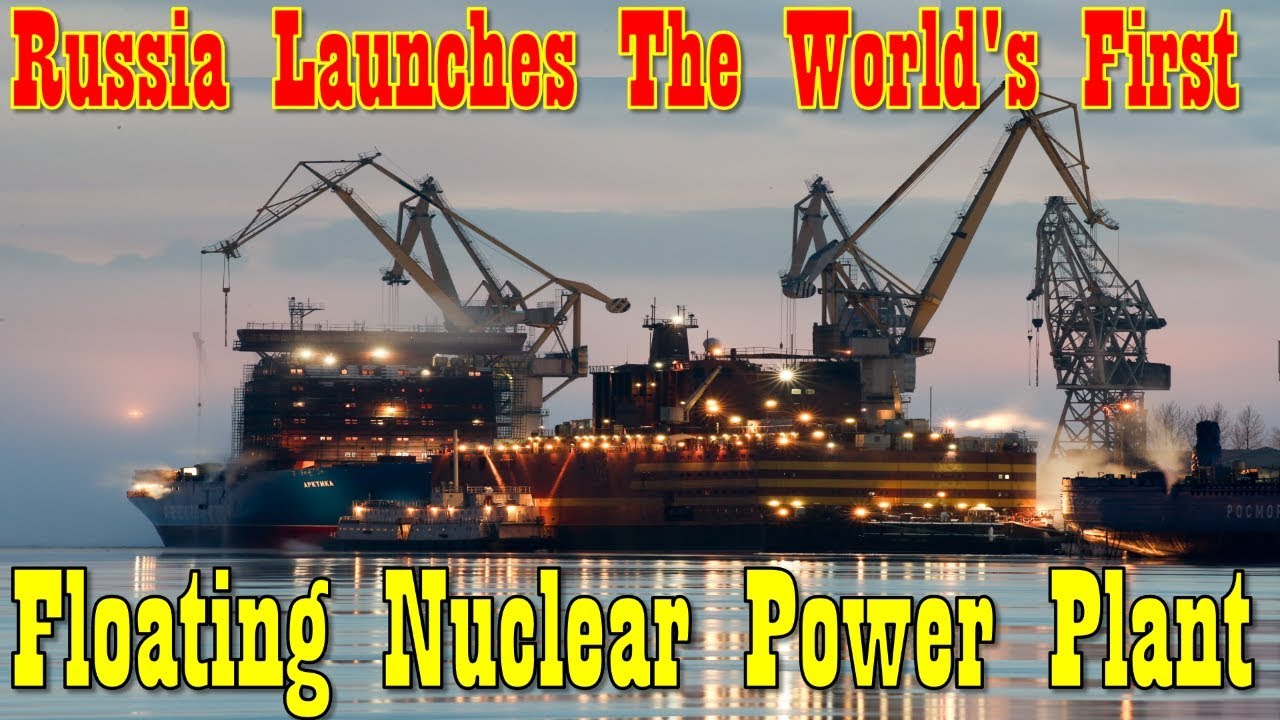
Russia has launched the world’s only floating nuclear reactor, beating countries like the US and China to the post. It has been fully commissioned at a port in Siberia’s Far East, the nuclear utility Rosenergoatom reported in May 2020.In a statement, Andrei Petrov, the company’s head, said that that construction of the floating plant “could be considered complete,” and the Akademik Lomomosov was “now the eleventh commercially operating nuclear power plant in Russia and the northernmost worldwide.”
Since May 2020, the world’s first floating nuclear power plant has been supplying electricity to the town of Pevek, and since the end of June, it has also been securing heating. The living conditions are harsh. The cold season lasts from September to June. Temperatures as low as minus 33 degrees Celsius are common and the Yushak, a wind that can be very harsh all year round, transforms the landscape into a snow desert within minutes in winter. Nevertheless, Pevek will boom, even if the population decreased from 12,000 people to about 4,000 between the 1980s and the 1990s. The reason is its location as a port on the Northeast Passage. This news, which at first glance seems unspectacular, proves to be a milestone in the economical development of Siberia. Although critics see the mobile nuclear power plant as a “floating Chernobyl,” the “Akademik Lomonosov” will become a driving force for the economic development of the region and for the exploitation of Siberian mineral resources for the next 40 years.
Besides Russia, China has been the most promising candidate to have an operational floating NPP since the country started the construction of its first plant in 2016, which would be followed by up to 20 floating NPPs to be operated in the South China Sea once the demonstration unit is completed and deployed for trials in the Bohai Sea by 2020. China has said it will develop floating nuclear power plants on a priority basis in the South China Sea as it seeks to beef up electricity supply to the islands in the disputed maritime region. The floating nuclear reactors could also power Chinese underwater mining operations, in which China has already invested heavily, and deepwater logistical bases for naval usage.
In 2016 China announced its first Chinese floating nuclear project using a 200 MWt (60 MWe) ACPR50S reactor designed indigenously by the China General Nuclear Power (CGN), which was followed by a joint-venture led by the main competitor of CGN in the domestic nuclear market – the China National Nuclear Corp. (CNNC) in 2017 based on its own 310 MWt (100 MWe) ACP100S model. Aside from CGN and CNNC, other types of floating NPPs based on fast reactors have also been under research and development in China.
The U.S. Army built the world’s first floating reactor, the SS Sturgis MH-1A, a 10-megawatt converted Liberty Ship, in 1967. It supplied power to the Panama Canal Zone from 1968 to 1975, before being defueled in 1977. Decades later, in 2010, Russia launched the 21,000-ton, 70 megawatt Akademik Lomonosov, which is expected to deploy in 2018 or 2019 to Vilyuchinsk, on the remote Kamchatka Peninsula.
On November 2, 2020, UK-based Core Power announced that it is working with Advanced Reactor developers, Southern Company, TerraPower, and Orano USA, to meet the demand for disruptive energy technology in ocean transportation. According to Core Power, the four companies have applied to the U.S. Department of Energy to be considered for its Advanced Reactor Demonstration Program (ARDP) to create a prototype molten salt reactor (MSR) technology. ARDP is a new DOE cost-sharing endeavor where selected projects share a 50/50 financial burden. Core Power believes that MSRs could be used for propulsion or electricity generation to decarbonize the world’s commercial shipping fleet, while also increasing shipping speed and efficiency.
TerraPower’s Natrium MSR project (in partnership with GE-Hitachi) was granted $80 million by ARDP to build a 345 MW reactor. In 2018, the International Maritime Organization created a strategy focused on reducing climate change impacts from ships. It set a goal that the carbon intensity of international shipping be cut by at least 40% by 2030 and 70% by 2050, when compared to 2008 levels. It further directed that the international shipping industry cut total annual greenhouse gas emissions by at least 50% by 2050 from 2008 levels.
According to the World Nuclear Association, nuclear power is well suitable for vessels at sea for long periods without refueling, or for powerful submarine propulsion. After all, nuclear power is at the core of United States’ naval strategy. Nuclear reactors power our navy’s aircraft carriers and submarines and enable them to conduct the long-term blue-water operations necessary for sustaining global peace and security. Indeed, there are already over 160 ships operating around the world powered by more than 200 small nuclear reactors.