

Countries like US, Russia and china are racing to deploy combat robots and drones on the battlefield and are investing in their research and development to have a military edge over other countries. Various militaries are fielding unmanned systems for surveillance, intelligence, logistics, or attack missions to make their forces or campaigns more effective. China has developed a large range armed and combat UAVs. It is also challenging US in development of AI and employing them in developing autonomous weapons including missiles. A top British intelligence expert had claimed that the US military will have more robot soldiers on the battlefield than real ones by 2025, suggesting that deadly combat robots are rapidly becoming a reality of modern day warfare.
Robotics is a top priority for Russia’s military future, given the length of the Russian border and the need for military operations in places unsuitable for humans, like the Arctic. Recently, the chief of the General staff of the Russian armed forces, General Gerasimov, stated that Russia seeks to completely automate the battle, and perhaps soon we will witness robotic groups independently conducting warfare.
According to Russia’s deputy prime minister Dmitry Rogozin, the robots will save lives: “We have to conduct battles without any contact, so that our boys do not die, and for that it is necessary to use war robots,” he said. Putin while talking to students envisioned a future for war where drones, ostensibly controlled by artificial intelligence, would fight proxy wars between countries. “When one party’s drones are destroyed by drones of another, it will have no other choice but to surrender,” he said.
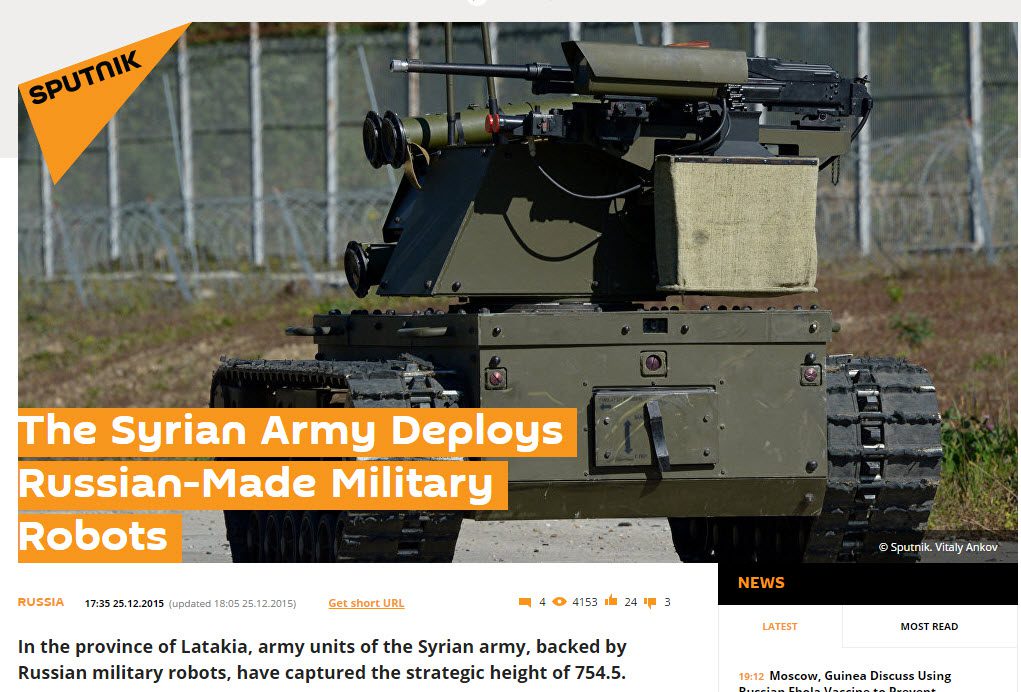
Russian Defense Minister Sergei Shoigu announced about the implementation of serial production of combat robots for the army. “We have started creating combat robots and their state and field trials are nearing completion. I hope that already this year (2018) we will start serial production,” the defense minister said. Russia has also completed work on developing robotic vehicles for area mine clearance, Shoigu said. “Today such robots are already serial-produced. We do not stop the work for any single day, for any single hour,” the Russian defense minister stressed.
In May 2018, the Russian military revealed it had combat-tested its Uran-9 robot tank in Syria. The diminutive remote-control tank is noted for its formidable gun and missile armament. However, robots being developed at present are not ready for combat roles. Defense Blog reported that Senior Research Officer Andrei Anisimov told a conference at the Kuznetsov Naval Academy in St. Petersburg that the Uran-9’s performance in Syria revealed that “modern Russian combat Unmanned Ground Vehicles (UGVs) are not able to perform the assigned tasks in the classical types of combat operations.” He concluded it would be ten to fifteen more years before UGVs were ready for such complex tasks.
“I see a greater robotisation, in fact, future warfare will involve operators and machines, not soldiers shooting at each other on the battlefield,” Lieutenant-General Andrey Grigoriev, head of the Advanced Research Foundation (ARF) had said last year. “The soldier would gradually turn into an operator and be removed from the battlefield.”
In response rapid development of killer drones by Russia and China, Pentagon officials have planned to develop and deploy Automated killer machines in US military within ten years. U.S. Army planning for its Bradley fighting vehicle replacement to be “optionally-manned.”
A report from the Defence Science Board in the US concluded that there are both benefits and dire negatives in using cyborgs to fight their battles, but the country needs to act quickly if it does not want to be left behind any further. The report said “there are both substantial operational benefits and potential perils associated with its use.” Robots on the battlefield will be more efficient, result in less casualties and could ultimately be cheaper. The Pentagon justifies its development with the statement that Russia and China allegedly also design ‘fast-moving, fully-autonomous killing systems’. Thus, the US will make robots ‘not to use them’, but to know how they work and how to counter them.