
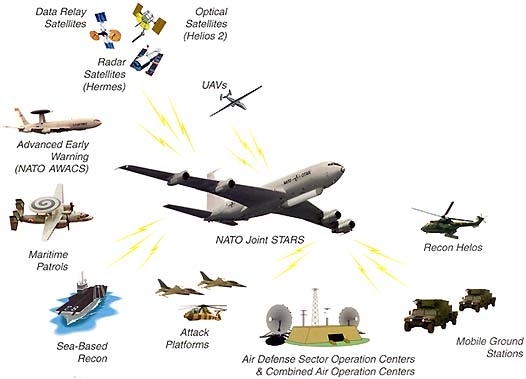

JSTARS is a joint development project of the US Air Force and Army which provides a picture of the ground situation equivalent to that of the air situation provided by AWACS. Operating from a stand-off position often in excess of 200 km, it can detect, locate and classify tracks and can target potentially hostile ground movement in all weather. It relays tactical pictures via secure data links to air force command posts, army mobile ground stations and centres of military analysis far from the point of conflict and also functions as battle management, command and control aircraft.
JSTARS was first deployed in Operation Desert Storm in 1991 when still in development, and has since been deployed to support peacekeeping operations in Bosnia-Herzegovina and during the Kosovo crisis. Recently, the lawmakers “were recently informed that the Air Force wishes to explore alternate intelligence and surveillance platforms instead of continued pursuit of the recapitalization of the E-8C Joint Surveillance Target Attack Radar System (JSTARS) fleet,” Isakson and Perdue said in a letter sent to Defense Secretary James Mattis. “The Air Force remains in source selection for a follow-on to JSTARS as we continue to evaluate alternative approaches for battlefield command and control that could be more effective in high-threat environments,” Grabowski said in an email to Military.com.
In 2018, the Air Force announced its plans to cancel its JSTARS replacement program and pursue a system-of-systems approach it called Advanced Battle Management System or ABMS. This was partly due to their increasing vulnerability of airborne ISR platforms to sophiticated air defense systems like S-400 and S-500. Flying below 40,000 feet, the JSTARS radar horizon is about 230 miles. That is within the reported range of the Russian S-400 SAM system—and a Boeing 707 has a large radar return. In addition amazing capabilities now available from commercial satellites, and an ambitious aim to intelligently network a variety of sensors from all domains.
The Trump administration’s national defense strategy directs the military to focus on “contested environments.” That means figuring out how to fight in places that are within the range of Chinese or Russian surface-to-air missiles. That would make JSTARS a nonstarter, Air Force Chief of Staff Gen. Goldfein argued. “They know what our asymmetric advantages are and they’ve invested in capabilities to take those away from us.” Their strategy is to “hold us off at ranges where we can either no longer perform our mission.” If JSTARS were taken down during a conflict, U.S. troops on the ground would be “blind to enemy activity.”
The service said it would keep the existing JSTARS until the mid-2020s. Meanwhile, it would investigate how to “network current and new sensors from air, space, land, and sea and fuse the information to create a more comprehensive battle management picture…coupled with an agile, resilient communications architecture.”
The U.S. Air Force has started work on a data architecture for its Advanced Battle Management System, the family of platforms that will eventually replace the E-8C JSTARS surveillance planes. The service in March 2019 named Preston Dunlap, a national security analysis executive at Johns Hopkins University Applied Physics Laboratory, as the program’s “chief architect.” Dunlap will be responsible for developing the requirements for ABMS and ensuring they are met throughout the menu of systems that will comprise it.
The Air Force is still deliberating what ABMS will look like in its final form, although officials have said it will include a mix of traditional manned aircraft, drones, space-based technologies and data links.