

As attack vectors increase with the burgeoning of the Internet of Things (IoT), the Defense sector is exposed to different risks that require increasingly advanced authentication techniques. Today’s threat players are using more sophisticated social engineering tactics, credential-stuffing botnets, and account takeover tactics to pull off all sorts of attacks. According to the IBM Security’s Future of Identity Report, identity fraudsters have stolen USD 112 billion over the past six years – that’s approximately USD 35,600 every minute. Advanced authentication methods in Defense can help identify malicious actions while reducing unwanted speed bumps in the online experience.
Biometric solutions are typically used for security and access control across businesses and government organizations. Voiceprint, facial recognition and fingerprinting as biometrics have become commonplace in identity assurance. Recently Cardiac, Iris and gait recognition are also gaining acceptance.
Biometric verification is any means by which a person can be uniquely identified by evaluating one or more distinguishing biological traits. There are two categories of biometric identification and recognition solutions: Physical and behavioral. Physical biometric solutions use distinctive and measurable characteristics of particular parts of the human body, such as a person’s face, iris, DNA, vein, fingerprints, etc., and transform this information into a code understandable by the AI system. Behavioral biometric solutions operate in a similar way, except they use unique behavioral characteristics, such as a person’s typing rhythm, way of interaction with devices, gait, voice, etc.
This encoded biometric information is stored in a database and digitally sampled during authentication and verification. A record of a person’s unique characteristic is captured and kept in a database. Later on, when identification verification is required, a new record is captured and compared with the previous record in the database. If the software matches the data in the new record with that in the database record, the person’s identity is confirmed, it then grants the appropriate level of access.
Fingerprint recognition is one of the oldest, simple to install, and low-cost technology; therefore, it finds numerous applications and is widely adopted by many industries. In travel and immigration, fingerprint recognition technology is used in e-passports, e-visas, and driving licenses to authenticate an individual. In the consumer electronics industry, fingerprint recognition technology is used in laptops, computers, and smartphones, among others. Biometric scanners are useful tools to manage relief distributions and cash grants, find and reconnect separated families, and restore lost documentation.
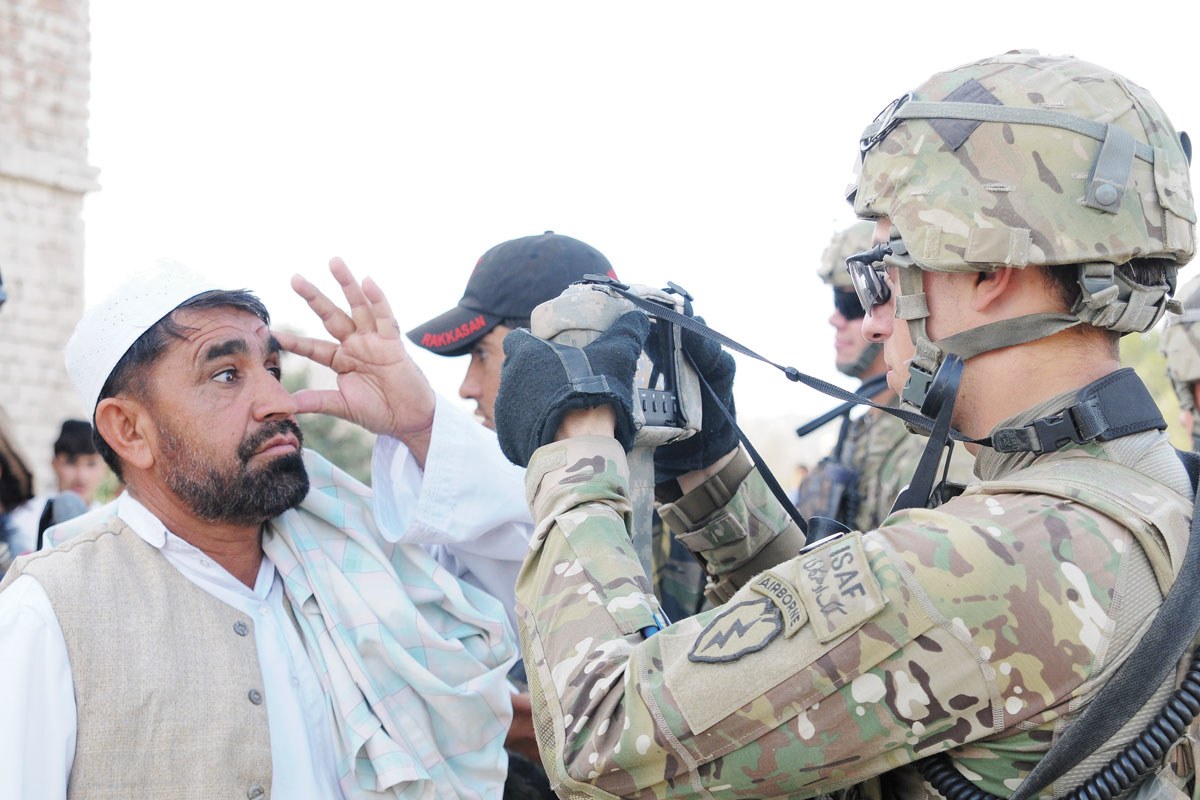
Armies around the world now use biometrics as a way to intensify battlefield awareness and handle encounters with mala fide members which may be hidden in civilian populations. The U.S. military pioneered the usage of biometrics in Iraq and Afghanistan, where biometric indicators such as irises, fingerprints, and facial images were gathered from captured prisoners and other people in the field. Since then, the application of biometrics in military applications has extended significantly. Biometrics are now used to know pirates in the Indian Ocean, trace terrorist travel around the world, and map the relationships between criminal networks that pose military intimidation.
Military and Security require more technologically advanced methods of ensuring security against terrorist activities and Illegal immigration. One of the most effective methods of curbing the same is by creating biometric authentication across borders and airports. “Biometric identification (perhaps at range) may strip away the anonymity that enables insurgents to blend into a society –or will allow future adversaries to identify, track, isolate, and target individual U.S. political or military leaders,” writes DOD report.
Advanced authentication is an approach to authentication which requires the presentation of two or more of the three authentication factors: a knowledge factor – something the user knows, a possession factor – something the user has, and an inherence factor – something the user is. Advanced authentication gives a central place for all authentication systems to be managed. This is critical because companies are usually made to operate and maintain various infrastructures.
Biometrics Enabled Intelligence (BEI) is playing a larger and essential role in U.S. Army intelligence, as described in the latest Army Doctrine Publication (ADP 2-0) for Army intelligence activities. These methods include recognizing an individual based on measurable anatomical, physiological, and behavioral characteristics, as well as intelligence resulting from the combination of biometric information with other intelligence, threat information, or information relating to other aspects.
Specifically, biometrics is being exploited pursuant to the U.S. Army’s new intelligence doctrine for two categories: All-Source and Identity Activities, and Complementary Intelligence Activities. These all-source activities result in the discovery of true identities; linking identities to events, locations, and networks, and revealing hostile intent, thus “enabling tasks, missions, and actions that span the range of military operations.”
However, the current state of biometrics is still facing challenges to successfully mitigate terrorist activities and other digital based financial theft crimes. To turn-over the situation, the market observes a range of research and development activities to integrate biometrics with artificial intelligence. The advanced software algorithm platform of the artificial intelligence (AI) processes information provided by biometric technology to detect and prevent suspicious activities in a bid to counterfeit cyber and physical threats in the community.