
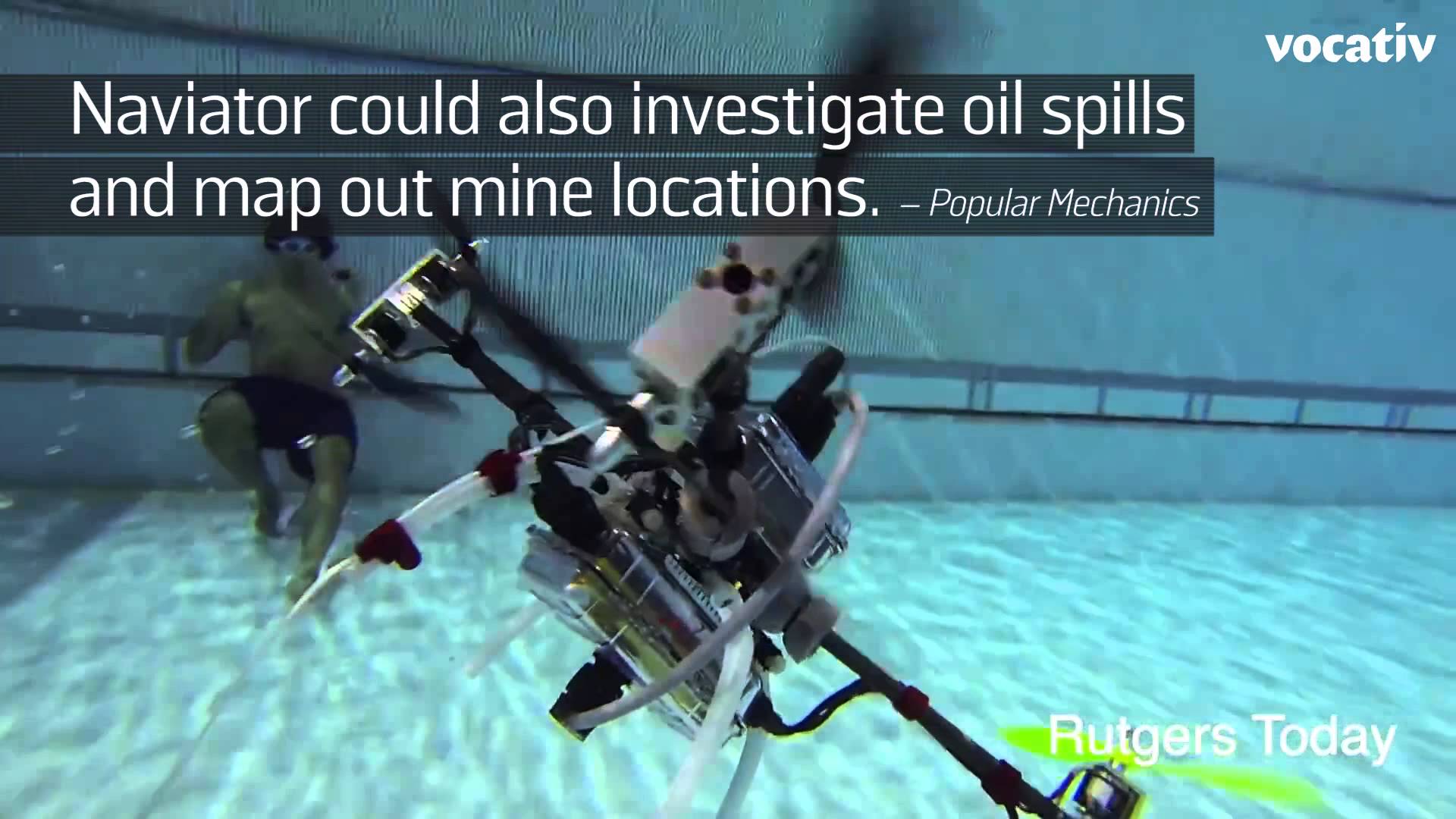

In recent years, a number of groups have begun researching and building vehicles that can smoothly transition from water to air and back again.
Among these new platforms are the Naviator, a multicopter unmanned aircraft system (UAS) from Rutgers School of Engineering, a quadrotor called CRACUNS built by Johns Hopkins University Applied Physics Laboratory, and the Loon Copter, built by Oakland (Michigan) University’s Embedded Systems Research Laboratory. The latter won the $1 million grand prize at the recent UAE Drones for Good Award.
The Office of Naval Research has awarded Rutgers University a grant to develop a drone – equally adept at flying through the air and navigating underwater – that could speed search-and-rescue operations, monitor the spread of oil spills and even help the Navy rapidly defuse threats from underwater mines
Researchers at Rutgers University have developed the ‘Naviator’ drone, designed to be able to plunge almost ten meters into the water and surface and fly from that depth, if necessary. The quadcopter, called the Naviator, is the first successful hybrid aerial-aquatic drone, according to the Office of Naval Research (ONR).
“Waterfowl are still better at flying than swimming, and flying fish are still better at swimming than flying. Our device is equally adept at both, In a sense, we are defying nature rather than emulating it, said Javier Diez, a professor in the Department of Mechanical and Aerospace Engineering.