

Unmanned Aerial Vehicles (UAVs) are growing at frentic pace driven by civil, consumer and military requirements. According to Volpe report, the number of UASs operating in the U.S. National Airspace System (NAS) will exceed 250,000 by the year 2035. There are growing number of civil and commercial applications of UAVs, including humanitarian aid and disaster relief, infrastructure monitoring (such as oil pipelines), wildlife conservation and precision agriculture.
Tech titans like Uber, Amazon, and Google have all laid out ambitious plans for filling the skies with autonomous aircraft. Uber plans to launch an “on demand aviation” service called Uber Elevate through its flying car project. The European aerospace giant Airbus recently unveiled its secret flying-car project dubbed Vahana — a single-manned, autonomously piloted aircraft that can take off and land vertically. Amazon and Google plans to launch automated drone delivery fleets across urban areas that could eliminate the need for shipping via post or UPS. One of the critical technology to these plans is reliable sense and avoid technology.
Safe and efficient integration of Unmanned Aircraft Systems (UAS) into Civil Airspace is a key challenge for unleashing their potential for non-military applications “without reducing existing capacity, decreasing safety, impacting current operators, or placing other airspace users or persons and property on the ground at increased risk”
UAS Traffic Management (UTM) technologies and the associated regulatory framework to allow unrestricted access of UAS to all classes of airspace, including very low-level and Beyond-Line-of-Sight (BLoS) operations. Recent developments in communications, navigation and Sense-and-Avoid (SAA) technology are progressively supporting UAS operations in medium-to-high density operational environments, including urban environments.
UAVs have also become indispensable to modern militaries in providing intelligence, near-real time reconnaissance and surveillance to commanders, and offering warfighters greater battlespace awareness. They have proven effective in electronic combat support, battle damage assessment and even in national security operations like border surveillance, low intensity conflict and guerilla / terrorist warfare. In the future, UAVs will act as airborne data links, enemy radar jammers, chemical and biological weapons detectors, target acquisition systems, and finally precision air attack systems.
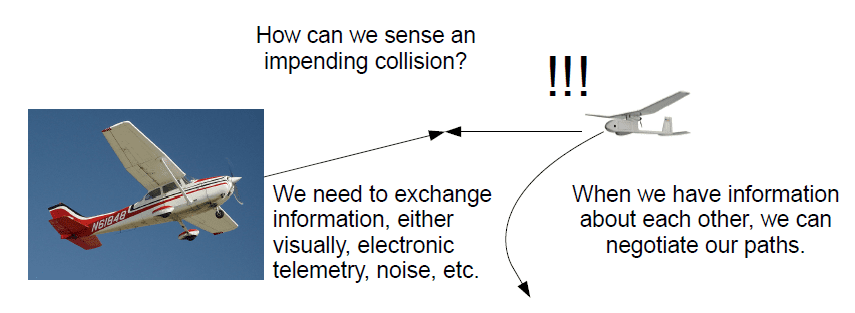
In order for a UAS to safely navigate in the already crowded aerial environment of the modern world, the U.S. Federal Aviation Administration (FAA) and other international organizations have mandated that unmanned aircraft must have an on-board Sense and Avoid (SAA). SAA can be defined as the capability of a UAS to remain well clear from and avoid collisions with other airborne traffic. SAA provides the intended functions of self-separation and collision avoidance as a means of compliance with the regulatory requirements to “see and avoid” compatible with expected behaviour of aircraft operating in the airspace system.
Till recently, UAVs could not autonomously detect or avoid other UAVs, aircraft or obstacles such as buildings, and therefore presented a severe concern for mid-air collisions. As a consequence, they were not allowed to be flown out of line of sight or within close proximity to large gatherings of people, thus restricting their uses within the commercial sector.
However, the Sense and Avoid technology, also referred to as ‘detect and avoid’, sense and avoid’ or ‘collision avoidance’ technology has now become matured and Drones with obstacle detection and collision avoidance sensors are becoming more prevalent in both the consumer and professional sectors. Sense and Avoid may utilize Stereo Vision, Monocular Vision, Ultrasonic, Infrared, Time-of-Flight and Lidar sensors to detect and avoid obstacles. Manufacturers are also using multiple sensors fusing them together to create the obstacle detection and collision avoidance systems.
This obstacle detection and avoidance technology started with sensors detecting objects in front of the drone. Now the latest drones from DJI, Walkera, Yuneec and others have front, back, below and side obstacle avoidance sensors.