

Over the past two decades, many wireless systems have been developed and widely used around the world. The most important examples are cellular mobile radio and Wi-Fi systems. Just like radio and television broadcasting systems, they radiate electromagnetic waves/energy into the air but a large amount of the energy is actually wasted, thus how to harvest and recycle the ambient wireless electromagnetic energy has become an increasingly interesting topic.
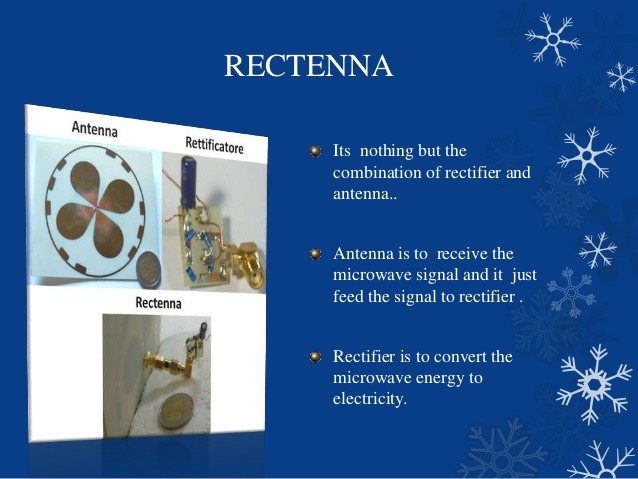
One of the most promising methods to harvest the wireless energy is to use a rectenna, which is a rectifying antenna — a special type of receiving antenna that is used for converting electromagnetic energy into direct current (DC) electricity. There are at least two advantages for rectennas: (1) the life time of the rectenna is almost unlimited and it does not need replacement (unlike batteries). (2) It is “green” for the environment (unlike batteries, no deposition to pollute the environment)
They are used in wireless power transmission systems that transmit power by radio waves. In future they may power our smartphones, laptops, wearables, and other electronics instead of batteries. Since the 1970s, one of the major motivations for rectenna research has been to develop a receiving antenna for proposed solar power satellites, which would harvest energy from sunlight in space with solar cells and beam it down to Earth as microwaves to huge rectenna arrays.
A proposed military application is to power drone reconnaissance aircraft with microwaves beamed from the ground, allowing them to stay aloft for long periods. In recent years, interest has turned to using rectennas as power sources for small wireless microelectronic devices.
The largest current use of rectennas is in RFID tags, proximity cards and contactless smart cards, which contain an integrated circuit (IC) which is powered by a small rectenna element. When the device is brought near an electronic reader unit, radio waves from the reader are received by the rectenna, powering up the IC, which transmits its data back to the reader.
Researchers from MIT and elsewhere have taken a step in that direction, with the first fully flexible device that can convert energy from Wi-Fi signals into electricity that could power electronics.