
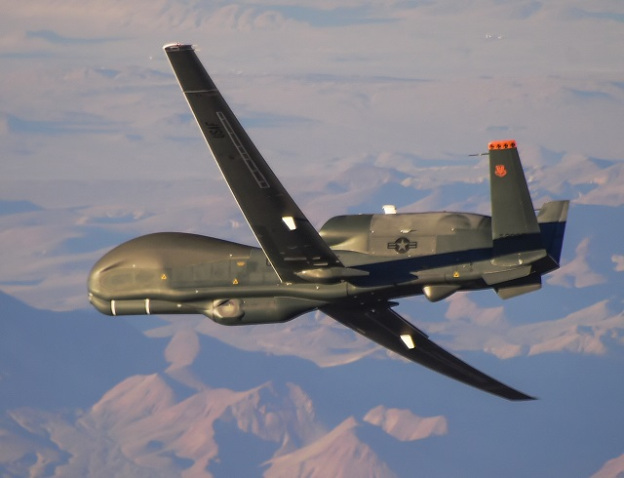

Current unmanned aircraft – including the MQ-1 Predator, MQ-9 Reaper and RQ-4 Global Hawk have excelled against terrorists, both for near-persistent intelligence, surveillance and reconnaissance and strike capability for Reapers and Predators. This was partly due to the permissive environments of southwest Asia counter terrorism missions against technologically inferior groups. In active operation with the USAF since 2001, Global Hawk is capable of flying at altitudes up to 60,000ft for more than 30 hours continuously. It is powered by a Rolls-Royce AE 3007 turbofan engine. The RQ-4 fleet carries out a range of missions including near real-time imagery, signals intelligence, airborne communications gateway and tactical networking.
The future conflicts shall involve operating them in anti-access/area-denial (A2/AD) environments established by more advanced nation-state adversaries. These platforms they are slow-moving and easy targets for advanced radar and anti-aircraft batteries of near-peer competitors. In June 2017, United States Air Force EQ-4 “Global Hawk” drone was shot down over the Mediterranean Sea off the coast of Syria, by a Russian S-300 surface-to-air missile fired from the Russian Base at Tartus, Syria.
Operation for A2AD environments requires either stand-off spectral imaging systems or penetrating spectral imaging systems. Stand-off systems require operations at high altitude (>50,000’) and long slant ranges (>60km), which necessitates advances in hardware and software.
The goal of the Standoff High Resolution Imaging (SHRI) effort is to perform exploratory and advanced development of technologies and systems to extend the effective range of high altitude reconnaissance imaging systems such as those employed on the U-2 and Global Hawk. Effective range is defined to be the range at which National Image Interpretability Rating Scales (NIIRS) 5 or better image quality can be achieved. Both broadband day and night imaging are within the scope of this effort.
A mix of capabilities to penetrate the highly contested environment as well as deliver effects from stand-off ranges offers a balanced approach to counter the A2/AD strategy,” stated the Air Force’s Air Superiority Flight Plan 2030, released in May 2016. The plan lists kinetic and non-kinetic concepts to achieve this, which include long-range strike capabilities, penetrating counter-air capabilities and electronic warfare, among others.
Penetrating spectral platforms must be compact and low cost, and they may operate on expendable platforms. AFRL has on-going activities to develop next generation hardware and software for spectral imaging in A2AD, which include novel longwave infrared spectrometer designs for increased sensitivity, advanced atmospheric compensation and target detection techniques, and research into compact and low cost spectral systems.
The EO-CHIL programme focuses on investigating, developing, and demonstrating concepts, components and systems technologies in order to enhance imaging performance for standoff high-resolution imaging (SHRI), hyperspectral sensing, infrared search and track (IRST), and sense and avoid (SAA) technology.
The primary aim of the programme is to defeat adversary anti-access and area denial (A2 / AD) threat environments through extended-range high-resolution imaging, hyperspectral sensing, and close-in imaging with expendable sensors.