
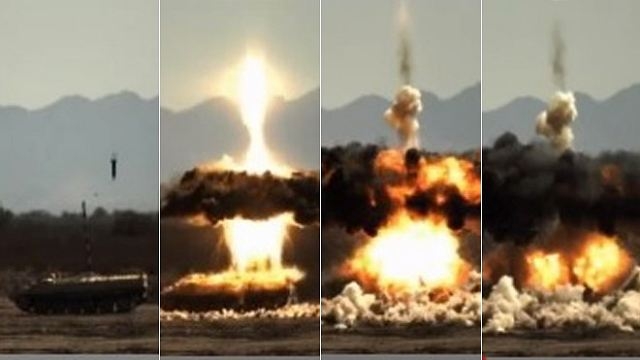

The Excalibur smart artillery shell has a ruggedized Global Positioning System (GPS) satellite navigation receiver and uses satellite signals to help guide itself to its intended targets. It first was fielded in Iraq in 2007 for urban or complex-terrain engagements in which collateral damage must be kept to a minimum. The Excalibur, is a true precision weapon, impacting at a radial miss distance of less than two meters from the target. Unlike “near precision” guidance systems, the Excalibur weapon provides accurate first-round effects at all ranges in all weather conditions. This weapon system also extends the reach of .39-caliber artillery to 40 km and .52-caliber artillery to more than 50 km. Raytheon is developing a laser spot tracker that will allow Excalibur to strike moving targets and counter attempts to jam the GPS. A sea-based variant is also under development.
Excalibur has been in service with the Army since 2007. Some 7,000 of the initial Excalibur 1A model have been built. The upgraded, longer-ranged 1B model entered full-rate production in 2014, with the price dropping to $68,000 a shot, much less than guided missiles. “Because Excalibur doesn’t have a rocket booster — it relies purely on gunpowder to propel it — it’s many times cheaper,” Daniels said.
Excalibur has been fired more than 1,400 times in combat. The Army shot a round from the gun tube of a prototype of the service’s Extended-Range Cannon Artillery system and hit a target at 62 kilometers. The service is developing the ERCA system as part of its Long-Range Precision Fires modernization program, which is the Army’s top priority within its modernization portfolio. The prototypes consist of a Paladin howitzer with an M109A7 chassis that upgrades the Paladin Integrated Management’s turret with a 58-caliber, 30-foot-long gun tube capable of shooting farther than 70 kilometers.
The Army is also aiming to compete for Cannon-Delivered Area Effects Munitions, which would upgrade the Excalibur airframe with an armored target seeker and will be able to defeat “moving and imprecisely located armored targets at long ranges” and will be fully compatible with the Army’s howitzers as well as ERCA and the M777 Extended-Range version, according to fiscal 2020 budget documents.
The Excalibur projectile’s precision, coupled with its ability to be integrated on multiple gun systems, enables both the U.S. and its coalition partners to provide overmatch capabilities against land targets in a variety of combat environments. This includes stationary land targets. Sweden, Canada, Australia and the Netherlands have chosen Excalibur to address vital security interests, and several other international partners are finalizing procurement plans says Raytheon.
The Indian Army has for the first time test fired M982 Excalibur precision-guided, extended range artillery projectiles from M777 155 mm 39-caliber towed ultra light howitzer guns at the Pokhran test range in the Thar Desert region in northwestern India on December 9. “Today [the Indian Army] conducted test-firing of the newly acquired US Excalibur precision guided munitions at Pokhran…a new capability that will integrate with the US-origin M777 Ultralight Howitzer,” the US Embassy in India posted on Twitter. The test firing was also confirmed by senior Indian Army officials.
A new version of Raytheon’s Excalibur precision-guided munition demonstrated in a U.S. Navy test at Yuma Proving Ground, Arizona, that it can change course to hit moving targets. The Excalibur S proved it can “survive the shock and stress” of being fired from a Howitzer, then transition from a GPS-guided capability to laser guidance and hit a moving target, a Feb. 2020 company statement said. The “S” version has GPS and a semi-active laser seeker to get after mobile land and maritime targets in GPS-contested environments without a loss in range capability. The Army and the Navy both use Excalibur Increment B projectiles, which can be upgraded with the S capabilities, the company said. “Using artillery to engage moving targets gives soldiers more flexibility,” Sam Deneke, Raytheon’s land warfare systems vice president, said in the statement. “Artillery is typically used to hit stationary objects, but Excalibur S expands the capability of artillery on the battlefield.”