

The mineral scarcity and rising prices of gold, copper and rare earth minerals is creating great interest among many nations for deep ocean mineral mining. The oceans, which cover seventy percent of our earth’s surface are believed to be able to satisfy our need of minerals like gold, copper, silver, zinc, cobalt and manganese for the next hundred years. There is enough gold on the seafloor to give every person alive nine pounds, scientists estimate. That would be worth about $150 trillion, or $21,000 a person.
Three kinds of platforms are generally used for mineral exploration the Remotely Operated Vehicles (ROV), Autonomous Underwater Vehicles (AUV) and manned submersibles. The manned submersible has advantage owing to the presence of the human in the loop when compared to the spatial limitations of tethered remotely operated vehicles (ROV) and requirement of autonomous technologies for underwater vehicles (AUV) which lacks human intervention. The primary advantage is that it permits the trained mind and eye to work in situ at greater depths in the ocean.
The mineral exploration requires submersibles to have capacity to teach deep underwater and with large endurance as the gas Hydrates in marine sediments are only found at more than 1000 m depth, hydrothermal Sulphides at greater than 2500m and Poly Metallic Nodules at more than 5500m depth.
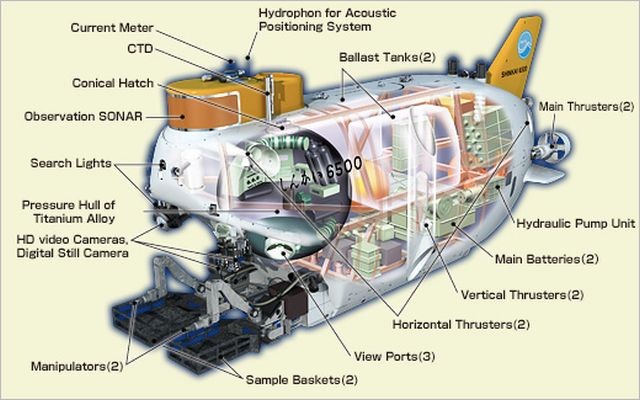
Manned submersibles have long history, on 17 Mar, 1966 the US Navy’s deep-sea vehicle Alvin located a hydrogen bomb on the seafloor off the coast of Palomares, Spain. The new Alvin can reach the depth of 6500 m and endurance of 6-10 hours. Japanese manned submersible Shinkai 6500 which has 1 pilot and 2 observers has also carried out Hydrothermal Vent Exploration. Russian MIR 1 and 2 can also reach the depth of 6000 meters and have endurance of 17-20 hours. China launched JIAOLONG in 2010 can reach upto the depth of 7000 meters and have endurance of 12 hours.
OceanGate (Everett, Wash., U.S.) announced in November that it plans to build two new submersibles using its carbon fiber and titanium design, called Cyclops 3 and Cyclops 4, to meet increasing expeditionary, research and commercial demand for deep-sea manned submersibles. The company says it has begun construction planning for the two new submersibles, which are planned to be rated for up to 6,000 meters.
Operational deep-sea manned submersibles are important underwater vehicles that provide strong technical support for international deep-sea research. Deep sea reach is also important to Navies which can collect the information about enemy submarines as well as carry out their own operations undetected. China continues to make progress in deep sea exploration following the three-month mission of a new underwater glider in the South China Sea, which experts said will also help in maritime warfare.