

The Quantum Key Distribution (QKD) market will grow to over $980 million by 2024 compared to around $85 million this year. So says the industry analyst firm, Inside Quantum Technology, in its latest report “Quantum Key Distribution (QKD) Markets: 2019 to 2028.”
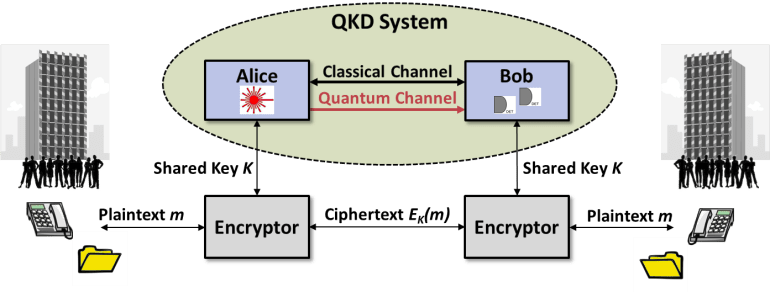
Quantum Key Distribution (QKD) is a major encryption technology designed to protect critical data in the quantum computing era. When Inside Quantum Technology published its first report on QKD in 2016, QKD was still mostly experimental and aimed at government/military markets. Today, the addressable market for QKD is expanding to business users and infrastructure providers, such as telephone companies.
A world-wide effort to develop standards for QKD systems has been formed through ETSI, the QKD Industry Specification Group (ISG). Its focus is to combine the QKD security analysis with details of practical implementations to develop standards that could be used by companies developing QKD products. The ultimate goal is to develop a certification framework that bridges the gap between theoretical security proofs and practical implementations with imperfect devices. In some cases, this has stimulated further theoretical research, in order to make the theoretical assumptions easier to meet in practice.
Another important aspect of the QKD technology is its integration into existing optical networks. An increasing number of QKD quantum networks and field trials from all over the world have been reported recently showing the feasibility of QKD architectures that are far more complex than the original point-to-point dark fiber connection. The QKD ISG aims to assist the integration process by defining relevant standards for such efforts.
Standardization is fundamental to promoting broad commercialization of QKD by building trust and consistency leading to certification. The standardization process is also highlighting areas of QKD research needed to support the development of these standards. A well-established set of standards would be beneficial both to potential QKD users, as it provides definition to what they might consider buying, and to QKD vendors, as it provides a framework for requirements and how to specify them.