

Quantum information is the enabling factor behind a number of emerging technologies that many physicists expect to have a huge impact on society in future: powerful quantum computers, (almost) perfectly secure quantum cryptography and the quantum internet that will distribute these capabilities round the planet. Quantum cryptography is an emerging technology in which two parties may simultaneously generate shared, secret cryptographic key material using the transmission of quantum states of light.
Where the Internet carries bits, the Quantum Internet will carry qubits, which can be in a superposition of both 0 and 1 at the same time. Qubits can be encoded, for example, in the polarization states of a photon or in the spin states of electrons and atomic nuclei. Quantum cryptography is an emerging technology in which two parties may simultaneously generate shared, secret cryptographic key material using the transmission of quantum states of light. Qubits are already being used for creating secret keys—random strings of 0s and 1s—that can then be used to encode classical information, an application called quantum key distribution (QKD).
Quantum Internet will be based on Quantum key distribution (QKD) that uses quantum mechanics to guarantee secure communication. It enables two parties to produce a shared random secret key known only to them, which can then be used to encrypt and decrypt messages. QKD is said to be nearly impossible to hack, since any attempted eavesdropping would change the quantum states and thus could be quickly detected by data flow monitors. This technology offers extremely high security, but its application is currently restricted to metropolitan area networks.
In July 2018 Alberto Boaron of the University of Geneva and his colleagues reported distributing secret keys using QKD over a record distance of more than 400 kilometers of optical fiber, at 6.5 kilobits per second. In contrast, commercially available systems, such as the one sold by the Geneva-based company ID Quantique, provide QKD over 50 kilometers of fiber. Whereas qubits encoded using a photon’s polarization can be sent over optical fibers (as is done with QKD), using such qubits to transfer large amounts of quantum information is problematic. Photons can get scattered or absorbed along the way or may simply fail to register in a detector, making for an unreliable transmission channel.
But there’s a problem with this vision of the quantum future. At the moment, physicists can only send photons carrying quantum information over the length of a single optical fibre. Current quantum communication systems are limited to couple of hundreds of kilometers because of losses in fibers. So far the majority of experimental quantum networks was limited to peer-to-peer communications between two parties. Practical implementation of quantum communications networks, however, needs to address the problem of scalability to serve large numbers of users.
Extending the quantum network relies on two ways one is use of quantum satellite which can connect over large distances, China has already launched a quantum satellite. Another method is to use optical amplifiers as Robert Thew, who co-leads the Quantum Technologies Group at the University of Geneva explains, “In classical communication, amplifiers are used to regenerate the signal. However, in the quantum regime this adds too much noise and destroys the coherence of the quantum states” .
Fortunately, there is a more robust way to exchange quantum information—via the use of another property of quantum systems, called entanglement. When two particles or quantum systems interact, they can get entangled. Once entangled, both systems are described by a single quantum state, so measuring the state of one system instantly influences the state of the other, even if they are kilometers apart.
China has also developed Beijing-Shanghai quantum link connects Beijing to Jinan to Hefei to Shanghai, a distance of more than 1,200 miles. Several major Chinese banks are already using the link to transfer their most sensitive data.However, even though the newly opened quantum link is technically quantum, it is still not 100 percent secure. Photons, or light, can only go through about 100 kilometers of optic fiber before getting too dim to reliably carry data. As a result, the signal needs to be relayed by a node, which decrypts and re-encrypts the data before passing it on. This process makes the nodes susceptible to hacking. There are 32 of these nodes for the Beijing-Shanghai quantum link.
This is still a significant security improvement over traditional fiber optics, said Yu-Ao Chen, a quantum physicist at the University of Science and Technology of China in Shanghai. “Before the Beijing-Shanghai line, hackers could in principle wiretap anywhere along the entire length of the optic fiber. Now, the number of vulnerable points has been narrowed down to just 32,” he said. Chen works in the research group in charge of China’s large-scale quantum communication projects, which is led by Jian-Wei Pan, known in China by his audacious nickname, “Father of Quantum.”
For a quantum communication system to be 100 percent secure, the nodes themselves would have to be hack-proof as well. Scientists are already working on a solution: the quantum repeater. A quantum repeater essentially serves the same purpose as an ordinary relay node, except it works in a slightly different way. A network using quantum repeaters is shaped more like a family tree than a linear chain. In this family tree-shaped game of telephone, the quantum repeater is the parent who distributes identical pairs of quantum keys between two children, therefore doubling the possible distance between users. Moreover, these “parents” can also have their own “parents,” which can then double the key-sharing distance between the children at the bottom for every extra level created atop the family tree. This in effect increases the distance a quantum message can be sent without ever having to decrypt it.
Although the principle is straightforward, each additional layer of parents creates a new set of technological challenges, such as additional noise in the data. A recent paper by Chen and his colleagues in Physical Review Letters reports how they built an experimental system up to the grandparent layer, quadrupling the theoretical distance limit for a hack-proof quantum communication link. But for international distances over thousands of miles, one’ll need to go higher up the family tree, perhaps up to the great-great-great-great grandparent level.
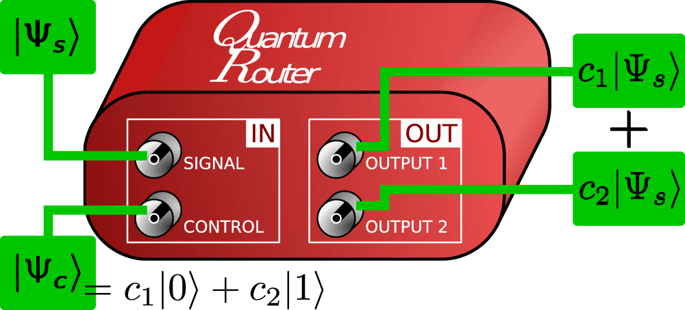
Implementation of quantum Internet require a network of quantum routers linked by fibers. These routers must receive quantum information, store it, and then send it on through the network. Similarly to classical computer networks, their quantum counterparts would require routing protocols to direct the signal from its source to destination. Devices implementing these routing protocols are called quantum routers and have recently been subject of an intense research.