
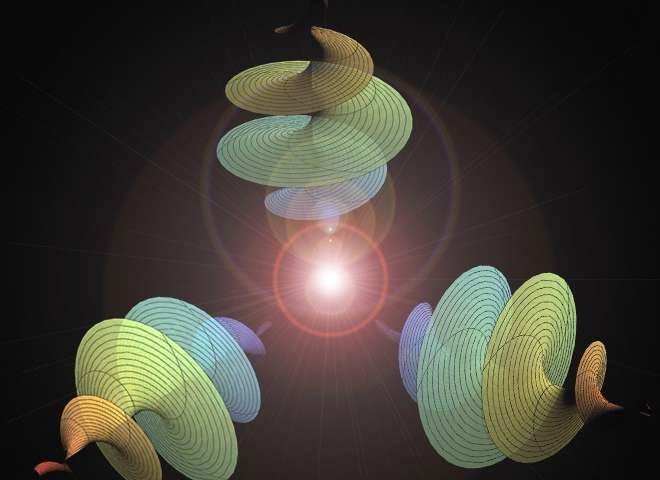

The extraordinary promise of quantum technology—depend on quantum “entanglement,” in which the physical states of two or more objects such as atoms, photons or ions become so inextricably connected that the state of one particle can instantly influence the state of the other—no matter how far apart they are. Today, entanglement is actively being explored as a resource for future technologies including quantum computers, quantum communication networks and high-precision quantum sensors.
In previous studies, photons have typically been entangled by one dimension of their quantum properties — usually the direction of their polarization. Hyperentanglement is a state of (two photons) being simultaneously entangled in multiple degrees of freedom such as polarization, energy-time, spatial mode, orbit-angular-momentum, time-bin and frequency DOFs of photons.
With each dimension of entanglement, the amount of information carried on a photon pair is doubled, so a photon pair entangled by five dimensions can carry 32 times as much data as a pair entangled by only one. Another advantage of using such a system is that it is relatively easy to perform quantum logic between qubits residing in different degrees of freedom of the same photon, as opposed to qubits residing in different photons.
Increasing the dimensionality of quantum entanglement is a key enabler for high-capacity quantum communications. Quantum cryptography (QKD) is an emerging technology in which two parties may simultaneously generate shared, secret cryptographic key material using the transmission of quantum states of light. QKD uses quantum superpositions and quantum entanglement and transmitting information in quantum states, to implement the communication system that detects eavesdropping. Current QKD systems are their slow key generation rate and limited range. The “unconditionally secure” system needs one bit of key for each bit of data, but current QKD systems generate key material far too slowly for this form of encryption.
Potential applications for the research include secure communication and information processing, in particular for high-capacity data transfer with minimal error. This could be useful for medical servers, government data communications, financial markets and military communication channels, as well as quantum cloud communications and distributed quantum computing.