
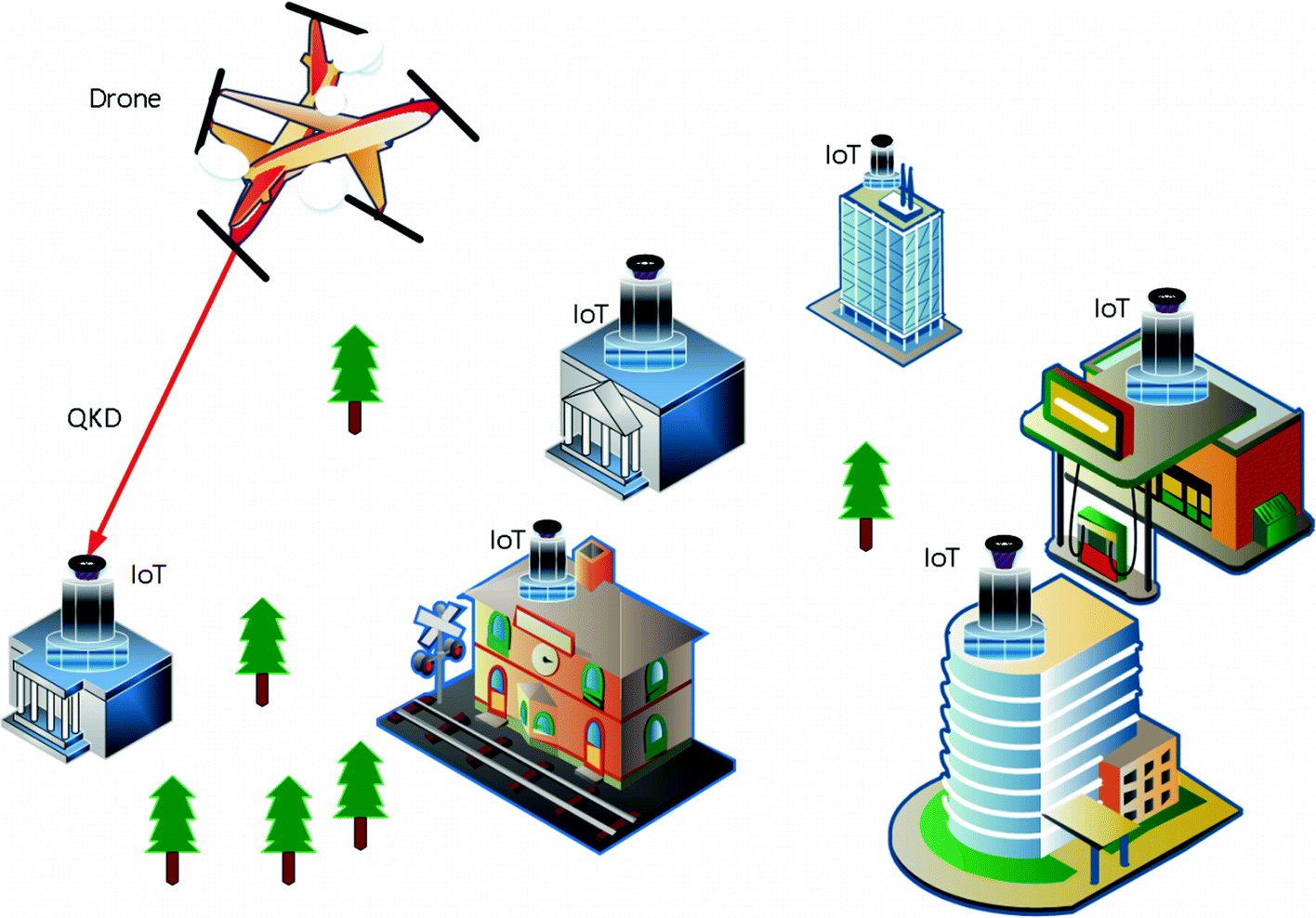

The Internet of things (IoT) is the network of physical devices, vehicles, home appliances and other items embedded with electronics, software, sensors, actuators, and connectivity which enables these objects to connect and exchange data. Each thing is uniquely identifiable through its embedded computing system but is able to inter-operate within the existing Internet infrastructure.
The rapid growth in IOT devices, however will offer new opportunities for hacking, identity theft, disruption, and other malicious activities affecting the people, infrastructures and economy. Some incidents have already happened, FDA issued an alert about a connected hospital medicine pump that could be compromised and have its dosage changed. Jeep Cherokee was sensationally remote-controlled by hackers in 2015. The implementation of IoT in military domain shall also make military systems and networks vulnerable to cyber and other attacks from adversaries, hackers, and terrorists. There is threat of unauthorized monitoring or even seizure and control of vital networks critical to military operations.
https://www.youtube.com/watch?v=_MMAK-dJm1o
Cryptography is an important part of how the internet keeps secret information (such as your credit card number) hidden from potential thieves. Random numbers serve as foundation in many security applications including encryption, authentication, signing, key wrapping and other cryptographic applications. Your encryption system is thus only as strong as your cryptographic key is unpredictable. A truly random number generator will provide impenetrable encryption for communications – be they military transmissions, secure banking, or online purchasing – that underpin the modern connected world,” noted Dr. Sussman. The weakness of random number generators can be exploited by Hackers to steal or guess keys.
Quantum mechanics could help cryptographers generate keys that are truly random and completely unique. A hacker can never write an algorithm to predict the key, because it is impossible for any algorithm to predict nature. Not just that, but the moment a hacker tries to observe the key, it changes the properties of the quantum system. This is how the observation principle could be exploited to design an alarm system that alerts users that a hacking attempt has been made. Thus quantum random generator can improve the security of classical cryptography,
Quantum cryptography is an emerging technology in which two parties may simultaneously generate shared, secret cryptographic key material using the transmission of quantum states of light. A unique aspect of quantum cryptography is that Heisenberg’s uncertainty principle ensures that if Eve attempts to intercept and measure Alice’s quantum transmissions, her activities must produce an irreversible change in the quantum states that are retransmitted to Bob. These changes will introduce an anomalously high error rate in the transmissions between Alice and Bob, allowing them to detect the attempted eavesdropping.
QKD provides a method of provably secure communication even under quantum computer attacks. Many QKD systems, including commercial systems, have been developed during the last 30 years, and important elements such as secret key rates and maximum transmission have continuously improved. QKD is suitable for use in any key distribution application that has high security requirements including financial transactions, electoral communications, law enforcement, government, and military applications.
IoT devices require “lightweight” cryptography to secure themselves as they don’t have the processing capability of traditional devices. Therefore Companies are creating cryptographic tools and protocols that require less energy or less software code to execute.
However, utilizing QKD for IoT still have some challenges. First because of sensitivity to environmental disturbances and fiber attenuation, the maximum length of point to point quantum communication link is limited to 400 kms. Additionally, QKD protocols are limited to only two connected devices. Again, this is not ideal for applications in the IoT, in which multiple devices need to exchange secure information with each other, often over a complex network.
Finally, the vast majority of the world’s electronic and IoT infrastructure is silicon-based. Although some chipmakers have made great advances in silicon photonics—the type of chips that integrate photon signals with standard silicon chips—this technology is still considered prohibitively expensive to employ on a larger scale. “There are some companies trying to miniaturize it using silicon photonics,” said Shahram Mossayebi, CEO and Founder of Crypto Quantique , “but those can be very expensive, not really scalable, and won’t be easily integrated into existing semiconductors. Pretty much you cannot use QKD in the real world yet.”
Quantique has build a hybrid solution, engineers use some sort of quantum tech, like quantum random number generators, and combine them with classical modern cryptographic algorithms. Hybrid solutions provide a far more realistic way forward that still manages to exploit the most important benefits of quantum cryptography. To devise a hybrid system, Mossayebi built a security chip that generates a unique quantum key for each and every IoT device within a network. The key lives inside the IoT device, and is only exchanged with the central hub during the onboarding process.