

The first quantum revolution enabled inventions such as the laser and transistor, the basic building block of computers, when scientists knew the rules of quantum mechanics and built devices that followed those rules. The second quantum revolution is all about controlling individual quantum systems,, such as charged molecules, to a greater extent than before, enabling even more powerful applications of quantum information . However, Quantum effects are very delicate, and physicists have to work very hard to maintain it in labs. They cool their systems down to near absolute zero, carry out our experiments in vacuums, and try and isolate them from any external disturbance.
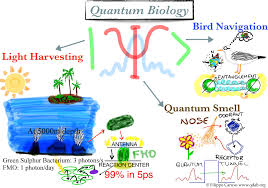
That’s very different from the warm, messy, noisy environment of a living cell. And for many years, scientists operated on the idea that biology was merely a product of deterministic chemical reactions, and as such, unaffected by quantum effects. However, Over the past decade, growing evidence suggests that certain biological systems might employ quantum mechanics. In recent years progress in experimental technology has revealed that quantum phenomena are relevant for fundamental biological processes such as photosynthesis, magneto-reception and olfaction. Quantum biology refers to applications of quantum mechanics and theoretical chemistry to biological objects and problems.
One of the most scientifically accepted hypothesis on how some migratory birds can sense the Earth’s magnetic field is based on photochemical reactions in the birds retina. The excitement of electrons in pairs of light sensitive proteins called cryptochromes causes a physical rather than chemical signature on the proteins that the birds detect. This hypothesis explains why some migratory birds, such as the European Robins, can only orient themselves to a magnetic field in light and with a working ocular system.
In 2010, Darpa’s Defense Sciences Office launched its Quantum effects in Biological Environments (QuBE) program looking for innovative research that will investigate the way that nature may be exploiting quantum mechanical effects in biological systems. “Nature is an extraordinary testbed. We think it’s possible that over millions of years of evolution, biological organisms have developed systems that exploit quantum physics,” Goodman said. “The QuBE program is designed to test this hypothesis. The work we’re pursuing questions fundamental assumptions about how biological processes work.”
If manifestly quantum effects are shown to be at play in biological systems, and scientists can understand the mechanisms at work, the findings could lead to fundamentally new technologies, including bio-inspired sensors. In addition to exploring magnetic navigation, QuBE researchers are also studying photosynthesis, olfaction, and the underlying theoretical framework needed to link biology and quantum phenomena.
“The time and cost to develop many of the traditional sensors that the Department of Defense uses is substantial. Nature, on the other hand, has already evolved extraordinary capabilities—think of a dog’s sense of smell,” Goodman explained. “In addition to being extremely capable, natural sensors are also robust, durable, exhibit great sensitivity and enormous selectivity, and are produced amid the dirt and dust of the natural world; nature doesn’t need clean rooms. We’re hoping to follow nature’s lead to capture those qualities in manmade sensor systems.”