
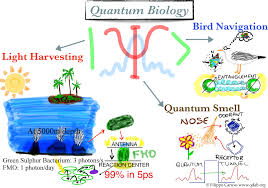

Quantum mechanics is the fundamental theory that describes the properties of subatomic particles, atoms, molecules, molecular assemblies and possibly beyond. Quantum technology (QT) deal with practical applications of quantum mechanical properties—especially quantum entanglement, quantum superposition and quantum tunnelling—applied to quantum systems such as atoms, ions, electrons, photons, molecules or various quasiparticles.
Fundamentally, all matter—animate or inanimate—is quantum mechanical, being constituted of ions, atoms and/or molecules whose equilibrium properties are accurately determined by quantum theory. All living systems are made up of molecules, and fundamentally all molecules are described by quantum mechanics. As a result, it could be claimed that all of biology is quantum mechanical.
Traditionally, however, the vast separation of scales between systems described by quantum mechanics and those studied in biology, as well as the seemingly different properties of inanimate and animate matter, has maintained some separation between the two bodies of knowledge.
However, Quantum effects are very delicate, and physicists have to work very hard to maintain it in labs. They cool their systems down to near absolute zero, carry out our experiments in vacuums, and try and isolate them from any external disturbance.
That’s very different from the warm, messy, noisy environment of a living cell. And for many years, scientists operated on the idea that biology was merely a product of deterministic chemical reactions, and as such, unaffected by quantum effects.
Quantum biology, a young and increasingly popular science genre, seeks to understand whether quantum mechanics plays a role in biological processes. Quantum biology is the application of quantum theory to aspects of biology for which classical physics fails to give an accurate description. quantum biology promises to give rise to design principles for biologically inspired quantum nanotechnologies, with the ability to perform efficiently at a fundamental level in noisy environments at room temperature and even make use of these ‘noisy environments’ to preserve or even enhance the quantum properties.
Quantum mechanical effects
What is meant by quantum biology is the involvement of phenomena that are normally confined to the quantum realm of atoms and molecules, such as coherence, tunnelling, entanglement or spin, because their effects are normally cancelled out at the macroscopic level due to decoherence and would thereby be thought highly improbable inside the warm, wet and disordered environments inside living cells.
Entanglement: two particles are said to be quantumly entangled if their states are interdependent, regardless of the distance separating them. In the classic example of entanglement two entangled electrons, when measured, will have opposite spins. Important for, quantum computing, quantum cryptography. Studied in, photosynthesis, magnetoreception, human consciousness.
Qubits: These units of information are the quantum equivalent of standard binary digits or bits. While a bit can have a state of 0 or 1, qubits can have multiple states simultaneously, and may be entangled with other qubits to perform parallel computations. Qubits can be encoded in the spin states of electrons and other subatomic particles. Important for, quantum computing. Studied in, human consciousness.
Tunneling: Particles at the quantum scale have wave-like properties, and their exact location at any moment is described by a probabilities, traverse – or tunnel through – apparently impermeable energy batteries. Important for, thermonuclear fusion, scanning tunneling microscopy. Studied in, enzyme catalysis, photosynthesis, olfaction, DNA mutation.
Coherence: Because quantum objects can behave like waves, they can exhibit a property of waves called coherence underlies several effects observed by quantum physicists, including entanglement as well as interference patterns manifested as so-called quantum beating. Loss
of coherence has traditionally been through to happen very quickly in the molecular bustle of
ambient–temperature environments. Important for, lasers, superconductors, quantum
computing. Studied in, photosynthesis, magnetoreception, vision, respiration.
Quantum Biology advancing from theory to experiments
Most ideas in quantum biology are still driven more by theory than by experimental support, but a number of researchers are now trying to close the gap. Recently, developments in experimental techniques such as ultrafast spectroscopy, single-molecule spectroscopy, time-resolved microscopy and single-particle imaging have enabled us to study biological dynamics on the increasingly small length and time scales, revealing a variety of processes necessary for the function of the living system that depends on a delicate interplay between quantum and classical physical effects.
Vedral’s team plans to collect more data on bacterial entanglement , and physicist Simon Gröblacher of Delft University of Technology in the Netherlands has proposed carrying out entanglement experiments with tardigrades. In 2017, Al-Khalili and his Life on the Edge(2014)
coauthor, University of Surrey biologist Johnjoe McFadden, helped establish a doctoral
training center for quantum biology to encourage interdisciplinary crosstalk and advance
research efforts. Among the wider community of scientists and research funders, “now you’re
not considered completely mad if you say you’re studying quantum mechanics in biology,”
McFadden says. “It’s just considered a little bit wacky.”
Recently scientists are finding that Bird navigation, plant photosynthesis and the human sense of smell all represent ways living things appear to exploit the oddities of quantum physics. Quantum mechanics operates on the nanometre and sub-nanometre scales and is at the basis of fundamental life processes such as photosynthesis, respiration and vision.
It has only been in the past few years that scientists have started figuring out how quantum mechanics is exploited by animals, plants and bacteria to give some of them a keen sense of smell and others a very efficient way to harness energy from the sun, said Lloyd, a professor of quantum mechanical engineering at the Massachusetts Institute of Technology.