
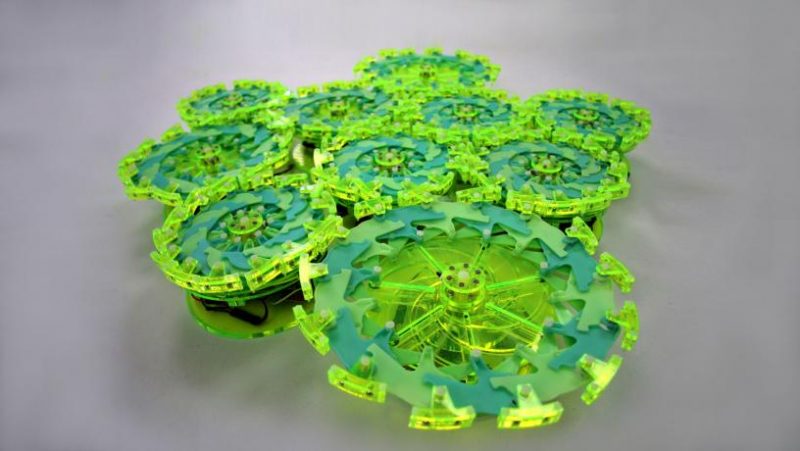

Recently scinetists are considering not only individual robots but developing of groups of robots, because a swarm of collaborative robots, each one observing the problem from a different point of view, is able to solve more difficult tasks than one robot by itself. The strength of a swarm can be found in the sharing of information. Pieces of information are sent by a robot to a nearby robot and so on, connecting in this way all the robots of the swarm in a synergistic network. For example, each robot used for the exploration of unknown environment could explore by itself a little part of the search space and at the same time could share information with neighbours. In this fashion the exploration task is achieved after a shorter time than using a single robot.
The basic principle behind this new approach to robot coordination was directly inspired by the observation of natural systems. In nature, in fact, it is possible to see a lot of animals that work together for a final common purpose. Some typical example can be found in the sea, on the ground and in the air, and more evolved animals can collaborate to perform more complex social behaviours. Swarm Intelligence (SI) is a research field, afferent to Artificial Intelligence, that studies the decentralized collective behaviour of entities belonging to both artificial and natural systems. SI takes advantage of ideas and theories strongly inspired by biological systems.
The system commonly used as matter of tests is made up by a population of entities, which are called units, agents or particles in relation to the research field. Entities have the ability to interact with the surrounding environment and with other entities of the population exchanging information in some fashions. Each entity operates autonomously and in a completely decentralized fashion with the purpose to achieve the same target and following the same simple rules. The intelligent behaviour of the group emerges in a self-organized way from the behaviour of each single entity. The most biological groups studied from SI are schools of fishes, flocks of birds, swarms of bees, colonies of ants and herds of animals in general, from which scientist have created many applications in mathematics, statistics, immunology, sociology, engineering and in many other research fields included robotics e.g. multirobot systems.
Hybrid bio-inspired robotics tries not only to mimic living organisms in nature, but also to improve them to make them adaptable to multiple terrains and environments, while mechanically modular and efficient. The development of hybrid robots requires new designs of mechanical elements that take advantages of 3D printer technologies combining soft and rigid materials in the same part for multifunctional purposes.
Bio-inspired spherical mobile robots have been embedding mechatronic modifications to make them more adaptive to different terrains and environments, they can swim, dive from integrated thrusters; move in snow from their rugged outer shell; and even walk from using its shell as legs; but never embedding an active exoskeleton. The main reason is the challenging mechatronic system to be fitted inside the constrained space of the robot’s exoskeleton, which integrates a sealed spherical mobile robot as an inner shell together with a sensorized and actuated outer shell, plus managing their complex interactions.
The particle robots were inspired by an interesting rather boring animal, the biological Echinoid (sea urchin) and by spherical mobile robots. The sea urchin consists of a round shaped body with long spines that come off it. The spines are used for multiple purposes, such as protection and to move about in the water. On the other hand, spherical mobile robots embed a special morphology with multiple advantages such as protection from their outer shell and smooth motion with good power efficiency. Whether, based on the spherical mobile robots, soft robotics and highly compressible linear actuators state-of-the-art, it is possible to create a new specie of robot with novel locomotion methods, able to reconfigure itself to swim, move on snow or sand, pass over obstacles and even jump by contracting or extending its spines.