
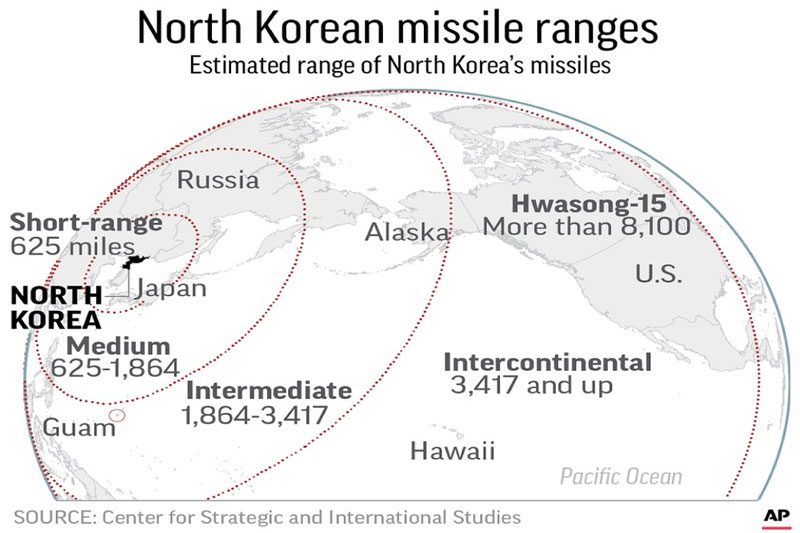

Throughout 2017, North Korea tested several missiles demonstrating the rapid advances in its military technology. The Hwasong-12 was thought to be able to reach as far as 4,500km (2,800 miles), putting US military bases on the Pacific island of Guam well within striking distance.
Later, the Hwasong-14 demonstrated even greater potential, with a range of 8,000km although some studies suggested it could travel as far as 10,000km if fired on a maximum trajectory. This would have given Pyongyang its first truly intercontinental ballistic missile, capable of reaching New York.
Eventually, the Hwasong-15 was tested, peaking at an estimated altitude of 4,500km – 10 times higher than the International Space Station. If fired on a more conventional “flatter” trajectory, the missile could have a maximum range of some 13,000km, putting all of the continental US in range. Kim succeeded in developing an ICBM operational capability through which it can deliver a nuclear weapon anywhere in the United States, according to analysis based on Images released by North Korea.
In an analysis for the Washington-based 38 North think tank, missile expert Michael Elleman of the International Institute for Strategic Studies said the North Korean photos showed a missile considerably larger than its predecessor. “Initial calculations indicate the new missile could deliver a moderately sized nuclear weapon to any city on the US mainland,” Elleman said. Elleman said the missile was large and powerful enough to carry simple decoys or other countermeasures to challenge US missile defences.
But it was unclear if Pyongyang had the technology to miniaturise a nuclear warhead, however Jeffrey Lewis of the Middlebury Institute of Strategic Studies said on Twitter the Hwasong-15 was “so big that the warhead wouldn’t need to be miniaturised.” Experts and US officials also question whether it has a re-entry vehicle capable of protecting a nuclear warhead as it speeds toward its target and about the accuracy of its guidance systems. Kim’s testing freeze ushered in unprecedented diplomacy with US President Donald Trump, leading to historic meetings in Singapore, Vietnam and the demilitarised zone separating the two Koreas.
Kim has been busy churning out fissile material for bombs and developing new missile technology that could make the next big launch of an intercontinental ballistic missile even more concerning to Pentagon military planners. A series of shorter-range missile launches have improved North Korea’s ability to make solid-fuel ballistic missiles that are easier to move, hide and fire than many of its liquid-fuel versions. That makes it more likely he is on course toward developing an ICBM that uses solid-propellant technology, potentially giving the US less warning of an imminent strike anywhere from California to New York.
Gen. Paul Selva, vice chairman of the U.S. Joint Chiefs of Staff, provided an assessment of North Korea’s missile technology at an Air Force Association breakfast in Washington, according to Bloomberg. He said the last two pieces of technology were a reliable reentry vehicle and a reliable “arming, firing and fusing system,” which would detonate the ICBM on command. “A handful of additional flight tests are needed to validate the Hwasong-15’s performance and reliability, and likely establish the efficacy of a protection system needed to ensure the warhead survives the rigors of atmospheric re-entry,” Elleman wrote. Only two or three more tests might be needed if North Korea could accept low confidence in the missile’s reliability.
In October 2020, North Korea unveiled its new ballistic missile. It has not yet been named or tested. Like the Hwasong-15, it is a two-stage liquid fuelled missile, but with a greater length and diameter. It could possibly allow for multiple warheads. It has not yet been named or tested. Like the Hwasong-15, it is a two-stage liquid fuelled missile, but with a greater length and diameter. It could possibly allow for multiple warheads.
It is believed to be able to deliver a nuclear warhead to anywhere in the US, and its size had surprised even seasoned analysts when it was put on show in 2020.
In January 2021, North Korea unveiled another missile – a new type of submarine-launched ballistic missile which it declared to be “the world’s most powerful weapon”.
The unveiling of the new missiles appeared to be a message to the Biden administration of the North’s growing military prowess, say experts. In March 2021 year, it carried out a launch of what it called a “new-type tactical guided projectile”, which is said was able to carry a payload of 2.5 tons – so capable of in theory of carrying a nuclear warhead.
The weapon has not been formally identified. Analysts at the James Martin Centre for Nonproliferation Studies told Reuters that it appeared to be “an improved variant” of a previously tested missile, the KN-23.
In response, US is perfecting its Ground-Based Midcourse Defense (GMD) which it considers as essential to protect itself from nuclear missile attacks from rogue states such as North Korea and Iran. The Trump administration is seeking a significant expansion in the Ground-based Midcourse Defense program – a missile defense system on which the United States has already spent some 67 billion.
The GMD is an element of the US Ballistic Missile Defense System that provides combatant commanders the capability to engage and destroy limited intermediate- and intercontinental-ballistic missile threats in space to protect the United States. US experts and officials said the Korean missile still appeared to be powered by liquid fuel, something that made it vulnerable as it could take to up to two hours to fuel on-site before launching.
The Missile Defense Agency is deeming the first salvo test of its homeland missile defense system against an intercontinental ballistic missile threat a success, according an agency statement. The MDA conducted the test in March 2019. It last tested the Ground-Based Midcourse Defense System’s (GMD) Ground-Based Interceptors (GBI) against an ICBM target in May 2017. At that time, the MDA’s director said the agency was next shooting to conduct a more complex salvo test involving two GBIs against an ICBM, because firing off two GBIs against one target is more operationally realistic and important in proving out the effectiveness of the overall system.
The lead GBI destroyed the ICBM’s reentry vehicle “as it was designed to do,” according to the agency’s statement. The trailing GBI “then looked at the resulting debris and remaining objects, and, not finding any other reentry vehicles, selected the next ‘most lethal object’ it could identify, and struck that, precisely as it was designed to do,” the statement adds.
“This was the first GBI salvo intercept of a complex, threat-representative ICBM target, and it was a critical milestone,” MDA Director Air Force Lt. Gen. Samuel Greaves said in the statement. “The system worked exactly as it was designed to do, and the results of this test provide evidence of the practicable use of the salvo doctrine within missile defense,” he said. “The Ground-based Midcourse Defense system is vitally important to the defense of our homeland, and this test demonstrates that we have a capable, credible deterrent against a very real threat.”
The United States has steadily strengthened its missile defense system against North Korean missiles. There are currently 44 GBIs installed in the United States, 40 at Fort Greely and four at Vandenberg Air Force Base, California. The 44th and final GBI — under the previous requirement — was put in place at Greely. But the MDA is ramping up the number of GBIs to 64 in silos at two missile fields in Fort Greely after receiving special funding to do so in fiscal year 2019. The MDA is requesting $1.2 billion in FY20 to continue the expansion of the GMD system and will equip 20 GBIs with its new RKV.
Lieutenant General David L. Mann, commander of U.S. Army Space and Missile Defense Command/Army Strategic Forces Command and Joint Functional Component Command for Integrated Missile Defense, recently told the Senate Armed Services Committee “the GMD system remains our Nation’s only defense against an ICBM attack.” He went on to state, “As the Secretary of Defense and various Combatant Commanders have previously testified, the Warfighter remains confident in our ability to protect the Nation against a limited intercontinental ballistic missile attack, even in the face of the changing fiscal environment