
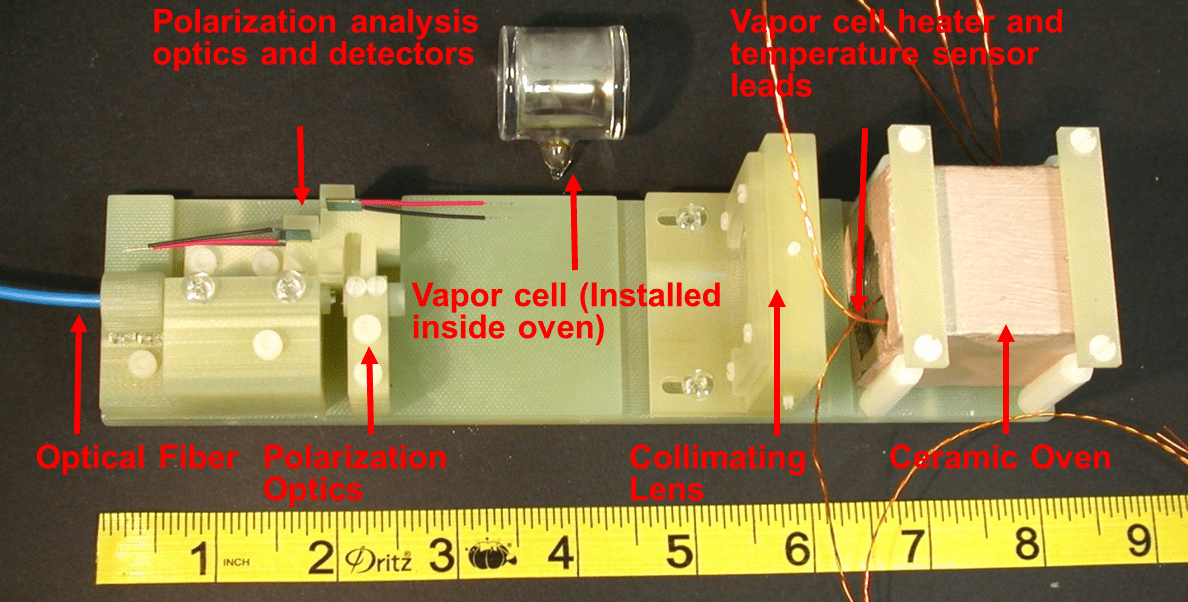

A magnetometer is a device used to measure the direction and strength of the magnetic field at a particular location. Magnetometers are employed across several sectors such as energy, healthcare, aerospace & defense, consumer electronics, surveys, and industrial. A magnetometer is an instrument with a sensor that measures magnetic flux density B (in units of Tesla or As/ m2) at the point in space where the sensor is located. A magnetic field drops in intensity with the cube of the distance from the object. Therefore, the maximum distance that a given magnetometer can detect the object is directly proportional to the cube root of the magnetometer’s sensitivity. The sensitivity is commonly measured in Tesla.
The Earth generates a weak magnetic field that produces flux densities (in air) of about 18 micro Tesla in some parts of South America to a high of over 60 microTesla in the Arctic Circle and Antarctica. Since magnetic flux density in air is directly proportional to magnetic field strength H [A/m], a magnetometer is capable of detecting fluctuations in the Earth’s field.
The magnetometer sensor is even present in the tablet or smartphone that utilizes the modern solid state technology to create a miniature Hall-effect sensor that detects the Earth’s magnetic field along three perpendicular axes X, Y and Z. The Hall-effect sensor produces voltage which is proportional to the strength and polarity of the magnetic field along the axis each sensor is directed. The sensed voltage is converted to digital signal representing the magnetic field intensity. Other technologies used for magnetometer may include magneto resistive devices which change the measured resistance based on changes in the magnetic field.
Magnetometry has two general aims: measuring magnetic fields highly precisely and on the smallest scale. Magnetometers have been used intensively for a long time – as compasses to measure the earth’s magnetic field, for geological studies or to analyze nanostructured magnetic layers in hard drives for data storage. There have been numerous breakthroughs in the scientific and technological use of magnetic fields during the past decades, yet the detection of smallest magnetic fields with highest spatial resolution at room temperature has proven to be a great scientific challenge.
Magnetometers are classified into two categories:Vector magnetometers, that measure the flux density value in a specific direction in 3 dimensional space. An example is a fluxgate magnetometer that can measure the strength of any component of the Earth’s field by orienting the sensor in the direction of the desired component.A SQUID sensor is basically a magnetic flux-voltage converter having an extremely low magnetic flux noise. The physical quantities (magnetic field, current, voltage, displacements, etc.) to be detected are converted in a magnetic flux by using suitable flux transformer circuits.Scalar magnetometers that measure only the magnitude of the vector passing through the sensor regardless of the direction. Quantum magnetometers are an example of this type of magnetometer.