

The first quantum revolution brought about semiconductor electronics, the laser and finally the internet. The coming, second quantum revolution promises spy-proof communication, extremely precise quantum sensors and quantum computers for previously unsolvable computing tasks.
Quantum secure communication relies on sharing of entangled states between parties. Over short distances (less than 100 km), these states can be distributed by sending photons over optical fibers, but losses in those fibers limit long-distance sharing. Currently Most Quantum Communication links are direct point-to-point links through telecom optical fibers and, ultimately limited to about 300-500 km due to losses in the fiber. Experimentally, QKD has been implemented via optical means, achieving key rates of 1.26 megabits per second over 50 kilometres of standard optical fibre and of 1.16 bits per hour over 404 kilometres of ultralow-loss fibre in a measurement-device-independent configuration.
The next important milestone, is development of large scale QKD network to extend QKD from point-to-point configuration to multi-user and large-scale scenario. China has also operationalised the 2,000-km quantum communication main network between Beijing and Shanghai using quantum repeaters.
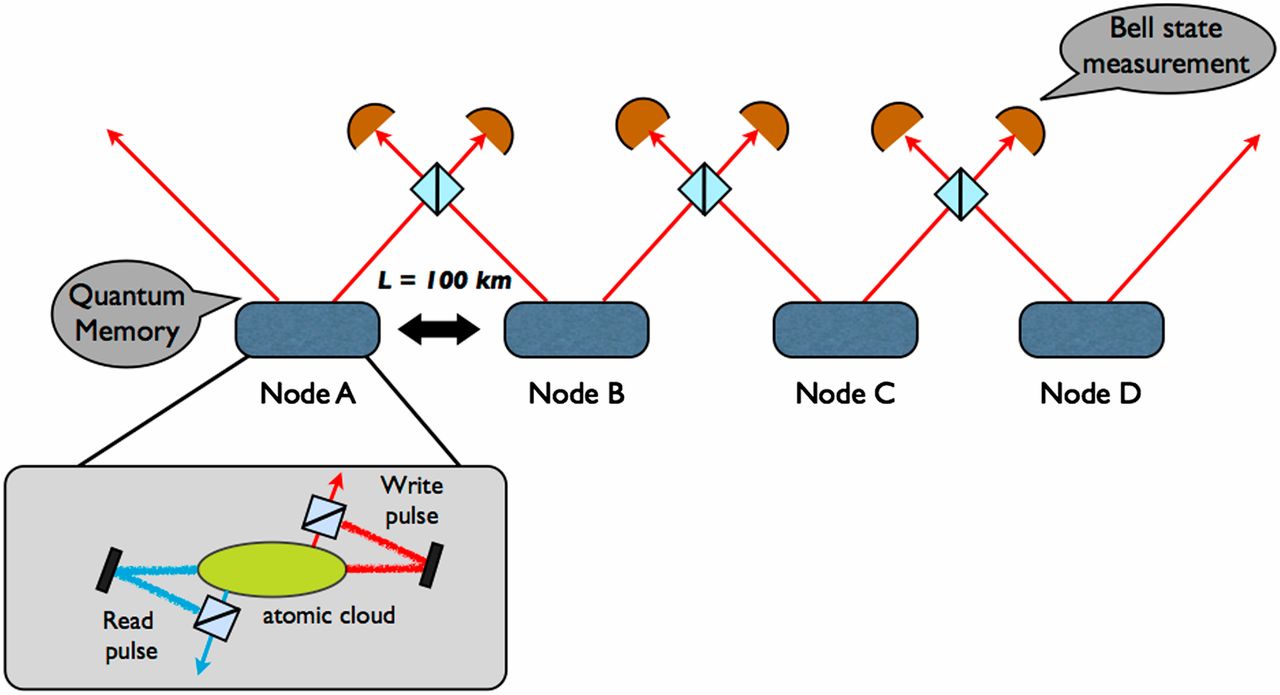
One solution to extend the range of quantum communication between sender and receiver is to use a sequence of “quantum repeaters” along the optical fiber connection. Quantum Repeaters can be thought of as being analogous to the optical amplifiers that provide an economic and compact solution for long distance classical communication. However, whereas the idea of amplifiers is to regenerate the classical optical signal, what these Quantum Repeater links do is to create sections of lossless transmission line over which the quantum state is teleported.
These devices can store the quantum information in an excited state of matter. The states of two relatively close repeaters can be entangled through photon emission. This process can conceivably be repeated over and over to entangle more distant repeaters together, until the entanglement extends from one continent to another.