

Recent years have seen multiple new security challenges emerge in the maritime arena. Navies, coast guards and other maritime security agencies face a proliferation of security challenges. These include: illegal fishing of territorial waters; incursion of mineral exploitation across legal boundaries; maritime terrorism; narcotics smuggling; pollution as a result of shipping accidents or malpractice; trafficking of illegal immigrants; and avoidance of tax duties through smuggling.
Military threats have also multiplied and become very sophisticated from sea skimming missiles and drones, supercavitating missiles and torpedoes, stealth aircrafts and HALE UAVs, stealth submarines. Naval Warships now faces wide spectrum of threats from hypersonic missiles, ballistic and cruise missiles, cavitating torpedoes, rail guns, lasers and UAVs. Anti-Ship Missiles are guided missiles most of them of the sea skimming variety, and many use a combination of inertial guidance and active radar homing. A good number of other anti-ship missiles use infrared homing to follow the heat that is emitted by a ship; it is also possible for anti-ship missiles to be guided by radio command all the way. Naval ships employ integrated combination of soft-kill countermeasures, that make incoming missiles miss, and hard-kill countermeasures, that destroy incoming missiles.
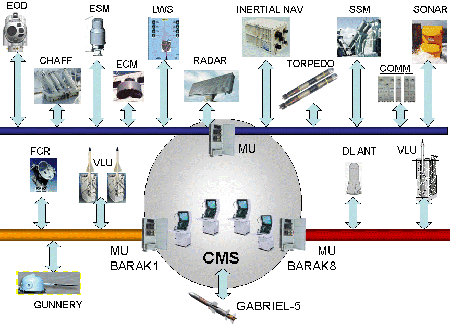
The combat management system (CMS) is the central command and decision-making element of a naval vessel combat system. Its function and performance – supporting sensor management, picture compilation, situation assessment, action support and weapon control – are critical to the operational effectiveness of a naval vessel. A CMS is designed to collect and review and adjust information in order to have superior knowledge over potential enemies, shorten decision-making cycles and execute rapid and accurate weapon engagement.
A CMS can handle vast amounts of information, can keep track of thousands of positions and tracks, is highly automated, has full sensor fusion, can provide threat evaluation, can assist weapon and sensor pairing, has a command, control and communication capability, is easy to operate and easy to maintain. In fact, it integrates “everything” that a commanding officer has at his disposal. A CMS has a modular and scalable design assuring compatibility with a broad range of air, land and sea based systems and platforms.