

Anti-submarine warfare (ASW) has always been a game of hide and seek, with adversarial states looking to adopt and deploy emerging technologies in submarine stealth or detection to give them the strategic edge. The advantage has shifted back and forth, but, on the whole, it has proved easier to hide a submarine than find one: the oceans are wide, deep, dark, noisy, irregular and cluttered. Sonar detection is one of the most important techniques for the detection of overwater and underwater vessels. But with the development of noise reduction and stealth material, the overall noise of some advanced warships is close to ocean background noise level, resulting in traditional sonar detection ability of this kind of “quiet” type ship have been on the verge of the limit.
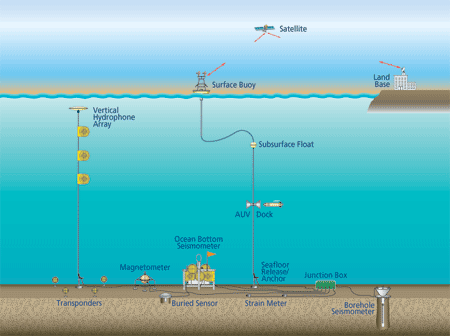
The U.S. Navy is in process of developing a new, more rapidly deployable, fixed, persistent, deep water active anti-submarine surveillance system. This system would consist of large sonar arrays attached to buoys that ships could emplace in a particular spot in the ocean straight from inside a standard shipping container. This is just one part of a multi-tier effort that comes as senior naval officers continue to warn publicly about increasing worrisome submarine activity from potential adversaries, especially with regards to Russian subs operating more regularly off the coast of the Eastern United States.
On Feb. 19, 2020, the Office of Naval Research (ONR) issued a notice on beta.SAM.gov, the U.S. government’s central contracting website, asking for white papers detailing possible options to meet the demands for what it is calling the Affordable Mobile Anti-Submarine Warfare Surveillance System, or AMASS. ONR’s goal is to eventually develop a “persistent, deep water, active ASW [anti-submarine warfare] system that can detect new emerging threat submarines at extended ranges.”
DARPA under TUNA program developed a network of “radio relay mounted on sea buoy”, deployed from ships or planes, that are tethered together by fiber optic cables to create data network. These very-small-diameter fiber-optic cables will be able to last 30 days in the rough ocean environment, which is long enough to provide essential connectivity until primary methods of communications are restored.