

Because of higher density chips, the design of more compact electronic components makes heat dissipation even more difficult. All advanced electrical or electronic devices are facing heat management challenges due to the increased levels of heat generation and the reduction in the surface area for heat rejection or dissipation. So a reliable heat management system is very important for the continuous and smooth working of these modern electronic devices.
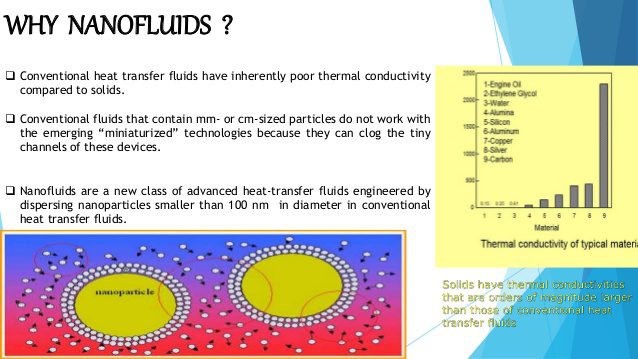
The traditional heat transfer fluids used in today’s thermal management systems, such as, water, oils, and ethylene glycol, have inherently poor thermal conductivities which is the one of the major limiting factors for the low heat transfer performance of these fluids. The thermal conductivity of metallic liquids is much higher than those of non metallic liquids. As a consequence, the thermal conductivities of fluids that contain suspended solid metallic particles could be expected to be significantly higher than those of conventional heat transfer fluids.
Nanofluid is a new type of heat transfer fluid, having nanoparticles (1–100 nm) which are evenly distributed in the base fluid. These uniformly distributed nanoparticles are generally metal or metal oxides which have a great enhancing effect on the thermal conductivity of the nanofluid, thus increasing conduction and convection coefficients and allowing for higher heat transfer.
The emergence of nanofluids as a new field of nano scale heat transfer in liquids is related directly to miniaturization trends and nanotechnology. Nanofluids, a suspension of nano-sized particles in liquids, have emerged as a potential candidate for the design of heat transfer fluids. The enhanced thermal conductivity of nanofluids offer several benefits such as higher cooling rates, decreased pumping power, smaller and lighter cooling systems and improved wear resistance. The novel nanofluids enable a more efficient, effective and uniform heat removal capability for systems requiring highly accurate temperature control at high heat fluxes.
It is quite interesting to note that nanoparticles can be dispersed not only in coolants and engine oils, but also in transmission fluids, gear oils, and other fluids and lubricants. Actually nanofluids provide better overall thermal management and better lubrication.
The cooling applications of nanofluids include Crystal Silicon Mirror Cooling, Electronics cooling, Vehicle cooling, Transformer cooling, Space and Nuclear systems cooling, Defense applications and so on. One of the first applications of research in the field of nanofluids is for developing an advanced cooling technology to cool crystal silicon mirrors used in high-intensity x-ray sources.