

Muons are subatomic particles that behave a lot like electrons but are around 200 times heavier. As the US Department of Energy explains, “Muons created in the atmosphere constantly hit every inch of the Earth’s surface and pass through almost any substance.”
Many scientists have noted that measuring the passage of muons offers the chance to measure the interior of whatever object the particles pass through during the 2.2 microseconds or so they exist before decaying into an electron and neutrinos. Muon radiography works by tracking the charged subatomic particles muons, generated when cosmic rays interact with Earth’s atmosphere. These muons travel down at high speeds through the atmosphere and can pass through solid objects.
Muography is an imaging technique based on the measurement of absorption profiles for muons as they pass through rocks and earth. As they pass through the space, nuclear emulsion plates are used as detectors to ‘catch’ the particles and develop an image of where the muons passed through, and where they were absorbed or deflected. This same method has been used on pyramids in Egypt, using the constant rain of atmospheric muons that bathes the Earth every day, and techniques that aren’t vastly different to those used with gamma rays, X-rays, neutrons, protons, and electrons in imaging applications.
This technology has developed rapidly over the last 15 years, and it is currently branching out into many different applications and moving from academic research to commercial application. The technological developments in the detection of elementary particles have opened the way to its application in various fields, such as archaeology, studies of geological structures, civil engineering and security issues.
Russian Researchers used a nuclear physics technology known as muon radiography to reveal details of Hidden underneath the Naryn-Kala fortress in Derbent, Russia, a mysterious subterranean vault – a buried structure whose original purpose has been unknown for decades. Scientists from three major Russian research institutes have made an important breakthrough in the field of muon tomography, creating tracking devices which allow geologists to ‘see through’ objects up to thousands of meters in diameter below the earth’s surface. By using this method to meticulously scan the subterranean structure, the team arrived at a suggestion it was once a vast church.
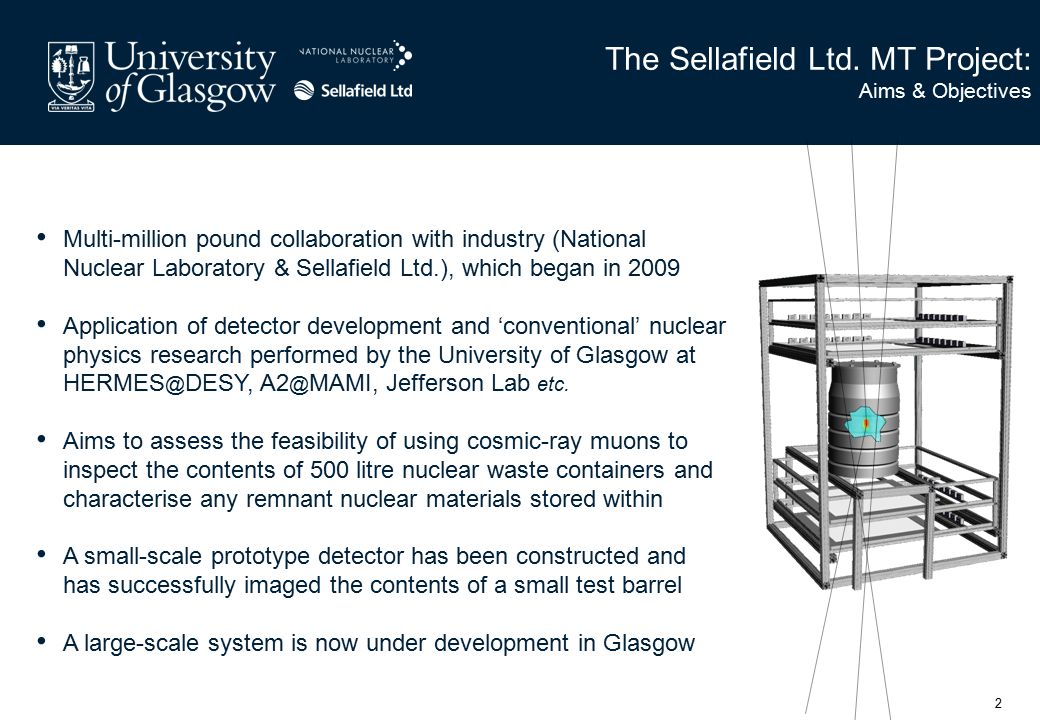
Michael Staib of Florida Institute of Technology and his team are harnessing this natural phenomenon to scan for hidden nuclear materials, and for any shielding hiding it. Muon tomography is a passive vehicle interrogation technique designed especially for detecting well-shielded nuclear contraband,” Staib said. “We simply use cosmic ray muons. Those are constantly being produced in the upper atmosphere and passing through us all the time.”
The new technology has other uses as well, Professor Polukhina said. “It is possible to non-invasively appraise a volcano’s vent, the reactor of a nuclear power plant, or a mountain glacier. [The technology can be used] to find new underground sources of natural gas, to catch a fire rising in a mountain used for coal mining long before it burns out from the inside, to predict the eruption of a volcano, or prevent the disastrous consequences of sinkholes in mines or city streets,” the scientist noted.