

The civil global aviation market has experienced considerable economic growth in recent years and will keep increasing. It is estimated that around 1300 new international airports will be required, and the commercial aircraft fleet will double by 2050, with a projected passenger throughput of 7.2 billion in 2035.
This growth is desirable from an economic standpoint, but aviation is predicated on fossil fuels, which increase greenhouse gas and air pollutant emission.
Presently, Aviation Industry generates 2-3 percent of the world’s human-generated carbon dioxide emissions and 12 percent of the CO2 emissions from all transportation sources. It is projected to rise to 11% if new technology is not advanced in the next two decades to cope with the projected annual growth of the aviation industry.
To reduce its impact on the environment and improve the sustainability of its operations, the commercial aviation industry has committed to achieve net-zero air transport emissions by 2050.
Although aircraft have seen many improvements in vehicle configurations and engine systems that have enhanced their flight efficiency, their continued dependency on hydrocarbon fuels means that commercial aviation will continue to contribute a significant amount of greenhouse gas emissions across the national and international transportation industry.
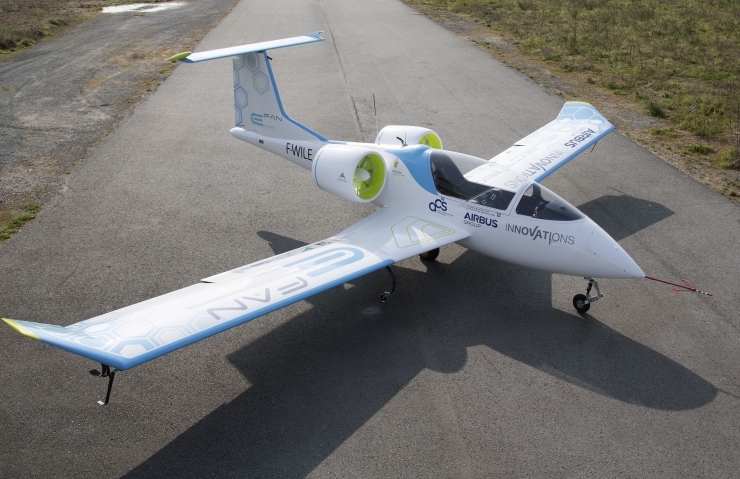
Achieving these goals requires disruptive innovation in the propulsion system of aircraft. The need to reduce gas emissions, optimize aircraft performance, decrease operating and maintenance costs, is pushing aircraft industry to progress towards more electric aircraft (MEA), and ultimately an All Electric Aircraft. Electric propulsion can be powered by rechargeable batteries, fuel cells, or solar energy.
The Clean Sky initiative launched in public-private partnership between the European Commission and the European aeronautics industry had announced plans to improve the MEA performance to reach 20-30% lesser fuel consumption and related CO2 emissions. Airbus and Boeing are two aircraft dealers operating MEA, and Boeing’s B787 is the only aircraft in the MEA segment which has successfully balanced fuel consumption and weight to deliver power equal to that of a fully ATF powered aircraft engine
Rolls-Royce in Jan 2019 revealed plans to build a 300-mile-per-hour, 500-horsepower, all-electric aircraft capable of flying from London to Paris on a single charge.
Researchers at NASA’s Glenn Research Center are actively researching the next generation of efficient aircraft. One of their current objectives is to help shift the industry from solely using gas turbines to start implementing hybrid or turboelectric propulsion. The benefits of this are reduced energy consumption, emissions, and noise.
Boeing backed Zunum Aero’s 12-seat plane will be powered by battery packs with a small fuel reserve for a back-up engine. According to the company, the first model will fly about 700 miles, far enough to ferry travelers from Boston to Washington or Silicon Valley to Los Angeles. Short-haul flights produce over 40 per cent of aviation emissions. Zunum said in a sttement, “With our aircraft, we believe these will be largely eliminated within twenty years.
Our aircraft are ”hybrid-to-electrics” that sip fuel only when they have to, will use even less over time as batteries upgrade, and will one day go completely without. They add, Zunum’s plans reveal a rush to develop small electric aircraft based on rapidly evolving battery technology and artificial intelligence systems that avoid obstacles on a road or in the sky.
Military is also interested in the gains like obtaining the weight savings benefits of a full more electric architecture implementation. Joint Strike Fighter (JSF), C-141 transport aircraft, and UAV’s like Condor, Global Hawk and Dark Star are some examples where the MEA concept has been introduced. With MEA technology, the weight in an aircraft can be shifted from hydraulic systems and plumbing to passengers, fuel or mission payloads. MEA technology could dramatically reduce per passenger costs and ticket prices for commercial aircraft, while giving military planes more maneuverability and survivability due to less vulnerability to enemy fire, says Honeywell.
Whilst full electric flight in the civil aviation sector is still a long way in the future, electrically assisted engines, a hybrid technology step, will soon be possible and the consequences of this technology change in terms of aircraft engine design and aircraft efficiency improvements are important to the industry.
The report “More Electric Aircraft Market – Global Forecast to 2021”, estimates the more electric aircraft market to grow from USD 7.68 Billion in 2016 to USD 10.94 Billion by 2021, at a CAGR of 7.33% from 2016 to 2021.