

The vision for the future soldier is to be combat effective and also highly mobile, adaptive, networked, sustainable with total battle space situation awareness and information assurance. Therefore, he is equipped with night- vision goggles, radios, smartphones, GPS, infrared sights, a laptop as well as batteries to power them. All of Sensors and peripherals generate data which could provide useful information to the higher hierarchical levels.
Therefore there is requirement of Soldier Personal Area Networks (PAN) that shares that data between different sensors. A personal area network (PAN) is a computer network organized around an individual person, and that’s set up for personal use only. A master-slave device relationship can take place in a PAN where a number of devices connect to the “main” device called the master.
Wearable Biosensors are being developed that measure EEG, ECG, and EMG (electroencephalograms, electrocardiograms, and electromyography, tests which monitor brain, heart, and muscle activity). Personal Area Networks (PAN) allow vital and health parameters can be monitored using appropriate sensors distributed on its body, and sent to a wireless controller.
There is also requirement of Command, Control, Communications & Computers (C4) including conformable & wearable antennae and wearable computers and Individual soldier combat ready displays. Army Research Laboratory is working on a wearable ultra-lightweight computer with a flexible display to fix to a soldier’s wrist, which will act as a hub for sending and receiving vital information.
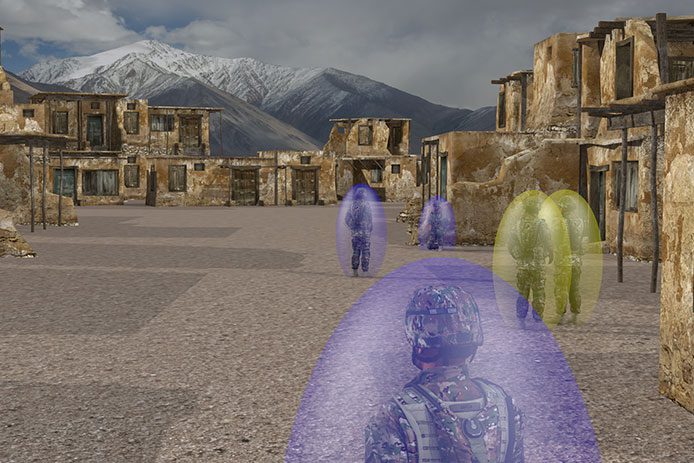
At squad level, new capabilities could be added using spatial distribution of sensors and their interoperability; Soldier squads (equipped with PDA, cameras , …) should be able to provide C2 chain with sensors and localization information; The soldier network will need to integrate several custom and COTS peripherals that comply with different international standards.