
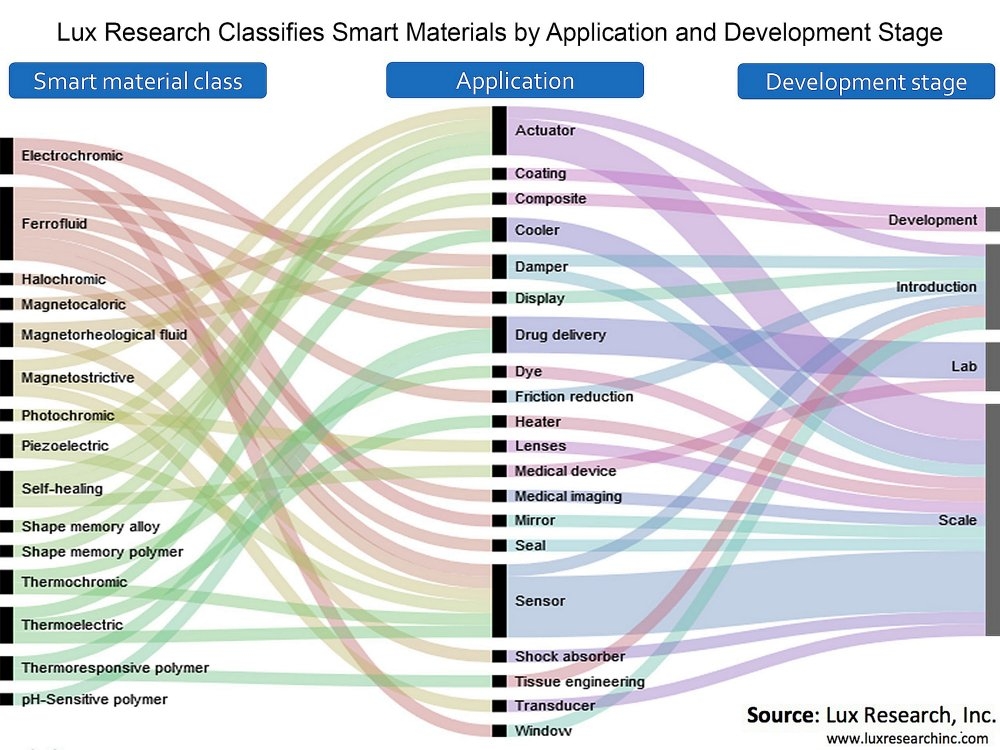

Smart materials or Active materials or Functional materials are designed materials that have diverse, dynamic features that enable them to adapt to the environment. They have one or more properties that can be significantly changed in a controlled fashion by external stimuli, the stimulus and response may be mechanical, electrical, magnetic, optical, thermal, or chemical.
Smart materials include self-healing materials, coatings with damage sensing, chemical sensing, friction changing, hydrophobicity changing capabilities, and also materials with several “smart” capabilities. They derive smart properties from structural patterning, often at the micro- or nanoscale, of already known material chemistries.
Smart materials are used to construct smart structures. A smart structure is a system containing multifunctional parts that can perform sensing, control, and actuation; it is a primitive analogue of a biological body. Smart structures are an integration of sensors, actuators, and a control system. Apart from the use of better functional materials as sensors and actuators, an important part of a “smarter” structure is to develop an optimized control algorithm that could guide the actuators to perform required functions after sensing changes.
New applications of shape memory materials are being demonstrated worldwide while new morphing structural concepts were tested in new ways. In 2019, Boeing and NASA’s Glenn Research Center in Ohio tested shape memory alloys, or SMAs, that could be incorporated into the composite materials that form the components of deployable structures on commercial airplanes. These SMA compositions would respond autonomously to ambient temperature changes. The new NASA-Boeing SMAs were incorporated into the hinge of a deployable vortex generator that was flight-tested on a Boeing 777-200 in November as part of the company’s ecoDemonstrator program. The vortex generator retracts at cruise to reduce drag.
In 2019, Texas A&M University researchers worked with University of British Columbia to develop SMA artificial muscle actuators mimicking the functionality of characterized bird muscles. Results were first presented publicly in May, showing that SMA components can act as actuators, brakes and structural components under cyclic stimuli, emulating avian muscle functions.
In July 2019 , the Harbin Institute of Technology in China revealed the existence of an experimental satellite that tested a prototype shape memory polymer composite for self-deploying solar arrays, or SMPCs. In a paper in the journal Smart Materials and Structures, the designers of the experiment, called Mission SMS-I, described the mission as the first SMPC demonstration in geostationary orbit. The authors said they have proved that their carbon-reinforced SMPC can deploy solar arrays by direct harvesting of solar energy without drawing system electrical power. To increase the stiffness of the solar array, new SMPC-based structures were studied this year toward the goal of a second round of flight testing, according to the authors.
Military and aerospace also have large demand for smart materials and devices including smart self-repair, smart clothing such as cloaking suits, winglets in aeroplanes that adapt automatically to changing flight conditions and adaptive hull structures for ships. The technology has been used in the head up displays of fighter pilot helmets to enable them to see the visual display even under conditions of rapid change in light intensity like going from bright sunlight into cloud or from cloud into bright sunlight. Smart materials could change shape to unfold a solar panel on a space satellite without need of a battery-powered mechanical device.