
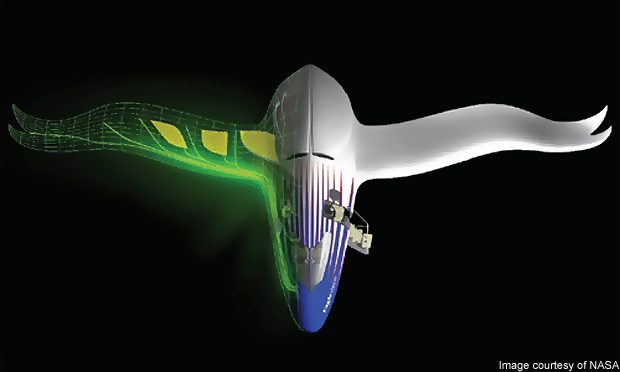

The design of aerodynamic airfoils is optimized for certain conditions. For instance, the shape of the wings of fixed-wing aircrafts are designed and optimized for a certain flight condition (in terms of altitude, speed, aircraft weight, etc.). However, these flight conditions vary significantly during the flight. Currently, aircraft are provided with control surfaces such as flaps, slat and ailerons, normally governed by powerful but heavy hydraulic mechanisms. These moving parts allow the aircraft to fly under many different flight conditions, although usually with non-optimal performance. Moreover, these mechanisms introduce hinges and surface discontinuities between parts which cause undesirable effects such as turbulences and noise or a decrease of the lift-to-drag ratio.
In contrast, the wings of a bird can be reshaped to provide optimal performance at all flight conditions. Observations by experimental biologists reveal that birds such as falcons are able to loiter on-station in a high-aspect ratio configuration using air currents and thermals until they detect their prey. Upon detection, the bird morphs into a strike configuration to swoop down on an unsuspecting prey.
This issue motivates the research and development of the so-called ‘morphing aircraft’ or ‘morphing wings’. “Shape morphing” has been used to identify those aircraft that undergo certain geometrical changes to enhance or adapt to their mission profiles. Ideally, a morphing aircraft is able to modify quickly the shape of its wings in-flight, thus reaching optimum aerodynamic performance under any flight condition. Morphing technologies offer aerodynamic benefits for an aircraft over a wide range of flight conditions.
The military establishment is looking long and hard at morphing aircraft. One reason for their interest is that military aircraft today are designed to perform one kind of mission. For example, one aircraft might excel at reconnaissance, while another is designed for bombing missions.
Features such as the capability to carry more weight, high speed, and a small turning radius are difficult to combine in one aircraft. Because their designs are so specific, aircraft can’t perform more than one role, and in many cases they are limited to certain airfields or ships to use for takeoff and landing.
The Morphing Aircraft Structures (MAS) was started to design and build these shape-changing aircraft for the military. If the military is successful, that would mean that one aircraft might be able to perform more than one role and be able to take off and land from more types of airfields or ships. This flexibility could result in huge savings and much improved efficiency.