

High speed Supercomputers enable advanced computational modeling and data analytics applicable to all areas of science and engineering. They are being widely used in applications like Astrophysics, to understand stellar structure, planetary formation, galactic evolution and other interactions; Material Sciences to understand the structure and properties of materials and creation of new high-performance materials; Sophisticated climate models, which capture the effects of greenhouse gases, deforestation and other planetary changes, that have been key to understanding the effects of human behavior on the weather and climate change.
However, such enormous processing power comes at a cost. Sunway TaihuLight at the National Supercomputing Center in Wuxi, Chinavers a whopping 93 petaflops (one petaflop equals a quadrillion floating-point operations per second). But it requires 10.649.600 processing units, so-called cores, that consume 15.371 megawatts – an amount of electricity that could power a small city of about 16.000 inhabitants based on an average energy consumption equal to that of San Francisco.
In contrast human brain’s processing power is estimated at about 38 petaflops, about two-fifths of that of TaihuLight. But all it needs to operate is about 20 watts of energy. Watts, not megawatts! And yet it performs tasks that no machine has ever been able to execute. It is simply “programmed” by the interconnections between its active components, mostly so-called neurons.
Electronic computers are extremely powerful at performing a high number of operations sequentially at very high speeds. However, they struggle with combinatorial tasks that can be solved faster if many operations are performed in parallel for example in cryptography and mathematical optimisation, which require the computer to test a large number of different solutions.
Tomorrow’s applications demand stronger computing powers at much lower energy consumption levels. But digital computers simply can’t provide this out of the box. Therefore many alternative approaches are being pursued by the researchers.
There have been significant efforts in conceiving parallel-computation approaches in the past, for example: Quantum computation and microfluidics-based computation. However, these approaches have not proven, so far, to be scalable and practical from a fabrication and operational perspective.
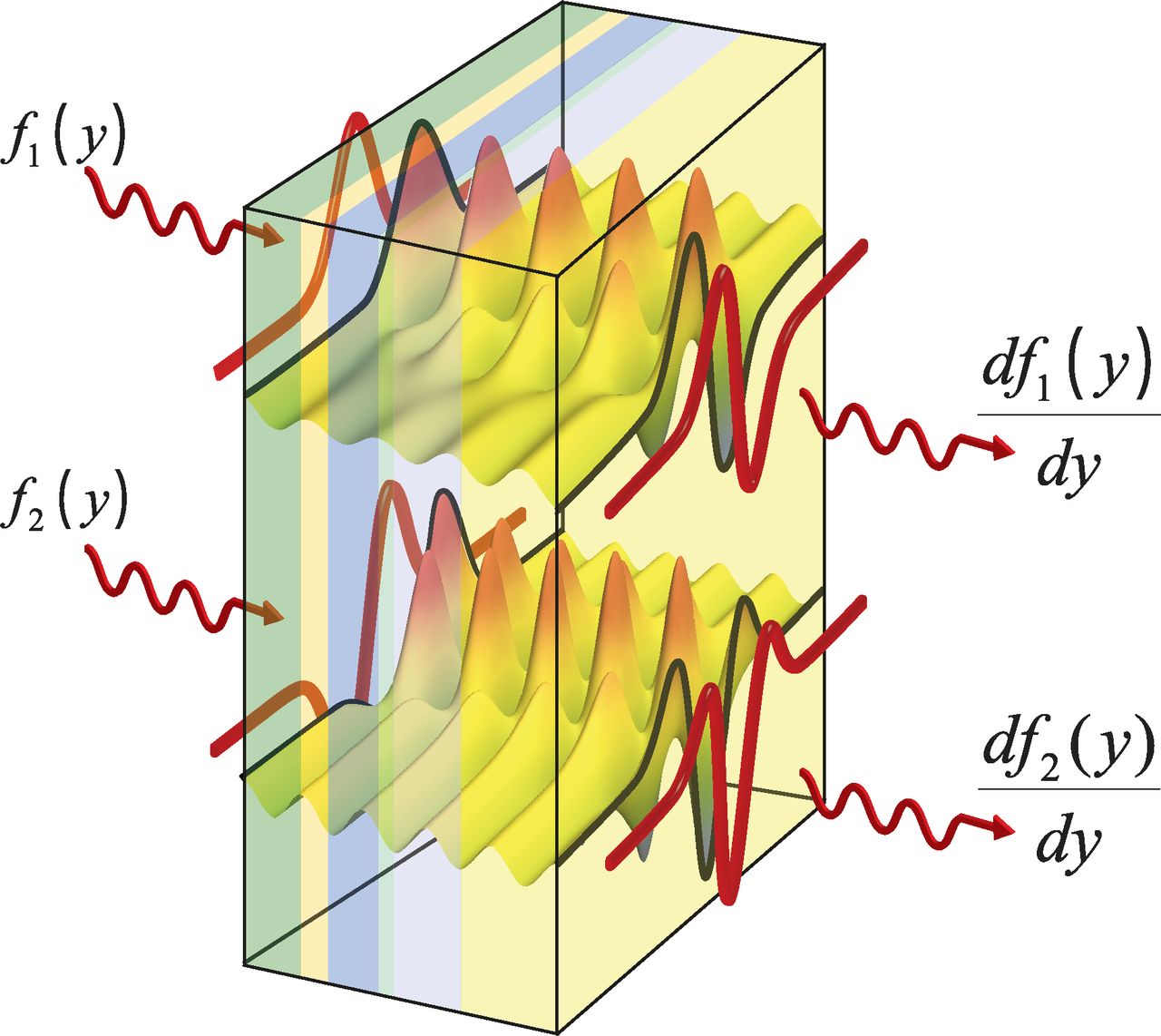
Analog computer can be described as a model for a certain problem that can then be used to solve that very problem by means of simulating it. Typically such analogs are based on analog electronic circuits such as summers, integrators and multipliers. But they can also be implemented using digital components in which case they are called digital differential analyzers.
There is no stored program that controls the operation of such a computer. Instead, you program it by changing the interconnection between its many computing elements – kind of like a brain. All of the machine’s computing elements work in complete parallelism with no central or distributed memory to access and to wait for.
Such analog computers reach extremely high computational power for certain problem classes. Among others, they are unsurpassed for tackling problems based in differential equations and systems thereof – which applies to many if not most of today’s most relevant problems in science and technology.
For instance, in a 2005 paper, Glenn E. R. Cowan described a Very-Large-Scale-Integrated Analog Computer (VLSI), i.e. an analog computer on a chip, so to speak. This chip delivered whopping 21 gigaflops per watt for a certain class of differential equations, which is better than today’s most power-efficient system in the Green500-list.
Another proposed approach is Hybrid Approach. That is instead of full analog computer developing modern analog co-processors that take off the load of solving complex differential equations from traditional computers. The result would be so-called hybrid computers.