
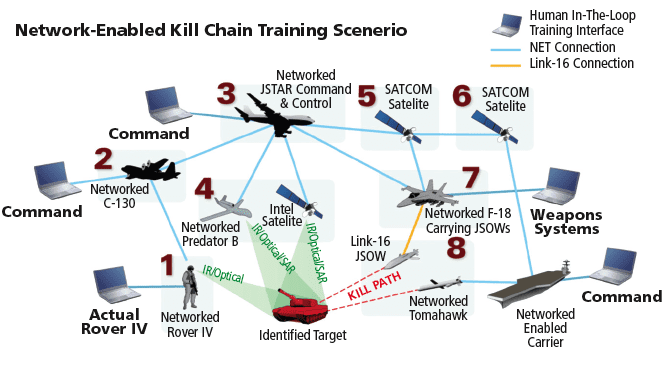

As the 21st Century battlefield becomes increasingly complex and asymmetrical, military forces are striving to harness network technology to gain an operational advantage, by transforming traditional linear command structures and linking sensors, unmanned vehicles, command posts and ground troops to achieve decision superiority for full spectrum dominance.
Network Centric Warfare (NCW) is theory of warfare in the information age which hypothesizes that forces which are networked will outperform forces that are not. NCW is an ‘integration of sensors, decision-makers, weapons platforms and support capabilities to enable agility’ providing ‘interoperability and collaboration within and between services’. U.S. Naval Studies Board’s working definition of network-centric maritime warfare (NCMW) is “Military operations that exploit state-of-the-art information and networking technology to integrate widely dispersed human decision makers, situational and targeting sensors, and forces and weapons into a highly adaptive, comprehensive system to achieve unprecedented mission effectiveness.” Network-centric warfare concept also encompasses the combination of emerging tactics, techniques and procedures that a networked force can employ to create a decisive warfighting advantage.
According to U.S. Defense Department, Network centric systems increase the quality and degree of shared mission critical information. This permits a common perception of the battlespace to emerge, creating a shared awareness of the environment. This decreases the level of uncertainty, thus improving the degree of decision quality information which improves the quality and degree of sensemaking and interactions. This in turn improves a force’s agility, time to execute, efficiency, and mission effectiveness.