

Stealth has revolutionized the Air power by vastly enhancing the penetration capabilities of fifth generation aircrafts like the F-22A Raptor developed by Lockheed Martin and Boeing, L.M. F-35 Lightning II. Stealth in military is often described to mean, all the methods, techniques and measures intended to deny or delay the detection and tracking of friendly forces by the enemy including electronic signature masking, Infra-red and acoustic signature suppression.
For the last four decades or so, the US has had total dominance in the area of stealth technology, but this is now coming to an end with China and Russia developing stealthy fighters and unmanned combat aircraft. China is developing the Chengdu J-20 and J-31. The smaller Shenyang J-31 has been flying for more than two years. Chengdu Aircraft Corporation has rolled out “2017,” the eight in the line of J-20 jets that China has been developing in the past few years giving China the largest number of stealth fighters in the world after the United States. The Sukhoi PAK FA is being developed by Sukhoi for the Russian Air Force. Its prototype, T-50, flew for the first time in 2010.
The rise in stealth technology has complicated the air defense of countries as it creates lots of gaps in Air defense coverage therefore militaries have been developing many counter stealth solutions and technologies. Many technologies have potential to detect stealthy targets including Over-the-horizon radars, active / passive multistatic radars, very low frequency radars, and sensitive IR sensor systems, laser radar imaging, hyperspectral imaging, e.t.c. . The beauty of infrared search and track technology (IRST) technology? It is completely passive and does not highlight the location of the aircraft, unlike when a pilot decides to use the on-board radar, which can give away its position as radiofrequency energy bursts out.
IRST systems are becoming essential elements of advanced fifth generation aircrafts to detect ultra stealthy targets like F-22. IRST sensors also critical to detect heat sinking missiles and to locate and destroy enemy forces in radar-denied environment . US F-35 and Russia’s Su-35 Flanker have IRST systems, as well as Eurofighter Typhoon that has PIRATE (Passive InfraRed Airborne Track Equipment) suite.
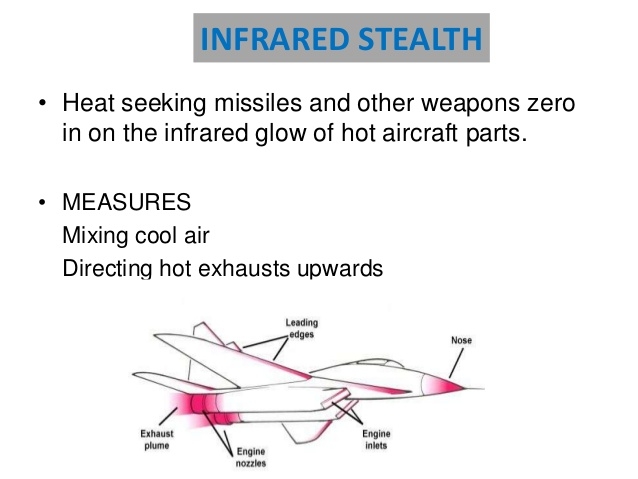
Selex has claimed hat its IRSTs have been able to detect and track low-RCS targets at subsonic speeds, due to skin friction, heat radiating through the skin from the engine, and the exhaust plume. The U.S. Navy’s Greenert underscored this point in Washington in early February, saying that “if something moves fast through the air, disrupts molecules and puts out heat . . . it’s going to be detectable.”
The U.S. Navy recently placed an order with Boeing for the procurement of 12 Infrared Search and Track (IRST) systems intended for the F/A-18 Super Hornet to provide “see first, strike first” capability. The Super Hornet’s IRST is a long-wave infrared detection system that can detect and lock weapons onto enemy aircraft without using radar. In addition to detecting airborne threats, IRST significantly enhances multiple target resolution compared to radar, providing greater discrimination of threat formations at longer ranges. Data from the IRST sensor is fused with other on-board F/A-18 sensor data to provide maximum situational awareness to the warfighter.
Wang Yanyong, technical director for Beijing A-Star Science and Technology, has confirmed that its two systems – the EOTS-89 electro-optical targeting system (EOTS) and the EORD-31 infrared search and track (IRST) – are in development for China’s J-20 and J-31 fighters. Marketing brochures on A-Star’s booth suggest that the J-20 could use the passive sensors to detect and aim missiles against the Northrop Grumman B-2 bomber and Lockheed Martin F-22 fighter, even while its radar is being jammed by a Boeing EA-18G Growler. “It lists detection ranges for the B-2 at 150km and for the F-22 at up to 110km,” as reported by Stephen Trimble.
To detect ultra-stealthy aircraft like the F-22 and Chengdu J-20, India needed to strengthen the capabilities of the Su-30MKI and now the country has decided to design and develop a long-range dual-band infrared imaging search and track system i.e., IRST. The system will enable Sukhoi with additional capabilities. The need was felt more when India find it difficult to detect China operationalized the J-20 fighter jets which are made up of radar-absorbing materials last year
Even amid electronic attack or heavy RF and infrared countermeasures, IRST provides autonomous, tracking data that increases pilot reaction time, and enhances survivability by enabling first-look, first-shoot capability, Lockheed Martin officials say. Giorgio Balzarotti, vice president of IRST programmes at Leonardo’s Nerviano site in Italy, said having an IRST sensor is like being in a dark room with your enemy. You are able to see your enemy because of the temperature emitted by them, but they would have to shine a light (analogous to turning on a radar) to be able to see your position. “You are at an advantage…you can be completely silent,” he added.